Airbus A350-900
A359Airbus · Widebody · In production
In the wild
History
The Airbus A350 that eventually flew was not the aircraft the programme started with. In the early 2000s, as Boeing gathered momentum with its all-composite 787, Airbus initially responded with a modest proposal: an updated, re-engined derivative of the existing A330, marketed as the A350. Several influential airlines and leasing companies, including senior figures at the lessor ILFC, publicly criticised it as an inadequate answer to the 787. Airbus reconsidered, and in 2006 announced a substantially new design, the A350 XWB, the suffix standing for Xtra Wide Body.
The programme was formally launched in December 2006. The A350-900 became the baseline member of a family originally intended to include a shorter A350-800 and a stretched A350-1000; in practice the -800 attracted few orders and was quietly dropped, leaving the -900 and -1000 to carry the range. The -900 made its first flight from Toulouse on 14 June 2013 and, following a flight-test campaign widely regarded as relatively trouble-free, entered service with launch customer Qatar Airways in January 2015, initially on Doha to Frankfurt services.
Airbus positioned the A350-900 to sit between the Boeing 787 and the larger 777, competing with both. Its fuselage, just under six metres wide externally, is broader than the 787's, allowing a comfortable nine-abreast economy cabin or a denser layout at the operator's discretion. Much of the structure is carbon-fibre-reinforced polymer, around 53 percent by weight, with titanium and aluminium-lithium alloys making up much of the remainder. The aircraft is powered exclusively by the Rolls-Royce Trent XWB, which was developed as its launch and only engine.
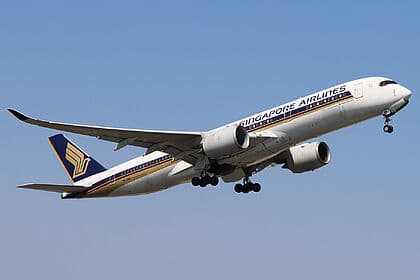
Commercially the A350-900 has done well. It became the best-selling member of the family and, together with the -1000, has taken well over a thousand orders. Airlines have used it both to replace older widebodies such as the A340 and early 777s and to open thin long-haul routes that would not support a larger aircraft. An ultra-long-range development, the A350-900ULR, was tailored for Singapore Airlines with additional fuel capacity; from 2018 it operated Singapore to New York, widely cited as the world's longest scheduled passenger flight.
The type also became a fixture of the long-haul recovery in the 2020s, as some carriers turned to it while awaiting delayed deliveries of competing aircraft. A freighter version, the A350F, is in development, with first flight and entry into service anticipated later in the decade. More than a decade after its debut, the A350-900 is generally regarded as one of the more commercially and technically settled widebodies of its generation, and it remains in steady production alongside the larger -1000.
Specifications
- First flight
- 2013
- Entered service
- 2015
- Engines
- 2 × Rolls-Royce Trent XWB-84
- Typical seating
- 315 (2-class)
- Cruise speed
- Mach 0.85
- Range
- 8,300 nm
- MTOW
- 280,000 kg
- Length
- 66.8 m
- Wingspan
- 64.75 m
- Status
- In production
Design notes
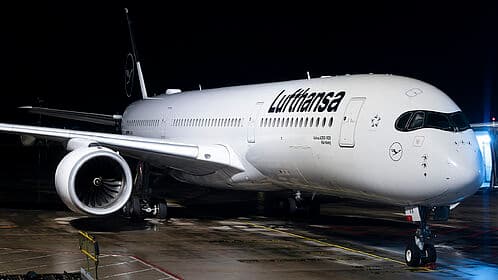
The most cited external signature of the A350 is its cockpit, framed by a curved, dark-tinted surround that enthusiasts commonly liken to a mask or sunglasses. The nose is more sharply sculpted than on earlier Airbus widebodies. The composite wing spans just under 65 metres and ends in a smoothly upswept, curved wingtip that is blended into the wing rather than added as a vertical fin. The wing also incorporates a variable-camber system that adjusts the trailing-edge surfaces in cruise to reduce drag as fuel burns off.
Structurally, the airframe's roughly 53 percent composite content, together with a titanium and aluminium-lithium supporting structure, allowed Airbus to raise cabin humidity and lower the cabin altitude relative to older metal aircraft, and to fit larger windows. The cabin cross-section supports a nominal nine-abreast economy layout at 18-inch seat width, though several operators choose ten-abreast.
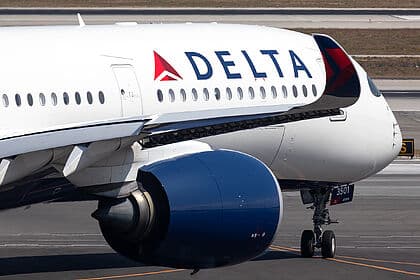
Power comes solely from the Rolls-Royce Trent XWB, in the 84,000-pound-thrust class on the -900. The aircraft uses fly-by-wire controls with Airbus's characteristic sidestick, and shares a common type rating with the A330, easing crew transition. The main landing gear on the -900 is a conventional four-wheel bogie on each side, a detail that helps separate it from the six-wheel gear of the stretched -1000. Together these features gave the -900 a meaningful step down in fuel burn per seat compared with the four-engine and early twin-engine widebodies it was designed to replace.
Notable facts
- First Airbus airliner with an airframe built largely from carbon-fibre-reinforced polymer (around 53%).
- Powered exclusively by the Rolls-Royce Trent XWB, its launch and only engine.
- Entered service with Qatar Airways in January 2015.
- Developed to compete with the Boeing 777 and 787.
- The A350-900ULR variant enabled the world's longest scheduled flights (Singapore–New York).
Who flies it
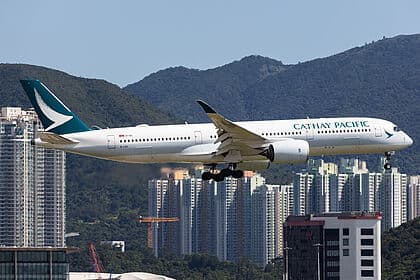
The A350-900 is operated by a broad spread of full-service long-haul carriers across every inhabited continent. Launch customer Qatar Airways remains one of the largest operators, alongside Singapore Airlines, Cathay Pacific, several Chinese carriers, Lufthansa, British Airways, Air France, Delta and United, among many others. Typical roles are premium-heavy long-haul routes and ultra-long-haul sectors where the type's range and relatively low operating cost per seat suit thin but lucrative markets.
Many operators adopted the -900 as a replacement for four-engine types such as the A340 and Boeing 747, and for early-generation 777s and A330s. Singapore Airlines uses dedicated ultra-long-range examples for its Newark and Los Angeles nonstops. The aircraft also sees use on shorter regional widebody rotations in Asia, where high-frequency trunk routes justify a large twin. It is a common sight at major intercontinental hubs worldwide.
Flying on one
Flying on one is among the more comfortable long-haul experiences of the current widebody generation. The A350's cabin is just under six metres wide, so operators who keep the intended nine-abreast economy layout give you a seat around eighteen inches across, noticeably roomier than a ten-abreast Boeing 777. A minority densify to ten-abreast, which narrows the seat, so the airline's choice matters more than the aircraft. What most passengers notice is how settled it feels: the composite airframe lets Airbus pressurise the cabin to a lower altitude and keep the air more humid than older metal jets, which many travellers find less dehydrating on an overnight sector. It is quiet, the windows are large, and the airflow is calm. Overhead bins are deep and take roll-aboards without a fight. For the best seat, a window in the nine-abreast cabin gives both the wide seat and the view; light sleepers should avoid the final rows beside the rear galleys and lavatories.
Who flies it, and how
3 airline cabin layouts of the Airbus A350-900 in our dataset — expand any to see the cabin breakdown and seat map.
DeltaA350-900306 seats32J · 48W · 226Y
- Business (Delta One Suite): 32 seats, 1-2-1 across
- Premium Economy (Delta Premium Select): 48 seats, 2-4-2 across
- Economy (Delta Comfort+): 36 seats, 3-3-3 across
- Economy (Main Cabin): 190 seats, 3-3-3 across
Classic 306-seat A350-900 (aeroLOPA 359). Delta also flies a newer 275-seat config (aeroLOPA 35H): 40 Delta One Suite / 40 Premium Select / 36 Comfort+ / 159 Main Cabin, which is now roughly as numerous as (or more numerous than) this config as the fleet is reconfigured.
LufthansaA350-900267 seats4F · 38J · 24W · 201Y
- First (First): 4 seats, 1-2-1 across
- Business (Business): 38 seats, 1-2-1 across
- Premium Economy (Premium Economy): 24 seats, 2-4-2 across
- Economy (Economy): 201 seats, 3-3-3 across
ALLEGRIS config with First Class (4 suites incl. centre 'Suite Plus' double). Legacy non-Allegris A350s still fly 0F/48J/21W/224Y = 293 or 0F/30J/26W/262Y = 318 — fleet mid-transition.
SingaporeA350-900 (long-haul)253 seats42J · 24W · 187Y
- Business (Business): 42 seats, 1-2-1 across
- Premium Economy (Premium Economy): 24 seats, 2-4-2 across, 38″ pitch
- Economy (Economy): 187 seats, 3-3-3 across, 32″ pitch
Standard long-haul 3-class. SIA also flies the A350-900 in a regional 2-class layout (40J/263Y=303) and an ultra-long-range 2-class layout (67J/94W=161, all-premium, used on Singapore–New York/Newark).
Variants
- A350-900ULR — Ultra-long-range; used for flights of up to about 9,700 nm
- A350F — Freighter derivative, in development
How to spot it
The clearest cue is the cockpit: the A350 wears a curved, dark surround around the flight-deck windows, often described as a mask, which no other current Airbus has. The nose is pointed and sculpted, and the wingtips sweep up in a smooth, curved blend rather than a distinct vertical winglet.
To separate a -900 from the stretched -1000, count the main gear wheels: the -900 has a four-wheel bogie on each side, the -1000 a six-wheel bogie. The -900 is also noticeably shorter, with three pairs of doors compared with the -1000's four.
Against the Boeing 787, which also has raked, flexing composite wings, look for the A350's cockpit mask and its more angular tail; the 787 lacks the mask and has distinctive serrated, sawtooth trailing edges on its engine nacelles.
Frequently asked
How do you tell an Airbus A350 from a Boeing 787?
The quickest tell is the cockpit. The A350 has a curved, dark-tinted surround around its flight-deck windows, commonly likened to a mask or sunglasses, whereas the 787 does not. The 787 also carries distinctive serrated, sawtooth trailing edges on its engine nacelles, which the A350's smoother nacelles lack. Both have flexible composite wings that sweep up at the tips, so the nose and nacelle details are the reliable cues.
What is the difference between the A350-900 and A350-1000?
The -1000 is a stretch of the -900, roughly seven metres longer, seating more passengers and using a more powerful Trent XWB-97 engine. The most reliable external difference is the main landing gear: the -900 uses a four-wheel bogie on each side, the -1000 a six-wheel bogie. The -1000 also has four pairs of passenger doors to the -900's three.
Why does the A350 use only Rolls-Royce engines?
Unlike the A330 or Boeing 777, the A350 was offered with a single engine type from the outset, the Rolls-Royce Trent XWB, developed specifically for the aircraft. Airbus did not sign up a second engine supplier, so every A350 flying uses a variant of the Trent XWB. This contrasts with several rivals that offer a choice between two manufacturers.
How far can the A350-900 fly?
A standard A350-900 has a range on the order of 8,000 to 8,300 nautical miles, enough for most long-haul city pairs. A dedicated ultra-long-range version, the A350-900ULR built for Singapore Airlines, extended that considerably. From 2018 it operated the Singapore to New York service that is widely cited as the world's longest scheduled flight.
What aircraft did the A350 replace?
Many airlines introduced the A350-900 to replace four-engine types such as the Airbus A340 and Boeing 747, and to succeed early-generation Boeing 777s and A330s. Its appeal is a large twin-engine widebody with lower fuel burn and long range, letting carriers cut trip costs while maintaining capacity on intercontinental routes.
In-depth comparisons
Compare with
Specs are approximate, compiled from public sources. See our editorial policy.