Hawker 800 / BAe 125-800 (H25B)
British Aerospace / Hawker Beechcraft · Business jet · Production ended
H25B is the ICAO aircraft type code for the Hawker 800 / BAe 125-800, a British Aerospace / Hawker Beechcraft business jet that first flew in 1983 and entered service in 1984. It typically carries 8 people, cruises at Mach 0.75, and has a range of about 2,800 nautical miles (5,186 km).

Loading live positions…
In the wild
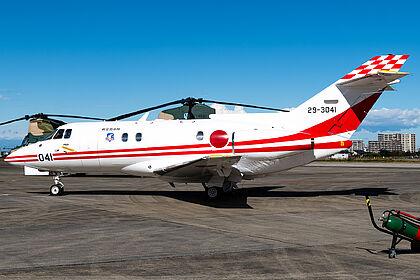
History
The Hawker 800 was an update of an airplane that was already selling well. The 125 had first flown as the de Havilland DH.125 in 1962, and its Series 700 of 1976 had replaced the original Viper turbojets with Garrett TFE731-3 turbofans; BAE Systems counts 215 of those built. In April 1981 the British Aerospace board approved a more thorough rework, and the prototype 125-800, G-BKTF, flew at Chester on May 26, 1983.
The type-certificate data sheet lists the changes: TFE731-5R engines in place of the -3s, 4 ft 6 in more wingspan, curved windscreens instead of flat panels, a reshaped rear underfairing with a larger ventral fuel tank, a fin extended forward, a stick pusher, an electronic flight instrument system and a Mach limit raised from 0.77 to 0.80. The FAA approved the 800A in July 1984 and the UK authority followed that September. The US Air Force bought six as C-29As for combat flight inspection, and Japan's air force later added U-125 flight-check and U-125A search-and-rescue versions.
One 800 had an unusually narrow escape. On August 7, 1988, a 125-800 carrying Botswana's president, Quett Masire, was hit by a missile fired by an Angolan MiG-23. With one engine torn away, the crew made an emergency landing on a bush strip, nobody was killed, and the airplane was later rebuilt.
In June 1993 Raytheon bought BAe Corporate Jets, and in January 1994 the FAA approved the new name, Hawker 800. Raytheon's Hawker 800XP followed in July 1995 with TFE731-5BR engines, standard Dee Howard thrust reversers, higher weights and vortilons in place of the old wing fences. Final assembly moved to Wichita in the mid-1990s, while the fuselage, wings and fin kept coming from Broughton in north Wales, and the 1,000th member of the 125 family was delivered in April 1998.
Raytheon added factory winglets with the 850XP, approved in February 2006, and in October that year announced two more models. By the time they were certified, Raytheon had sold the business, in March 2007, to the new Hawker Beechcraft Corporation. The 900XP, approved in August 2007, used Honeywell's TFE731-50R engines for better hot-and-high performance and almost 2,800 nm of range with six passengers, and the Hawker 750, approved that December, traded the ventral fuel tank for an external baggage pannier.
The recession ended the line. Hawker Beechcraft filed for Chapter 11 protection in May 2012 and emerged in February 2013 as Beechcraft Corporation without its business jets, closing a 125 production run of more than 50 years. The type certificate passed to the new company in April 2013 and is now held by Textron Aviation, which bought Beechcraft in 2014. Counting every version since 1962, BAE Systems puts 125 production at around 1,700 aircraft.
Specifications
- First flight
- 1983
- Entered service
- 1984
- Engines
- 2 × Honeywell TFE731-5BR (800XP, 850XP) or TFE731-50R (900XP)
- Typical seating
- 8 seats
- Cruise speed
- Mach 0.75
- Range
- 2,800 nm
- MTOW
- 12,700 kg
- Length
- 15.6 m
- Wingspan
- 16.56 m
- Status
- Production ended
Design notes
The basic layout is de Havilland's and has aged well. The one-piece wing is mounted under the fuselage, so wing and fuselage can be built separately and joined late in assembly, and most of the fuel sits in integral wing tanks. On the 900XP those hold 634 US gal a side, with another 233 US gal in a ventral tank under the rear fuselage. The type certificate limits the airplane to 280 knots indicated while that ventral tank still holds fuel, against up to 335 knots once it is empty.
The flight controls are simple by modern standards. Ailerons, elevators and rudder are manually operated, balanced with set-back hinges and geared tabs, and only the flaps and airbrakes are hydraulic. Each engine drives its own generator and hydraulic pump, so the systems keep running after an engine failure.
The quarter-chord wing sweep is 20 degrees, and the Mach limit is 0.80, or 0.73 if the Mach trim system fails. The EASA data sheet rates both the 800XP's TFE731-5BR and the 900XP's TFE731-50R at 4,750 lb for takeoff, but Hawker Beechcraft said the -50R gave 4.5 percent more thrust at a 5,000 ft airport at ISA+20°C, needed 1,767 ft less runway there and stretched engine inspection intervals to 3,000 and 6,000 hours. Early 800XPs used Honeywell SPZ-8000 avionics; later 800XPs, the 850XP and the 900XP have Collins Pro Line 21.
Notable facts
- The last major branch of the de Havilland DH.125 family of 1962; BAE Systems puts production of all 125 versions at around 1,700.
- The 125-800 gained a curved windscreen, 4 ft 6 in more wingspan, TFE731-5 engines and electronic flight instruments, and its Mach limit rose from 0.77 to 0.80.
- Raytheon bought BAe Corporate Jets in June 1993 and renamed the 800 the Hawker 800; the 1,000th 125 was delivered in April 1998.
- ICAO files the 125-700, 125-800, Hawker 750, 800, 850 and 900 and the military C-29 and U-125 under H25B; the longer Hawker 1000 is H25C.
- In 1991 the FAA took over the Air Force's six C-29A flight-inspection 125-800s and used them for international checks until Challenger 604s replaced them after 2005.
Who flies it
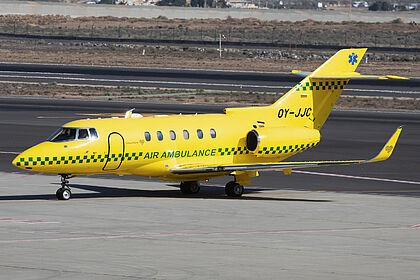
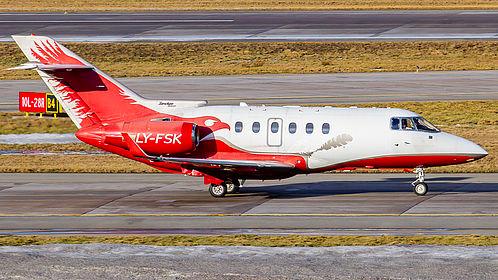
Companies, private owners and charter operators fly most Hawker 800-series jets, and fractional programs have used them too. In Europe, Sun-Air of Scandinavia flies an 800XP for the air-ambulance provider SmuuthCare, and charter firms such as Saxonair in Britain and Aurela in Lithuania operate 900XPs.
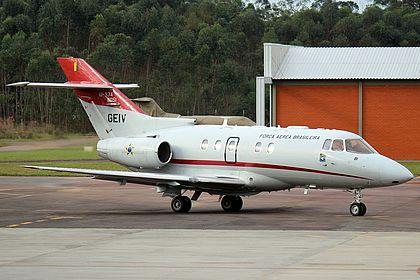
Military and government users are spread widely. Japan's air force flies U-125 flight-inspection aircraft and U-125A search-and-rescue jets, the latter fitted with a search radar, large observation windows and systems for dropping flares, marker buoys and life rafts. Brazil's air force flies 800XPs designated EU-93A, Saudi Arabia's air force flies 125-800s, and South Korea's air force has operated a signals-intelligence version called the RC-800. In the United States, the six C-29As the FAA inherited from the Air Force were replaced by Challenger 604s after 2005.
Flying on one
The Hawker's selling point was always a large cabin for its class. Brokers' specification sheets give it 21 ft 4 in long, 6 ft wide and 5 ft 8 in to 5 ft 9 in high, so taller passengers stoop a little in the aisle. Cessna's Citation Sovereign, a stretched Excel developed partly to compete with the Hawker, is 66 in wide and 68 in high, and Business & Commercial Aviation described the 900XP's cabin as wider but shorter than the Sovereign's.
Eight seats is the usual fit, either two facing clubs of four or a four-chair club followed by a three-place divan opposite a single seat. The type certificate allows up to 15 passengers, though few aircraft are set up that way, and two pilots are required on every flight. You board through a door just behind the cockpit into a small vestibule, which the original design used for luggage and for preparing meals. Brokers list about 48 to 49 cu ft of internal baggage space reachable in flight, and the Hawker 750 adds a 47 cu ft heated pannier outside, where other versions carry the ventral fuel tank.
The cabin is pressurized to 8.5 psi, holding a 7,500 ft cabin altitude at 41,000 ft. Most trips are a couple of hours between business airports, but a 900XP can stretch to almost 2,800 nm with six passengers.
Variants
- HS.125-700 — Garrett TFE731-3 turbofans replaced the Viper turbojets; first flew June 19, 1976, and 215 were built
- BAe 125-800 / Hawker 800 — Curved windscreen, longer wing, TFE731-5R engines and EFIS; renamed Hawker 800 in 1994
- Hawker 800XP — TFE731-5BR engines, standard thrust reversers and higher weights; FAA-approved July 1995
- Hawker 850XP — 800XP with factory winglets, updated avionics and a new interior; FAA-approved February 2006
- Hawker 900XP — TFE731-50R engines for hot-and-high work and almost 2,800 nm; FAA-approved August 2007
- Hawker 750 — Lighter, lower-priced model with an external baggage pannier in place of the ventral fuel tank; FAA-approved December 2007
- C-29A, U-125, U-125A — Flight-inspection and search-and-rescue versions for the US Air Force and Japan
How to spot it
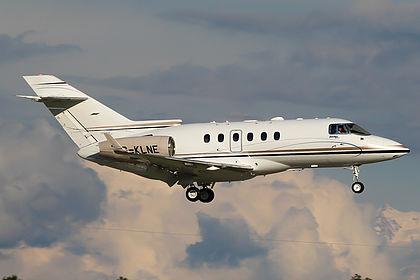
A Hawker is a low-wing twin with engines on the rear fuselage, a moderately swept wing slung beneath the fuselage and a horizontal tail set partway up the fin. Two cues separate the generations. The 125-700 has a flat-paneled windscreen and a ventral fin under the tail; from the 800 onward the windscreen is curved and the ventral fin is gone.
The 850XP and 900XP carry upturned winglets about 30 in tall, but some older 800s and 800XPs have retrofit winglets (sold as the 800SP and 800XP2), and an 850XP and a 900XP look identical outside; the 900XP's serial numbers start with HA-. Against a Citation Excel (C56X), the Hawker's swept wing is the giveaway, since the Excel's is straight. The Hawker 1000 (H25C) is 2 ft 9 in longer and uses Pratt & Whitney Canada PW305 engines.
Frequently asked
Is the Hawker 800 still made?
No. Hawker Beechcraft filed for Chapter 11 in May 2012, and when it emerged as Beechcraft Corporation in February 2013 it dropped its business jets, ending more than 50 years of 125 production. Textron Aviation, which bought Beechcraft in 2014, holds the type certificate and supports the fleet.
What is the difference between the Hawker 800XP, 850XP and 900XP?
The 800XP of 1995 has TFE731-5BR engines and standard thrust reversers. The 850XP of 2006 is an 800XP with factory winglets, updated avionics and a new interior. The 900XP of 2007 keeps the 850XP airframe but uses TFE731-50R engines, which improve hot-and-high performance and stretch the range to almost 2,800 nm with six passengers. All three have the same cabin.
Is a Hawker 800 the same airplane as a BAe 125?
Yes. The Hawker 800 is the BAe 125-800 under the name Raytheon gave it after buying BAe Corporate Jets in June 1993; the FAA approved the change in January 1994. Every 125, from the 1962 DH.125 to the 900XP, sits on one type certificate, and many registries still list Hawkers as 125s.
Why does a flight tracker show a Hawker as H25B?
H25B is ICAO's designator for the HS.125-700, the BAe 125-800 and the Hawker 750, 800, 850 and 900, along with the military C-29 and U-125. Earlier 125s up to the Series 600 are H25A, and the longer 125-1000 or Hawker 1000 is H25C.
How many passengers does a Hawker 800XP carry?
Usually eight, arranged as two four-seat clubs or a club plus a three-place divan. The certified maximum is 15, but a cabin about 6 ft wide with a little under 6 ft of headroom makes eight the comfortable number.
Can an older Hawker 800XP be upgraded with 900XP engines?
Yes. Hawker Beechcraft's 800XPR program, certified in 2011, replaced the original engines with the 900XP's TFE731-50R and added winglets. The company said the upgraded jet could climb directly to 41,000 ft at maximum takeoff weight in 25 minutes and burned 7 percent less fuel per pound of thrust.
What aircraft is H25B?
H25B is the ICAO type designator for the Hawker 800 / BAe 125-800, a British Aerospace / Hawker Beechcraft business jet that first flew in 1983. It is the code flight trackers and air traffic control use.
What is the wingspan of the Hawker 800 / BAe 125-800?
The Hawker 800 / BAe 125-800 has a wingspan of 16.56 m (54 ft) and is 15.6 m (51 ft) long.
What engines does the Hawker 800 / BAe 125-800 have?
Two Honeywell TFE731-5BR (800XP, 850XP) or TFE731-50R (900XP).
What is the MTOW and range of the Hawker 800 / BAe 125-800?
Maximum takeoff weight is 12,700 kg (27,998 lb) and maximum range is about 2,800 nautical miles (5,186 km) at a cruise of Mach 0.75.
How many passengers does the Hawker 800 / BAe 125-800 carry?
Typically 8 people including the pilot.
Compare with
Specs are approximate, compiled from public sources. See our editorial policy.