Airbus A330-300
A333Airbus · Widebody · Production ended
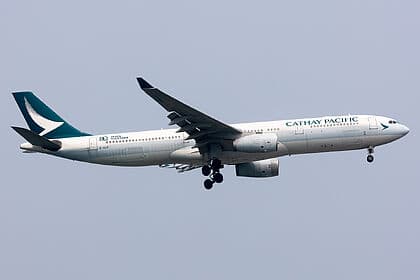
In the wild
History
The Airbus A330-300 is the original and larger member of the A330 family, a twin-engine widebody launched in the late 1980s as part of a combined programme with the four-engine A340. Airbus conceived the two aircraft together to share a common wing, fuselage cross-section, and flight deck, differing chiefly in the number of engines: the A340 used four for very long, thin routes at a time when twin-engine overwater flying was still restricted, while the A330 used two for shorter, denser markets. The A330-300 first flew in 1992 and entered service with Air Inter in early 1994, followed quickly by other European and Asian carriers.
Designed to seat roughly 300 passengers in a wide, twin-aisle cabin, the -300 targeted medium-haul, high-frequency routes where its low trip cost and generous capacity were attractive. It was offered with a choice of three engines, the Rolls-Royce Trent 700, the General Electric CF6-80E1, and the Pratt & Whitney PW4000, giving airlines unusual freedom to match existing fleets. Early aircraft were limited in range, but Airbus steadily raised the maximum takeoff weight over the programme, from around 212 tonnes to 242 tonnes, transforming the -300 from a regional widebody into a genuine long-haul aircraft capable of many intercontinental sectors.
The shorter-fuselage A330-200, with greater range, followed in the late 1990s, and between them the two versions gave Airbus a strong mid-size widebody family that sold steadily for two decades. The A330-300 became a mainstay of Asian, European, and Middle Eastern fleets, used both on short high-density hops and on longer regional and intercontinental routes. Its economics on medium-haul flying, in particular, made it hard for rivals to match, and it was frequently chosen to replace older widebodies such as early 767s, A300s, and MD-11s.
As newer, more efficient aircraft arrived, Airbus re-engined the family into the A330neo, and the A330-900 with new-generation engines and Sharklet wingtips became the natural successor. Passenger production of the original A330-300, retrospectively the ceo for current engine option, wound down accordingly, and the last such aircraft was delivered in early 2020. As of 2026 the type is no longer in meaningful passenger production, but very large numbers remain in front-line service worldwide, and it should stay common for years. Some early examples are moving to secondary operators, leisure carriers, and freighter-conversion programmes, echoing the second careers of the widebodies it once replaced. In all, well over 1,500 A330s of every version have been built, giving the family a deep support and spare-parts base that should keep the -300 economical to operate for years yet.
Specifications
- First flight
- 1992
- Entered service
- 1994
- Engines
- 2 × Rolls-Royce Trent 700, GE CF6-80E1, or Pratt & Whitney PW4000
- Typical seating
- 277 (2-class)
- Cruise speed
- Mach 0.82
- Range
- 6,350 nm
- MTOW
- 242,000 kg
- Length
- 63.66 m
- Wingspan
- 60.3 m
- Status
- Production ended
Design notes
The A330-300 is a conventional but highly refined twin-aisle widebody. Its most distinctive engineering feature is invisible from outside: the wing, systems, and cockpit are shared with the four-engine A340, so the two aircraft are near-identical apart from engine count. The wing is an aluminium design with small upturned wingtip fences rather than tall winglets, a common Airbus cue of the era. The fuselage keeps the roughly 5.6-metre-wide cross-section of the A300 and A310 before it, seating eight abreast in a 2-4-2 economy layout with two aisles.
Power comes from a choice of three high-bypass turbofans, the Rolls-Royce Trent 700, the General Electric CF6-80E1, or the Pratt & Whitney PW4000, each in roughly the 70,000 lbf class. That three-supplier choice was a deliberate sales feature. Each main landing gear leg carries a four-wheel bogie.
The flight deck uses Airbus's fly-by-wire architecture with sidestick controllers and a cockpit philosophy shared across the A320, A330, and A340 families, allowing common pilot type ratings that were a major selling point. Structurally the aircraft predates the composite-heavy A350, being largely aluminium. Over its life Airbus raised weights and updated the cabin and avionics, but the airframe's basic shape stayed constant, making the -300 a durable, well-understood design rather than a technically radical one.
Notable facts
- A twin-engine widebody that shares its fuselage cross-section, wing, and cockpit with the four-engine A340.
- Offered with a choice of Rolls-Royce Trent 700, GE CF6-80E1, or Pratt & Whitney PW4000 engines.
- Maximum takeoff weight grew over the programme from roughly 212 to 242 tonnes, extending range and payload.
- Effectively replaced by the re-engined A330-900neo; the last passenger A330-300 (ceo) was delivered in early 2020.
- A long-serving medium- to long-haul workhorse for Asian and European carriers, and a common leisure and charter jet.
Who flies it
As of 2026 the A330-300 remains a widely used medium- and long-haul widebody, even though passenger production has ended. It is especially common among Asian and Pacific carriers such as Cathay Pacific, China Eastern, China Southern, Korean Air, and Qantas, and among European operators including Lufthansa, Turkish Airlines, and several charter and leisure airlines; Middle Eastern and African carriers fly it too. In service it covers a broad range of missions, from short domestic and regional high-density shuttles to full-length intercontinental routes, usually in two- or three-class layouts. Its combination of wide cabin and modest trip cost makes it a favourite for building frequency on busy medium-haul markets. As airlines take newer A330neos and 787s, some -300s are passing to secondary operators or being eyed for freighter conversion.
Flying on one
The A330-300 is one of the great twin-aisle workhorses, and as a passenger it is a comfortable, familiar long-haul ride. Economy is laid out eight-abreast in a 2-4-2 pattern, the same passenger-friendly arrangement as its A330neo successor: the side pairs are ideal for couples, and only the two centre seats are true middles, so most people are at most one seat from an aisle. Seat width is competitive, usually around seventeen to eighteen inches. This is a pre-neo design, so cabin altitude and humidity are ordinary rather than class-leading, and the exact seats and finishes vary widely because so many -300s are now mid-career. The ride is smooth and reasonably quiet, and overhead bins take carry-ons without much fuss. For the best seat, target a 2-4-2 window pair on the A/B or J/K side for a window and an aisle with a single neighbour; the last rows sit near the aft galleys. It is a dependable choice on medium and long routes worldwide.
Variants
- A330-200 (A332) — Shorter-fuselage, longer-range variant
- A330-900neo (A339) — Re-engined successor with new-generation engines and Sharklet wingtips
- A330-200F — Dedicated freighter derivative
How to spot it
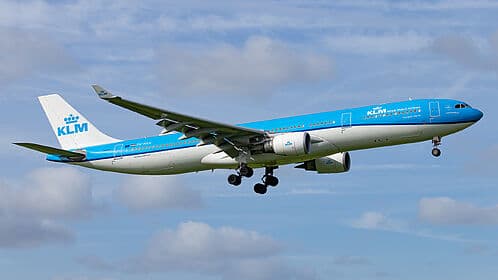
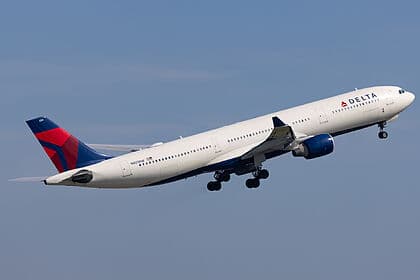
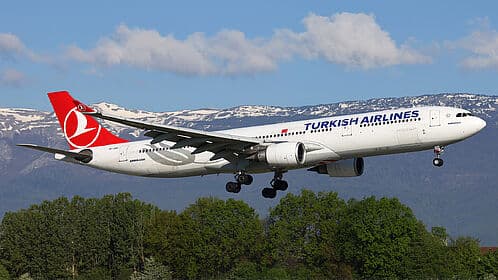
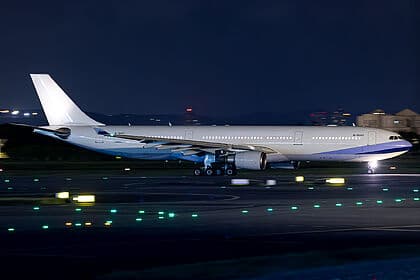
The A330-300 is a large twin-engine widebody with a smooth Airbus nose, a two-piece curved windscreen, and small upturned wingtip fences rather than tall winglets. Its four-wheel main gear bogies immediately separate it from the six-wheel bogies of the 777. Telling it from the shorter A330-200 is mainly a matter of length: the -300 is noticeably longer, with more windows, while the -200 has a taller-looking tail. The near-identical A340 is the trickiest look-alike, but the A330 has two engines to the A340's four. Against the 787, the A330 lacks the Dreamliner's raked, gull-shaped wingtips and its engine chevrons. Against the 767, the A330 is clearly larger and wider, eight-abreast rather than seven, and carries the wingtip fences most 767s lack.
Frequently asked
How do you tell an Airbus A330 from a Boeing 777?
Both are large twin-engine widebodies, but the surest cue is the main landing gear: the A330 rides on four-wheel bogies, while the 777 uses distinctive six-wheel bogies. The A330 is also smaller overall, has small upturned wingtip fences rather than raked tips, and wears the smooth two-piece Airbus windscreen. The 777's GE90 engines are visibly larger than the A330's.
What is the difference between the A330-300 and the A330-200?
The -300 is the longer, higher-capacity original, optimised for medium-haul and denser routes, while the -200 is a shorter-fuselage version with greater range. Externally the clearest difference is length and window count, the -300 being noticeably longer. The -200 also tends to look as though it has a taller tail relative to its body.
Is the Airbus A330-300 still in production?
Not as the original ceo passenger version. Airbus wound that line down in favour of the re-engined A330-900neo, and the last passenger A330-300 was delivered in early 2020. As of 2026 the type is out of meaningful passenger production, though large numbers are still flown daily by existing aircraft, and freighter conversions are extending some airframes' lives.
How is the A330-300 different from the A340?
They are almost the same aircraft externally, sharing a wing, fuselage, and cockpit, but the A330 has two engines while the A340 has four. Airbus built the A340 for very long routes at a time when twin-engine overwater flying faced tighter rules, and the A330 for shorter, denser markets. Once twins were cleared for long routes, the more economical A330 outlived its four-engine sibling.
What replaced the A330-300?
Airbus positions the re-engined A330-900neo, with new-generation engines and Sharklet wingtips, as the direct successor, and many operators also use the Boeing 787 in the same role. The neo offers lower fuel burn from the same basic airframe. Even so, large numbers of original A330-300s remain in service and will for years.
Compare with
Specs are approximate, compiled from public sources. See our editorial policy.