Bombardier CRJ900
CRJ9Bombardier · Regional · Production ended
In the wild
History
The Bombardier CRJ900 is a regional jet from the Canadair Regional Jet family, a lineage that traces back to a business aircraft. In the 1970s Canadair developed the Challenger, a wide-cabin business jet; after Bombardier acquired Canadair in 1986, engineers stretched the Challenger's fuselage and reworked the cabin to create the 50-seat CRJ100 and CRJ200, which entered service in the early 1990s and helped popularise the regional jet in North America. The CRJ700, a larger development seating about 70 with a new wing and a stretched fuselage, followed at the turn of the century.
The CRJ900 is a further stretch of the CRJ700, seating roughly 76 to 90 passengers. It first flew in 2001 and entered service in 2003, with Mesa Air Group among the early United States operators. Bombardier later added the CRJ1000, a longer version seating around 100, and the CRJ550, a low-density reconfiguration of the CRJ700 introduced for the American market. All shared the narrow, low-set cabin cross-section inherited from the Challenger.
For much of the 1990s and 2000s the CRJ family was central to the growth of regional flying, especially in the United States, where major airlines contracted regional partners to fly the jets in their colours. Over time, however, the type lost ground. Airlines and passengers increasingly preferred the roomier cabin of Embraer's E-Jets, whose wider fuselage offered more headroom, larger windows and larger bins. The E175 in particular came to lead new United States regional orders, while the CRJ's business-jet-derived cabin, comfortable when new but tight by later standards, became a competitive weakness. The economics of 50-seat regional jets also deteriorated as fuel prices rose and airline labour agreements evolved, pushing carriers toward larger 70-to-76-seat aircraft, the segment where the CRJ900 and the E175 competed directly.
Bombardier's priorities also shifted. The company invested heavily in the larger CSeries narrowbody, later sold to Airbus and renamed the A220, and progressively withdrew from commercial aviation. In 2020 Bombardier sold the CRJ program to Mitsubishi Heavy Industries of Japan, and production of the CRJ ended around the same time after roughly 1,900 aircraft of all variants had been built. Mitsubishi was widely reported to have valued the deal chiefly for the CRJ's global maintenance and support network, which it intended to use in support of its own SpaceJet regional-jet program; that program was itself cancelled in 2023. The CRJ900 remains common in service, particularly with North American regional carriers, but no new examples are being built. Across its production life the CRJ family was among the most numerous regional jets in service, and its large installed base will keep it visible at airports well after the end of production.
Specifications
- First flight
- 2001
- Entered service
- 2003
- Engines
- 2 × General Electric CF34-8C5
- Typical seating
- 76 (2-class)
- Cruise speed
- Mach 0.8
- Range
- 1,550 nm
- MTOW
- 38,330 kg
- Length
- 36.4 m
- Wingspan
- 24.85 m
- Status
- Production ended
Design notes
The CRJ900's defining characteristics come from its origins as a stretched business jet. The fuselage cross-section is narrow and set low to the ground, with a cabin ceiling and window line noticeably lower than those of comparable Embraer jets. Seating is four abreast in a two-plus-two layout. Two General Electric CF34-8C5 turbofans are mounted on pylons at the rear of the fuselage, keeping the wing clean, and the horizontal stabiliser is placed at the top of the fin in a T-tail arrangement.
The wing is a swept design with small winglets, shared in its essentials across the CRJ700, CRJ900 and CRJ1000. Compared with the earlier 50-seat CRJ200, the CRJ900 has a redesigned wing, larger engines and a longer fuselage, along with more cabin windows. It also has a higher maximum take-off weight and more powerful engines than the CRJ700, reflecting its larger size and heavier payload.
To serve the United States market, many CRJ900s are delivered in a 76-seat, two-class layout weighing under the limits set by airline scope clauses. Bombardier offered an optimised version with revised interior trim, larger bins and updated systems in later production. The aircraft's rear-mounted engines and clean wing give it good field performance, though its limited cabin height and modest overhead and under-seat storage are frequently noted drawbacks relative to newer designs.
Notable facts
- A stretch of the CRJ700, itself derived from the CRJ100/200 regional jet lineage.
- Common in US regional fleets at 76 seats to fit airline scope-clause limits.
- Its narrow four-abreast cabin and low ceiling are frequent passenger complaints.
- Bombardier ended CRJ production in 2020 and sold the program's support to Mitsubishi.
Who flies it
The CRJ900 is flown mainly by regional airlines, and in the United States it operates almost entirely under the regional-affiliate model, in which independent companies fly the aircraft in a major carrier's livery under capacity-purchase agreements. Operators such as Endeavor Air for Delta Connection, PSA Airlines and others for American Eagle, and SkyWest for several partners have run large CRJ900 fleets. Outside North America the type is used by carriers in Europe, Africa and elsewhere on regional and thinner mainline routes. In the United States the CRJ900 typically flies in a 76-seat, two-class configuration to stay within pilot-contract scope clauses. Although the E175 has taken much of the new-order market, the large installed base of CRJ900s means the type will remain a common sight at American hubs for years, gradually being retired or displaced as fleets renew.
Flying on one
The CRJ900 does its job well, but it is the aircraft that gave regional flying its cramped reputation. The cabin is four-abreast in a 2-2 layout — no middle seats, which is good — but the fuselage is narrow and the ceiling is low, so tall passengers quickly learn to duck in the aisle and can feel hemmed in. The defining passenger reality, though, is baggage: the overhead bins are small, and on most CRJ900 flights a standard roll-aboard will not fit, so it is gate-checked at the jet bridge — tagged and left at the aircraft door, then returned there or at the carousel. Travelling carry-on only is far less convenient here than on a mainline jet or an E175. The engines are mounted at the rear, so the back of the cabin is noticeably louder. For the best seat, sit as far forward as you can: it is quieter, you board and leave first, and you are farthest from the aft galley and lavatory. The very back rows are the ones to avoid.
Variants
- CRJ700 — Shorter, roughly 70 seats
- CRJ1000 — Stretched, up to about 100 seats
How to spot it
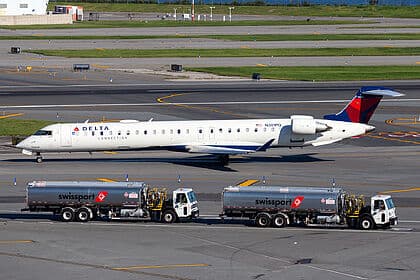
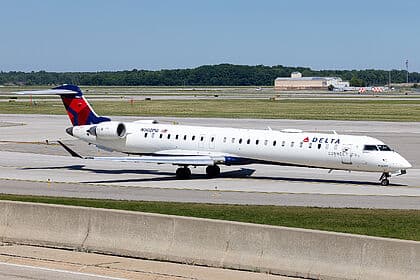
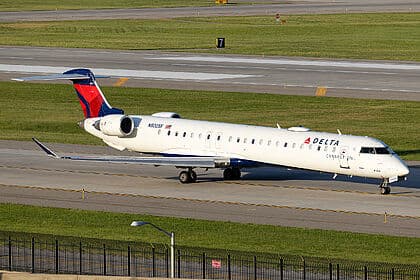
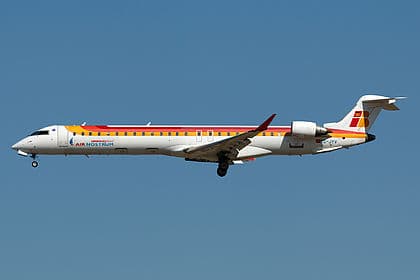
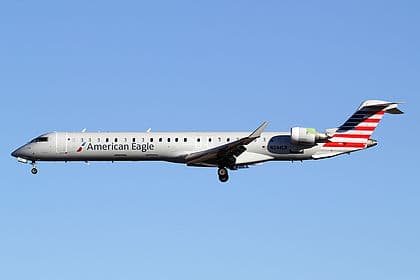
The CRJ900 shows the classic Canadair Regional Jet silhouette: two engines mounted high on the rear fuselage, a T-tail, a pointed nose and a slim fuselage that sits low to the ground. The cabin windows are small and set low on the side. The quickest way to separate it from an Embraer E175, its main rival, is the engine position and tail: the E175 hangs its engines on pylons under the wing and uses a low-set tailplane, while the CRJ mounts its engines at the tail beneath a T-tail. Telling the CRJ900 from the shorter CRJ700 and the longer CRJ1000 comes down to fuselage length and the number of windows and overwing exits, with the CRJ900 sitting between the two. Small winglets are fitted to all three.
Frequently asked
How do you tell a CRJ900 from an Embraer E175?
The engines and tail are the giveaway. A CRJ900 carries its two engines on the rear fuselage under a T-tail, while an E175 mounts its engines on pylons under the wing and has a conventional low tailplane. The E175 also has a taller, wider cabin with larger windows set higher on the fuselage, whereas the CRJ's cabin is narrower and its windows are small and low.
How is the CRJ900 related to the other CRJ models?
It is part of a single family that began with the 50-seat CRJ100 and CRJ200, themselves derived from the Challenger business jet. The CRJ700 stretched that design to about 70 seats, the CRJ900 stretched it further to roughly 76 to 90, and the CRJ1000 longer still to around 100. All share the same narrow cabin cross-section.
Why has the CRJ declined in popularity?
Airlines and passengers increasingly favoured the roomier cabins of Embraer's E-Jets, and the E175 captured most new United States regional orders. At the same time Bombardier shifted its focus to the larger CSeries, later sold to Airbus as the A220, and withdrew from commercial aviation. Production ended around 2020 after the program was sold to Mitsubishi.
Is the CRJ900 still being built?
No. Bombardier sold the CRJ program to Mitsubishi Heavy Industries in 2020 and production ended around that time. Large numbers remain in service, however, particularly with North American regional carriers, so the type will be operating for years yet.
How many passengers does a CRJ900 carry?
Capacity ranges from about 76 to 90 seats depending on configuration. In the United States it is usually fitted with 76 seats in two classes to stay within airline scope-clause limits. Elsewhere, higher-density single-class layouts approach 90.
In-depth comparisons
Compare with
Specs are approximate, compiled from public sources. See our editorial policy.