Cirrus SR22
SR22Cirrus · Piston single · In production
In the wild
History
The Cirrus SR22 is the product of a company founded to shake up a conservative industry. Brothers Alan and Dale Klapmeier started Cirrus Aircraft in the 1980s, and through the 1990s they developed a modern, all-composite personal aircraft built around a striking safety idea: a parachute for the whole aeroplane. Their first production model, the four-seat SR20, entered service in the late 1990s. The larger, more powerful SR22 followed, first flying in 2000 and entering service in 2001.
The SR22 was conceived as a fast, comfortable, technologically advanced personal aircraft rather than a trainer, aimed at owner-pilots who wanted to travel. It paired a sleek composite airframe with a powerful six-cylinder engine of around 310 horsepower, side-stick controls, and, from early on, large glass-cockpit displays. Above all, it came as standard with the Cirrus Airframe Parachute System, or CAPS, a rocket-deployed parachute that can lower the entire aircraft to the ground in an emergency.
That parachute was central to Cirrus's pitch and, initially, to the debate around the aircraft. Some traditional pilots were sceptical, and the type's early accident record drew scrutiny as owners learned to fly a fast, slippery aircraft. Over time, as training emphasised proper use of the parachute and the safety culture matured, the SR22's record improved markedly, and CAPS deployments were credited with saving a growing number of lives.
Commercially the SR22 was a striking success. It became, by most accounts, the best-selling piston aircraft in general aviation for roughly two decades from the mid-2000s, outselling long-established rivals from Cessna and Piper. Cirrus refined it steadily through a series of generations, adding a turbocharged SR22T for better high-altitude performance, more powerful avionics, updated cabins and refinements to the parachute system. The related but smaller SR20 continued in production alongside it, sharing the same airframe philosophy and parachute, while Cirrus grew into one of the most prominent names in modern personal aviation.
As of 2026 the SR22 remains in production and near the top of its market, and Cirrus has extended the same design language and safety philosophy into the single-engine Vision Jet. For enthusiasts the SR22 is significant as the aircraft that proved a whole-airframe parachute could be commercially successful and as a symbol of a more modern, safety-focused approach to personal flying. It is also simply one of the most recognisable light aircraft of its era, its sculpted composite lines and side-stick controls a clear break from the metal Cessnas and Pipers that preceded it.
Specifications
- First flight
- 2000
- Entered service
- 2001
- Engines
- 1 × Continental IO-550-N (310 hp)
- Typical seating
- 5 seats
- Cruise speed
- Mach 0.28
- Range
- 1,040 nm
- MTOW
- 1,633 kg
- Length
- 7.92 m
- Wingspan
- 11.68 m
- Status
- In production
Design notes
The Cirrus SR22 broke sharply with the metal singles that came before it. Its airframe is built largely from composite materials, allowing smooth, sculpted, aerodynamically clean curves that are difficult to achieve in aluminium and that give the aircraft its distinctive modern look. The wing is mounted low, and the undercarriage is fixed, a deliberate choice to avoid the weight, cost and complexity of a retracting system.
The aircraft's signature feature is the Cirrus Airframe Parachute System, CAPS, a rocket-deployed parachute packed into the rear fuselage that can lower the whole aeroplane under canopy in an emergency. Its housing gives the upper rear fuselage a characteristic shape, and placards mark the deployment handle in the cabin.
Inside, the SR22 uses side-stick controls mounted by each front occupant rather than a central yoke, and large Garmin-based glass displays branded Cirrus Perspective. Power is a six-cylinder Continental engine of around 310 horsepower, with a turbocharged version, the SR22T, offered for high-altitude cruise.
As of 2026 the SR22 seats up to five in current generations, where early models seated four. The overall design goal is fast, comfortable personal transport with a strong safety margin, rather than low-cost training, and that goal is reflected in every choice from the composite structure to the parachute.
Notable facts
- Fitted as standard with CAPS, the Cirrus Airframe Parachute System, a whole-airplane recovery parachute.
- Widely reported as the best-selling piston aircraft in general aviation for roughly two decades.
- An all-composite airframe with a fixed tricycle undercarriage and side-yoke (side-stick) controls.
- Uses Cirrus Perspective avionics based on Garmin glass displays.
- CAPS deployments are credited with saving well over 200 lives as of the mid-2020s.
Who flies it
As of 2026 the Cirrus SR22 is overwhelmingly a private owner's aircraft. Its speed, comfort, advanced avionics and whole-airframe parachute make it especially popular with individuals and businesses who use it as fast personal or company transport, often flown by their owners rather than professional crews. It appeals particularly to well-resourced owner-pilots stepping up to a capable travelling aircraft.
The type is also used by some flight schools, and increasingly by airline-pathway academies, which value its modern glass cockpit for advanced and instrument training. Fractional-ownership and shared programmes put SR22s within reach of pilots who do not want the cost of sole ownership. Some are flown in light business roles and personal charter. Because it has sold in large numbers for two decades, the SR22 is now a common sight at general-aviation airports, easily picked out by its sleek composite lines.
Flying on one
The Cirrus SR22 is what many people picture when they imagine modern personal flying, and it is a genuinely pleasant aircraft to ride in. It is sleek and fast for a piston single, with a big glass-cockpit display, side controls rather than a yoke, leather seats and a cabin quieter and more car-like than older light aircraft. Its most famous feature reassures nervous passengers: the whole aircraft carries a parachute, the Cirrus Airframe Parachute System, designed to lower the entire aeroplane to the ground in an emergency. There are four to five seats; luggage rides in a modest baggage area rather than overhead bins, and everyone wears a headset, though the cabin is relatively hushed. As a fast, comfortable single it is popular with owner-pilots for real travel rather than just training. For the best experience, take the front-right seat for the view and the panel; the aircraft's speed and comfort make even longer trips agreeable by light-aircraft standards.
Variants
- SR22 — Normally aspirated, ~310 hp
- SR22T — Turbo-normalised for high-altitude cruise
- Generations G1-G7 — Progressive avionics, power and cabin updates
- SR20 — Smaller, lower-powered stablemate (separate type)
How to spot it
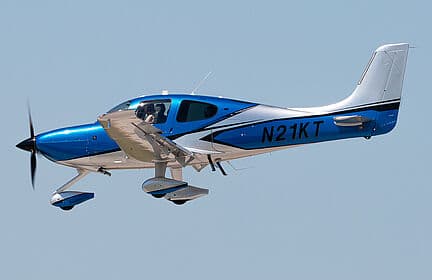
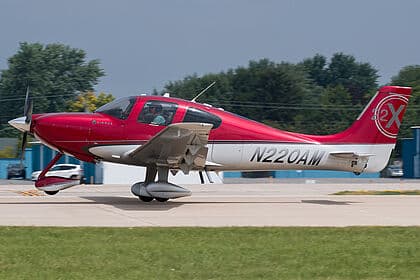
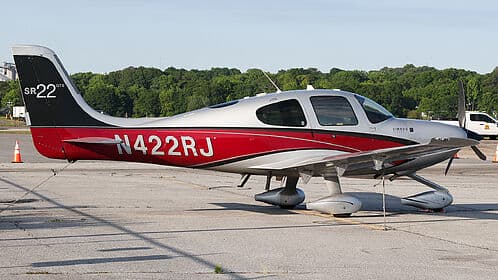
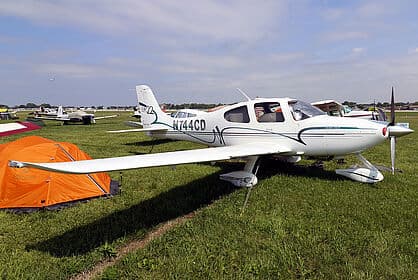
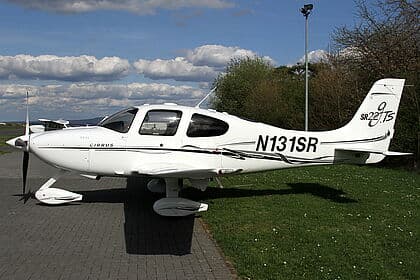
The Cirrus SR22 is one of the easier modern light aircraft to recognise. It is a low-wing single with a smooth, sculpted composite airframe whose curves are visibly rounder and more streamlined than the flat metal panels of a Piper or older Cessna. The undercarriage is fixed, with faired covers over the wheels that give it a clean, purposeful look.
The clinching feature is the parachute. The CAPS system sits in the upper rear fuselage, usually marked by a subtle bulge or a small cover panel and by prominent placards, and there is often a warning marking where the rocket fires. The cockpit uses side-sticks rather than a central control yoke, visible through the windows. Against a Diamond, the Cirrus looks broader and less glider-like; against a Piper or Cessna, its composite curves and parachute housing are unmistakable.
Frequently asked
Does the Cirrus SR22 really have a parachute?
Yes. Every SR22 comes as standard with the Cirrus Airframe Parachute System, or CAPS, a rocket-deployed parachute stowed in the rear fuselage that can lower the entire aircraft to the ground in an emergency. It is intended for situations such as engine failure over hostile terrain, loss of control or pilot incapacitation. As of the mid-2020s, CAPS deployments have been credited with saving well over 200 lives.
Is the Cirrus SR22 hard to fly?
It is not especially difficult, but it is a fast, slippery aircraft that rewards proper training and discipline. It cruises much quicker than a typical trainer, so events happen faster and good planning matters. Modern Cirrus training places heavy emphasis on energy management and on correct use of the parachute, and the type's safety record improved substantially as that culture matured. Most competent private pilots transition to it successfully with suitable instruction.
Why is the Cirrus SR22 so popular?
It combines speed, comfort, advanced avionics and a whole-airframe parachute in one modern package, which struck a chord with owner-pilots who wanted a capable travelling aircraft. By most accounts it has been the best-selling piston aircraft in general aviation for roughly two decades. Its composite airframe and glass cockpit also felt a generation ahead of the metal Cessnas and Pipers it competed against.
What is the difference between the SR22 and SR22T?
The SR22T is the turbocharged version of the SR22. Turbocharging maintains engine power at higher altitudes, so the SR22T cruises faster up high and copes better with hot conditions and high-elevation airports. The standard, normally aspirated SR22 is simpler and slightly cheaper to run, and is more than adequate for most missions. Both share the same airframe and parachute system.
How much does a Cirrus SR22 cost to buy and run?
A new SR22 is an expensive aircraft, costing roughly a million dollars or more depending on options, and even used examples command strong prices. Running costs are correspondingly higher than a basic trainer's, including fuel for the big engine, insurance, hangarage, maintenance and periodic repacking of the parachute system. Precise figures vary widely by region and usage, so these are only a rough guide. For many owners the safety features and performance justify the outlay.
Compare with
Specs are approximate, compiled from public sources. See our editorial policy.