Comac C919 (C919)
Comac · Narrowbody · In production
C919 is the ICAO aircraft type code for the Comac C919, a Comac narrowbody airliner that first flew in 2017 and entered service in 2023. It typically carries 164 passengers in a two-class layout, cruises at Mach 0.78, and has a range of about 2,235 nautical miles (4,139 km).

Loading live positions…
In the wild
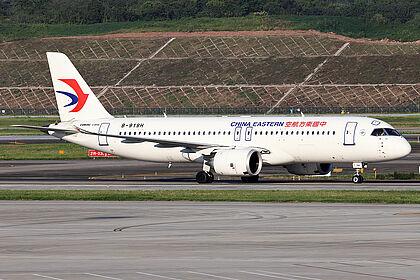
History
The C919 is China's first mainline airliner of its own design and the centerpiece of a decades-long effort to build a domestic aviation industry. Comac, the Commercial Aircraft Corporation of China, was created in Shanghai in 2008 to build it, following the smaller ARJ21 regional jet, and the program was announced that year with the goal of competing with the Airbus A320 and Boeing 737 in the world's fastest-growing airline market.
The design is conventional: a single-aisle twinjet seating 158 to 192 with CFM International LEAP-1C engines, the Chinese variant of the engine that powers the A320neo and 737 MAX. Most major systems came from Western suppliers through joint ventures, including Honeywell avionics and flight controls, Liebherr landing gear and Collins cabin systems, with Chinese partners building the airframe. The first C919 rolled out in November 2015 and flew on May 5, 2017 from Shanghai Pudong; six prototypes then spent five years in flight testing, far longer than Comac had planned.
China's regulator, the CAAC, certified the C919 in September 2022, and China Eastern flew the first commercial service, Shanghai to Beijing, on May 28, 2023. Air China and China Southern followed in 2024, and by 2026 Comac had delivered several dozen aircraft, all to Chinese carriers, with orders claimed to exceed a thousand, nearly all from Chinese airlines and lessors. Comac has announced a shortened C919-600 and a stretched C919-800 and is developing a widebody, the C929.
Two things hold the C919 back. Production has been slower than Comac's targets, and the program depends on imported engines and systems; in 2025 Reuters reported that the US government had suspended some export licenses for the LEAP-1C, a reminder of how exposed the supply chain is. And the aircraft is certified only in China, so it cannot fly for airlines outside the country until the European or American regulators approve it, which as of late 2026 has not happened. The C919 is nonetheless a milestone, the first Chinese jet to carry fare-paying passengers in competition with Airbus and Boeing on China's busiest routes.
Specifications
- First flight
- 2017
- Entered service
- 2023
- Engines
- 2 × CFM International LEAP-1C
- Typical seating
- 164 (2-class)
- Cruise speed
- Mach 0.78
- Range
- 2,235 nm
- MTOW
- 75,100 kg
- Length
- 38.9 m
- Wingspan
- 35.8 m
- Status
- In production
Design notes
The C919 follows the A320 and 737 formula closely. Its fuselage is 3.96 meters wide, slightly wider than an A320's, allowing six-abreast economy at 18 inches per seat with a 19-inch middle, and it is 38.9 meters long, between an A320 and an A321. The wing spans 35.8 meters with large blended winglets, and it uses a supercritical airfoil developed in China with Russian wind-tunnel help; composites are used in the tail and control surfaces, with aluminum-lithium in parts of the fuselage.
The engines are two CFM International LEAP-1C turbofans of about 31,000 pounds of thrust, the same core as the A320neo's LEAP-1A with a Chinese-specific nacelle and thrust reverser built by Nexcelle. China's domestic alternative, the ACAE CJ-1000A, has been in testing for years and is intended to replace the LEAP eventually.
The flight deck has fly-by-wire controls with sidesticks and a Honeywell-supplied avionics suite with large displays, similar in concept to an A350's. Maximum takeoff weight is 75.1 tons for the standard version and 78.9 tons for the extended-range version, with ranges of about 2,200 and 3,000 nautical miles. Cruise speed is Mach 0.785. The numbers put the C919 close to the A320neo on paper, with a little less range and, Western analysts believe, somewhat higher weight.
Notable facts
- China's first homegrown mainline jet, built in Shanghai to compete with the A320neo and 737 MAX. First flight May 5, 2017; first revenue flight with China Eastern on May 28, 2023.
- Its engines, avionics and many systems come from Western suppliers; the LEAP-1C is a CFM engine, and reported US export restrictions in 2025 showed how exposed the program is to that supply chain.
- As of late 2026 it is certified only by China's regulator and flies with Chinese airlines (China Eastern, Air China, China Southern), mostly on domestic routes. European certification is still in progress.
- The standard version seats 158 in two classes, up to 192 all-economy, with about 2,200 nautical miles of range; an extended-range version adds roughly 800 more.
Who flies it
The C919 flies only for Chinese airlines. China Eastern, the launch customer, operates the largest fleet on trunk routes from Shanghai Hongqiao and Pudong to Beijing, Chengdu, Guangzhou, Xi'an and other large cities, and in 2025 began using it on flights to Hong Kong. Air China and China Southern fly smaller fleets from Beijing and Guangzhou. Chinese lessors have placed further aircraft with other mainland carriers. No airline outside China has taken delivery because the type lacks certification from the FAA or EASA; Comac has signed memoranda with airlines in Southeast Asia and elsewhere that are contingent on that approval. On a tracker, every C919 is a Chinese domestic or regional flight, most of them to or from Shanghai.
Flying on one
From a seat the C919 feels like a new A320. China Eastern's standard layout has 164 seats: eight in business in 2-2 and 156 in economy at 3-3, with economy seats about 18 inches wide, the middle seat an inch wider, and pitch of 31 to 32 inches. The cabin has large overhead bins that take roll-aboards wheels-first, LED mood lighting and bigger windows than a 737's. The LEAP engines are quiet, and the quietest rows are forward of the wing. Lavatories are at the front and rear. Best seats are the window and aisle pairs in the first economy rows; the last rows are near the rear galley. Flights are domestic Chinese trunk routes of two to three hours, where the airplane has drawn curious passengers since 2023. The in-flight entertainment and Wi-Fi depend on the airline rather than the airframe.
Variants
- C919-100 STD — Standard version, described here
- C919-100 ER — Extended range, about 3,000 nmi
- C919 shrink and stretch — Shorter and longer versions announced by Comac
How to spot it
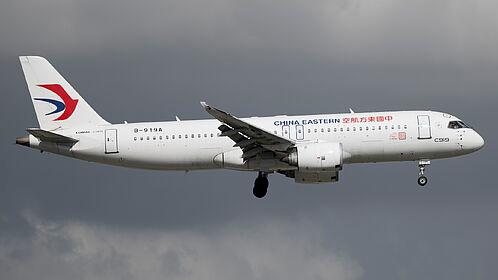
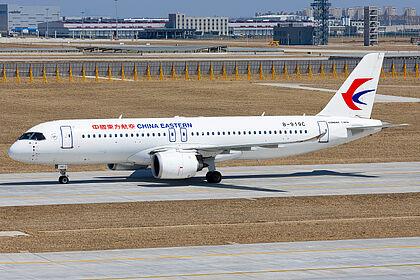
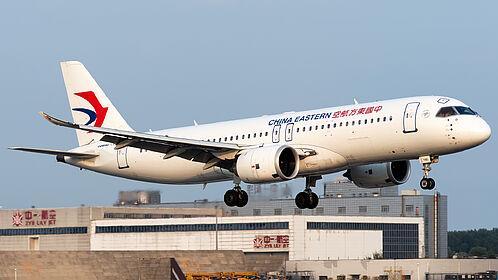
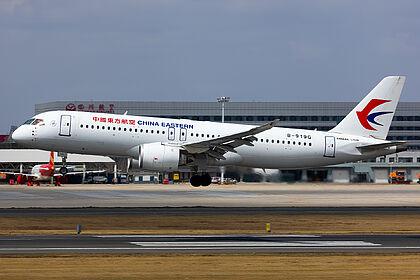
The C919 looks like a slightly larger A320neo and is easy to misidentify at a glance. The clearest clues are the nose, which is longer and more pointed than an A320's with a cockpit windshield of six panes in a smooth, swept-back arrangement, and the tail, whose fin has a straight leading edge with a small, sharp dorsal fillet. The winglets are tall and blended, resembling an A320's sharklets. The engines are LEAP-1Cs, so the fan and nacelle look like a neo's. Liveries narrow it fast: a China Eastern, Air China or China Southern narrowbody with a Comac badge on the nose and the registration prefix B-919 or B-65 is a C919. Against the 737 MAX it has a taller stance and no chevrons on the engine nacelles.
Frequently asked
Is the C919 a copy of the Airbus A320?
It follows the same single-aisle, six-abreast formula as the A320 and 737, as every modern narrowbody does, but it is Comac's own design with its own wing, fuselage and systems integration. Many of those systems, including the LEAP-1C engines, come from Western suppliers.
Can the C919 fly outside China?
Only to destinations its Chinese operators can serve under Chinese certification, such as Hong Kong. It is not certified by the FAA or EASA, so no non-Chinese airline can operate it yet. Comac has applied for European certification.
Who makes the C919's engines?
CFM International, the GE and Safran joint venture, supplies the LEAP-1C, a version of the engine on the A320neo. China is developing its own CJ-1000A engine as an eventual replacement.
Who flies the C919?
China Eastern, which launched it in May 2023, plus Air China and China Southern. All flights so far are by Chinese carriers, mostly on domestic trunk routes.
How many passengers does the C919 carry?
158 in a typical two-class layout, up to 192 in all-economy. China Eastern's aircraft seat 164.
What aircraft is C919?
C919 is the ICAO type designator for the Comac C919, a Comac narrowbody that first flew in 2017. It is the code flight trackers and air traffic control use.
What is the wingspan of the Comac C919?
The Comac C919 has a wingspan of 35.8 m (117 ft) and is 38.9 m (128 ft) long.
What engines does the Comac C919 have?
Two CFM International LEAP-1C.
What is the MTOW and range of the Comac C919?
Maximum takeoff weight is 75,100 kg (165,565 lb) and maximum range is about 2,235 nautical miles (4,139 km) at a cruise of Mach 0.78.
How many passengers does the Comac C919 carry?
Typically 164 passengers in a two-class layout; dense single-class layouts seat more and premium-heavy layouts fewer.
Compare with
Specs are approximate, compiled from public sources. See our editorial policy.