Bombardier Challenger 350 (CL35)
Bombardier · Business jet · In production
CL35 is the ICAO aircraft type code for the Bombardier Challenger 350, a Bombardier business jet that first flew in 2013 and entered service in 2014. It typically carries 8 people, cruises at Mach 0.8, and has a range of about 3,400 nautical miles (6,297 km).

Loading live positions…
In the wild
History
The business jet that topped the delivery charts in 2017 began life under another name. In the late 1990s Bombardier wanted an airplane to fill the gap between its Learjet 60 and the much larger Challenger 604: eight passengers, about 3,100 nautical miles and a cruise of Mach 0.80, enough to cross the United States without a fuel stop. Rather than shorten the 604, it drew a new design, and in June 1999 it launched the program at the Paris Air Show as the Bombardier Continental. Mitsubishi Heavy Industries joined as a risk-sharing partner and took on the one-piece wing, Taiwan's AIDC the rear fuselage and tail, AlliedSignal (soon part of Honeywell) the AS907 turbofan that became the HTF7000, and Rockwell Collins the Pro Line 21 flight deck.
The prototype flew on August 14, 2001. The engine's own certification ran late, and in September 2002 Bombardier pushed service entry back to make design changes. The same month it renamed the Continental the Challenger 300, ending an internal debate over whether it belonged with the Learjets, the Challengers or the Globals. Transport Canada certified it on May 31, 2003, the FAA on June 4 and Europe's JAA on July 31, and Flexjet flew the first one in revenue service on January 8, 2004. Most early buyers were in North America, and the airplane built a record for dispatch reliability, which Aviation Week put at 99.79 percent across nearly a million fleet hours by 2014.
The Challenger 350 refreshed the design rather than replacing it. It first flew on March 2, 2013, NetJets launched it with 75 firm orders and 125 options, and Transport Canada approved it on June 11, 2014, followed by the FAA on June 25. Canted winglets lengthened the span by about five feet, HTF7350 engines added 7.3 percent more takeoff thrust, maximum weight rose, and the cabin windows grew taller. For two years running it outsold every other business jet: GAMA delivery data made it the most-delivered of 2017, with 56, and Bombardier delivered 60 more in 2018, claiming 58 percent of the super-midsize segment. Embraer's cheaper Legacy 500 still put pressure on price, and in 2017 Bombardier cut the list price by about $7 million to match it.
Bombardier unveiled the Challenger 3500 in Montreal on September 14, 2021. It kept the airframe and added autothrottles, Nuage seats and a voice-controlled cabin, and it entered service in September 2022. The 200th was delivered in July 2026, less than four years later. In February 2026 Vista, the parent of VistaJet and XO, ordered 40 more, with options on 120. Counting both earlier models, Bombardier had delivered roughly 450 Challenger 300s and 350 Challenger 350s by July 2020.
The codes follow the marketing names. ICAO assigned CL35 to the Challenger 350, and the 3500 flies under it too, while a Challenger 300 normally appears as CL30, although all three are the same BD-100-1A10 on the type certificate.
Specifications
- First flight
- 2013
- Entered service
- 2014
- Engines
- 2 × Honeywell HTF7350
- Typical seating
- 8 seats
- Cruise speed
- Mach 0.8
- Range
- 3,400 nm
- MTOW
- 18,416 kg
- Length
- 20.92 m
- Wingspan
- 21 m
- Status
- In production
Design notes
The Challenger name is about the only thing the BD-100 shares with the older 600-series jets. Its fuselage is narrower, with a cabin Bombardier lists at 7 ft 2 in (2.19 m) wide and 6 ft (1.83 m) tall over a flat floor, and both fuselage and wing are aluminum semi-monocoque structures, with composite winglets.
The supercritical wing has a fixed leading edge, with no slats, and hydraulically driven single-slotted Fowler flaps with four positions: 0, 10, 20 and 30 degrees. The spoilers are fly-by-wire. In flight the outboard panels work as spoilerons to help the ailerons roll the airplane and as speedbrakes; after touchdown every panel deploys to dump lift. The ailerons themselves are mechanically actuated, while the elevators and rudder are hydraulically powered with a mechanical backup. Aviation Week credits the winglets with trimming induced drag in cruise by about 17 percent.
Two Honeywell HTF7350 turbofans, each flat-rated at 7,323 lb of thrust up to ISA+15°C, hang on the rear fuselage below the T-tail. Bombardier's figures for the 3500 are Mach 0.80 typical cruise, Mach 0.83 maximum, a 45,000 ft ceiling, a 4,835 ft takeoff run at maximum weight and sea level, and a cabin altitude of 4,850 ft when cruising at 41,000 ft. Flight International's 2004 test of the original 300 measured a climb from maximum takeoff weight to 41,000 ft in 18 minutes.
Up front, Collins Pro Line 21 avionics drive four large displays. The 350 spread synthetic-vision imagery across the full width of each primary flight display, and the 3500 made autothrottles standard, along with an optional head-up display with enhanced vision.
Notable facts
- A clean-sheet super-midsize design launched in 1999 as the Bombardier Continental; despite the name, it shares no structure with the older Challenger 600 series.
- General Aviation Manufacturers Association figures made the Challenger 350 the most-delivered business jet of any size in 2017, with 56 handed over.
- Canted winglets and uprated Honeywell HTF7350 engines set the 350 apart from the original Challenger 300, which trackers normally list as CL30 rather than CL35.
- The Challenger 3500 of 2022 added standard autothrottles, Nuage seats and what Bombardier calls the first voice-controlled cabin; the 200th was delivered in July 2026.
- Built for fractional and membership flying: Flexjet introduced the Challenger 300 in 2004, NetJets launched the 350, and VistaJet's parent ordered 40 Challenger 3500s in 2026.
Who flies it
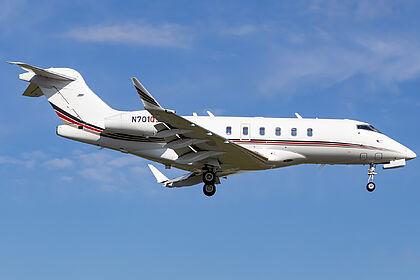
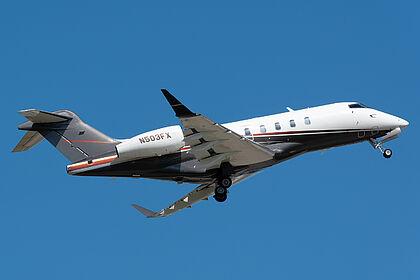
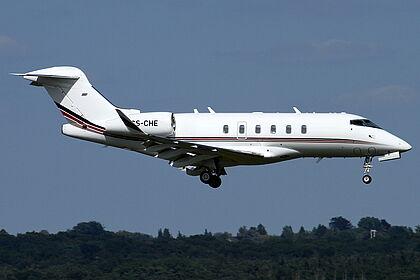
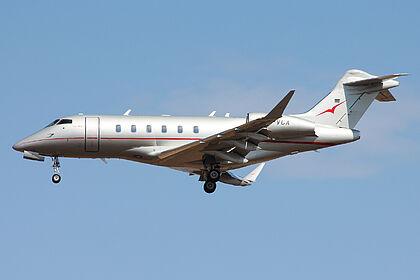
The biggest Challenger 350 fleets belong to fractional and membership programs. Flexjet put the first Challenger 300 into service and was the biggest operator of the 300 and 350 at the end of 2015; its jets carry N-numbers ending in FX. NetJets was the 350's launch customer and flies it in the United States under QS registrations and in Europe under Portuguese CS-CH marks. VistaJet's silver-and-red 350s are registered in Malta as 9H-VC, and Vista's 2026 order for 40 Challenger 3500s keeps the type at the core of that fleet. Charter firms, aircraft-management companies and corporate flight departments account for most of the rest. Aviation Week counted about three-quarters of the 300/350 fleet in North America at the end of 2015, and the range covers a US transcontinental leg nonstop, the trip the design was drawn around.
Flying on one
Many passengers meet the Challenger 350 through a fractional share, a jet card or a charter booking rather than a company airplane, because Flexjet, NetJets and VistaJet operate so many. The cabin is 25 ft 2 in long, 7 ft 2 in wide and 6 ft tall, by Bombardier's numbers, with a flat floor and no dropped aisle, so most passengers can walk upright. That is about nine inches narrower than a Challenger 650; in exchange the 350 is lighter and can cruise as high as 45,000 ft, against the 650's 41,000 ft. The usual layout is a double club, two groups of four facing seats, for eight passengers; a three-place divan can raise that to ten. Seats swivel and recline, and on the 300 and 350 all of them can berth, with some layouts lining up pairs into beds. The galley is forward, closed off on the 350 by a pocket door that also cuts noise, and the lavatory is at the back, where an optional belted seat can be fitted. The 106 cu ft baggage hold can be reached from the cabin at any time. On the 3500, Bombardier claims the quietest cabin in the class, adds a 24-inch 4K screen on the bulkhead and holds the cabin at 4,850 ft while cruising at 41,000 ft.
Variants
- Challenger 300 (CL30) — Original model, in service from January 2004 with HTF7000 engines and about 3,100 nm of range; same BD-100-1A10 type certificate, but tracked under its own code, CL30
- Challenger 350 — Certified in 2014 with canted winglets, HTF7350 engines, a 40,600 lb maximum takeoff weight and about 3,200 nm of range with eight passengers
- Challenger 3500 — In service from September 2022 with standard autothrottles, Nuage seats, a voice-controlled cabin and a 24-inch 4K display; Bombardier quotes 3,400 nm
How to spot it
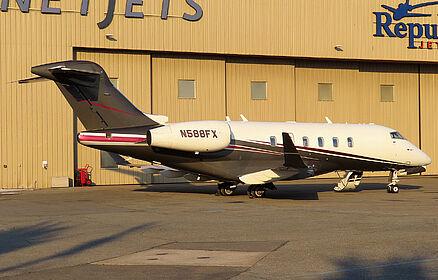
Look for a medium-size T-tail twin with two engines mounted high on the rear fuselage, a pointed nose and a long, slender wing. The winglets are the quickest way to sort the family: on the 350 and 3500 they are canted outward at a shallow angle, while the original Challenger 300 has more upright ones. A 3500 is hard to tell from a 350 from outside, so the registration settles it. The Challenger 650 is nearly the same length, about 20.9 m, but it sits on a shorter 19.6 m wing beneath a visibly fatter fuselage; the 350 has the opposite proportions, a slimmer body on a 21 m span. Dassault's Falcon 2000 mounts its horizontal tail partway up the fin rather than on top. On a tracker, a 350 or 3500 shows as CL35 and an older 300 as CL30.
Frequently asked
Why do some Challengers show as CL30 and others as CL35 on a flight tracker?
ICAO gave the original Challenger 300 the code CL30 and the later Challenger 350 the code CL35, and the Challenger 3500 uses CL35 too. All three are the same BD-100-1A10 model on the type certificate, so the code reflects the marketing variant. A CL35 on the map is therefore a Challenger 350 or 3500, delivered from 2014 onward.
What is the difference between the Challenger 350 and the Challenger 3500?
The airframe, engines and cabin dimensions are the same. The 3500, in service since September 2022, adds standard autothrottles, Bombardier's Nuage seats, a voice-controlled cabin and a 24-inch 4K display, and Bombardier quotes it at 3,400 nautical miles of range against the 350's 3,200 with eight passengers. From outside the two are very hard to tell apart.
How far can a Challenger 350 fly nonstop?
Bombardier's 350 brochure gives 3,200 nautical miles with eight passengers at a long-range cruise of Mach 0.80, under NBAA IFR reserves; for the 3500 the company quotes 3,400 nautical miles. That is comfortably enough to cross the continental United States in one hop, which was the design target. Real trips are shorter when winds, weather or a full cabin and baggage hold cut into the margin.
Is the Challenger 350 a smaller version of the Challenger 650?
No. The 350 descends from the Challenger 300, a clean-sheet design of the late 1990s with Honeywell engines and a narrower cabin, while the 650 comes from the Canadair Challenger 600 of 1978 and uses General Electric CF34s. They share a brand, not a fuselage, and they carry different ICAO codes: CL35 and CL60.
How many passengers does a Challenger 350 carry?
Eight is typical, in two facing clubs of four, and Bombardier offers layouts for up to ten with a three-place divan. The Transport Canada type certificate allows up to 16 passengers in a high-density cabin, but executive layouts stop at about ten. Two pilots fly it.
What aircraft is CL35?
CL35 is the ICAO type designator for the Bombardier Challenger 350, a Bombardier business jet that first flew in 2013. It is the code flight trackers and air traffic control use.
What is the wingspan of the Bombardier Challenger 350?
The Bombardier Challenger 350 has a wingspan of 21 m (69 ft) and is 20.92 m (69 ft) long.
What engines does the Bombardier Challenger 350 have?
Two Honeywell HTF7350.
What is the MTOW and range of the Bombardier Challenger 350?
Maximum takeoff weight is 18,416 kg (40,600 lb) and maximum range is about 3,400 nautical miles (6,297 km) at a cruise of Mach 0.8.
How many passengers does the Bombardier Challenger 350 carry?
Typically 8 people including the pilot.
Compare with
Specs are approximate, compiled from public sources. See our editorial policy.