Cessna Citation X (C750)
Cessna · Business jet · Production ended
C750 is the ICAO aircraft type code for the Cessna Citation X, a Cessna business jet that first flew in 1993 and entered service in 1996. It typically carries 8 people, cruises at Mach 0.92, and has a range of about 3,460 nautical miles (6,408 km).
Loading live positions…
In the wild
History
By 1990 the top of the Citation range was the Model 650 family, the Citation III, VI and VII, and Cessna wanted to shed a reputation. The first Citations of the 1970s had been designed to be practical and easy to fly, and next to Learjets they were slow. The slow image stuck even after later Citations caught up. When Cessna's customer advisory council asked for more speed, the answer grew into a new airplane. Cessna announced the Model 750 Citation X at the NBAA convention in New Orleans in October 1990. The X is the Roman numeral ten.
Only the Citation III's fuselage cross-section carried over. The X had a new wing, tail, landing gear and systems, and an engine from Allison, the GMA 3007, selected in September 1990. Rolls-Royce bought Allison in 1995, so the X entered service as the first Cessna with Rolls-Royce engines. The engine was flight-tested from August 1992 on a Model 650 Citation testbed that flew with mismatched engines: a standard Garrett TFE731 on one side and the much larger AE3007 on the other. The prototype X first flew on December 21, 1993.
Certification, first planned for August 1995, took longer. Jane's All the World's Aircraft listed the problems: integrating the avionics and engines, flameouts at high altitude and low speed, bird-strike requirements and directional stability. Cessna then sought about 800 lb more maximum takeoff weight so the jet could carry seven passengers with full fuel, and it struggled to balance cabin soundproofing against the extra weight. The FAA certified the X on June 3, 1996, and the first customer airplane was delivered that July. Its design team received the Collier Trophy for 1996.
Fleet operators bought it for speed. NetJets ordered 60 and later 21 more. XOJET placed a $600 million order for 30 in September 2007, and Cessna's 5,000th business jet, delivered to XOJET that December, was a Citation X. Aircraft delivered after January 2002 got AE3007C1 engines with about 5 percent more thrust and a 400 lb higher takeoff weight. Winglet Technology's elliptical winglets became available as a retrofit in 2009, and from 2011 Honeywell's Primus Elite replaced the five CRT displays with LCD screens.
In October 2010 Cessna announced a deeper update as the Citation Ten. It was certified and sold as the Citation X+, with AE3007C2 engines, a Garmin G5000 cockpit with autothrottles, standard winglets and a cabin about 15 in longer. FAA high-speed testing in 2013 confirmed a Mach 0.935 limit, beating the Gulfstream G650's Mach 0.925, and the X+ was certified in June 2014.
The X+ sold slowly. AVweb reported that Textron delivered four in 2017, against 54 Latitudes, and noted that newer designs, Textron's own Latitude among them, were almost as fast and had more comfortable cabins. In June 2018 Textron confirmed it was ending production; by then it had delivered 314 Xs and 24 X+s. The last X+ was delivered in late 2018, closing a 22-year run of about 340 aircraft. No business jet beat its Mach 0.935 until Bombardier's Global 8000 entered service in December 2025, rated for Mach 0.95.
Specifications
- First flight
- 1993
- Entered service
- 1996
- Engines
- 2 × Rolls-Royce AE3007C/C1 (Citation X) or AE3007C2 (Citation X+)
- Typical seating
- 8 seats
- Cruise speed
- Mach 0.92
- Range
- 3,460 nm
- MTOW
- 16,601 kg
- Length
- 22.43 m
- Wingspan
- 21.08 m
- Status
- Production ended
Design notes
Almost every part of the Citation X was shaped for speed. The supercritical wing is swept 37 degrees at the quarter-chord, close to a Boeing 747's 37.5, which delays the sharp rise in drag as the airplane approaches the speed of sound. Instead of passing through the cabin, the one-piece wing is slung beneath the fuselage. That frees cabin volume and simplifies the joint. The fuselage is area-ruled for transonic flight, and the tail is a swept T-tail.
The AE3007 turbofans have a bypass ratio of about 5 to 1. That is why their nacelles look so big on a small airplane, and it helps both fuel burn and noise. Thrust grew over the life of the type: 6,442 lb on the AE3007C, 6,764 lb on the C1 and 7,034 lb on the X+'s FADEC-controlled C2.
The original cockpit used Honeywell's Primus 2000 with five CRT displays. Later Xs moved to Primus Elite LCD screens, and the X+ switched to Garmin's G5000, with three 14 in displays, touchscreen controllers and autothrottles. The winglets, standard on the X+ and a retrofit for earlier jets, were credited by their maker with about 150 nm more range, 4 to 5 percent lower fuel burn and a climb to 43,000 ft in 22 minutes instead of 26.
The certified ceiling is 51,000 ft. The X+ has a maximum cruise of 528 knots true airspeed and a 3,460 nm range, and it needs 5,250 ft of runway for takeoff at its 36,600 lb maximum weight.
Notable facts
- The wing is swept 37 degrees at the quarter-chord, nearly matching the 37.5 degrees of a Boeing 747.
- Its design team won the Collier Trophy for 1996, the year the first Citation X reached a customer.
- No business jet exceeded the X+'s Mach 0.935 limit until Bombardier's Global 8000 entered service in December 2025.
- Cessna's 5,000th business jet, delivered to the charter operator XOJET in December 2007, was a Citation X.
- Production ended in 2018 after a 22-year run of about 340 aircraft, fewer than 30 of them the X+.
Who flies it
Fractional and charter fleets made the Citation X's name. NetJets was the biggest customer, flying its Xs 1,100 to 1,200 hours a year according to BCA. XOJET, founded in 2006, built its early fleet around the type. Wheels Up also flew Citation Xs, then sold the ones it owned in early 2025 while moving its fleet to Phenom 300s and Challenger 300s. No Citation X remains on the FAA registry with NetJets' QS suffix.
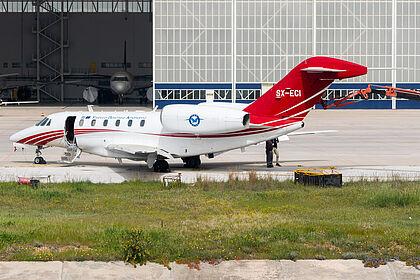
As those fleets moved on, the type passed to charter operators, smaller fleet operators and company flight departments, mostly in the United States. A few government agencies use it too; Greece's Hellenic Civil Aviation Authority, for example, has flown a Citation X registered SX-ECI. With production over, the youngest airframes in the registry are X+ models built in 2018.
Flying on one
The Citation X cabin uses the Citation III cross-section, about 5 ft 8 in tall and 5 ft 6 in wide. Many adults walk through it with a slight stoop, and it feels noticeably narrower than the 6 ft 5 in cabins of the later Latitude and Longitude. The X+ cabin is about 25 ft 2 in long, the same as a Longitude's; the original X is about 15 in shorter. Most Xs were fitted with eight seats in two club groupings, and Cessna offered the X+ with seating for up to 12.
What passengers notice is the time saved. Take a 2,000 nm leg flown at maximum cruise in still air. The X+, at 528 knots, needs about 3 hours 47 minutes; a Citation Latitude at 446 knots needs about 4 hours 29 minutes. That is roughly 40 minutes saved per trip, and more on longer legs.
Cabin noise was one of the hard problems of the original certification, when Cessna had to trade soundproofing against payload. The X+ brought new seats and Cessna's Clairity cabin management system, with a touchscreen at each seat for entertainment and climate control. With the big fractional fleets gone, a seat on a Citation X today usually means a charter booking or a company trip.
Variants
- Citation X (1996) — Original model with AE3007C engines of 6,442 lb thrust, a Honeywell Primus 2000 cockpit with five CRT screens and a Mach 0.92 limit
- Citation X (2002 update) — AE3007C1 engines with about 5 percent more thrust and a 400 lb higher maximum takeoff weight; elliptical winglets offered as a retrofit from 2009
- Citation X+ — Launched in 2010 as the Citation Ten and certified in 2014; AE3007C2 engines, Garmin G5000 with autothrottles, standard winglets, a longer cabin and a Mach 0.935 limit
How to spot it
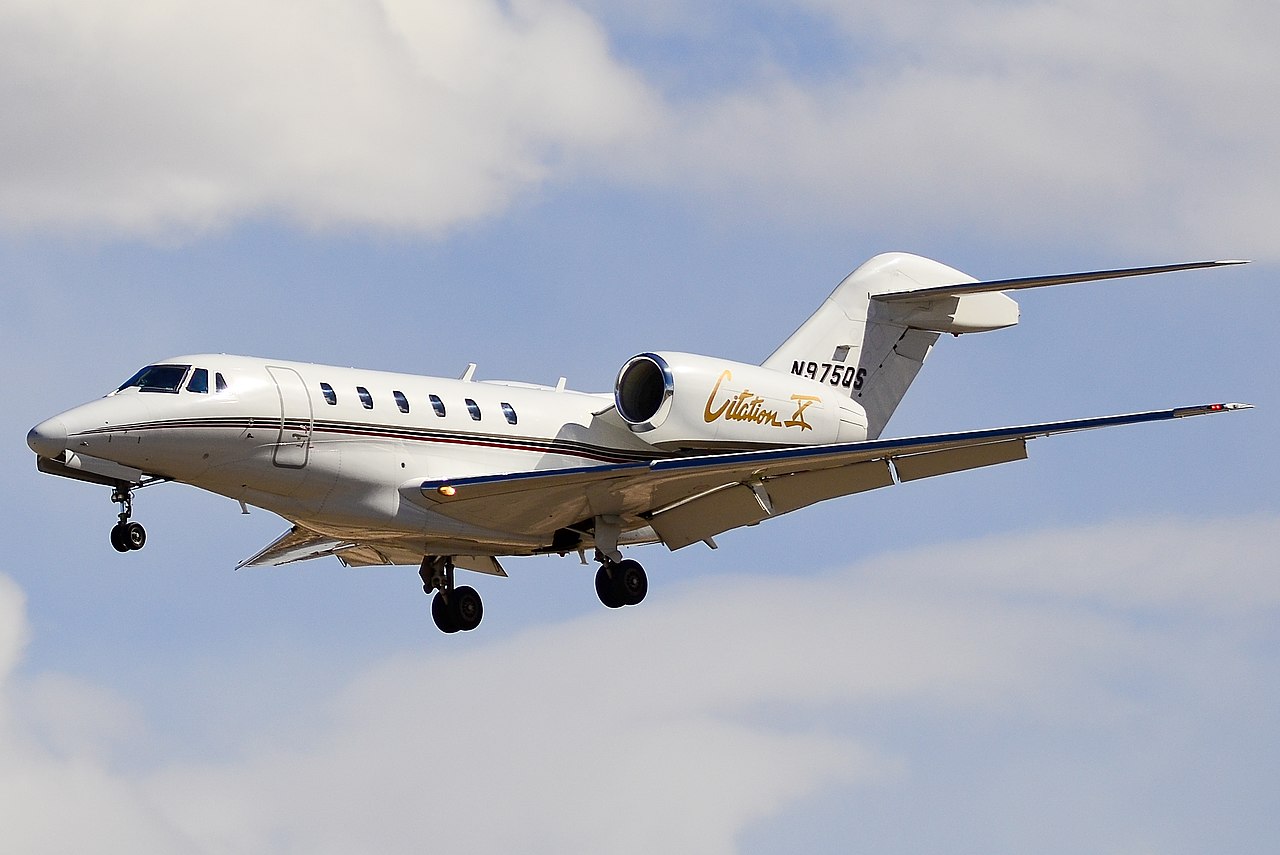
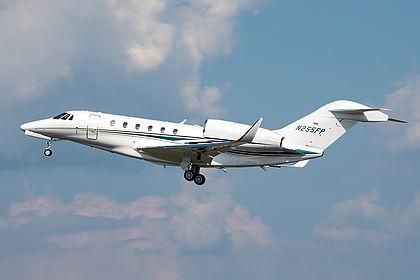
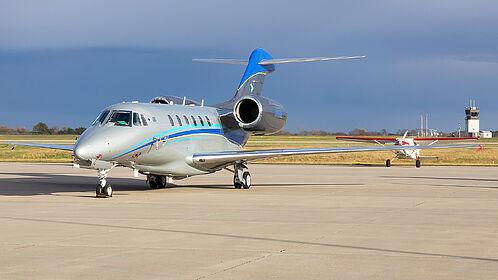
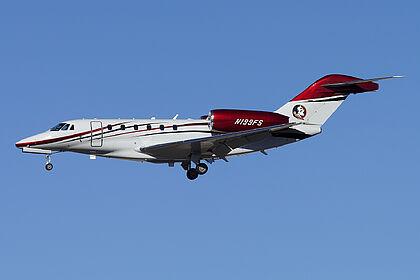
Look for a wing swept back hard, at 37 degrees, joined to the underside of a slim fuselage, so the body seems to sit on top of the wing. The two AE3007 engines are large for the airplane and mounted high on the rear fuselage, close to a sharply swept T-tail, with wide, round intakes. Original Xs have plain wingtips. The X+ and retrofitted Xs have elliptical winglets that curve upward.
The Citation Longitude also has a T-tail, but its wing is swept less and its fuselage is visibly fatter. The Latitude and Excel have their stabilizers partway up the fin. On trackers both the X and X+ show as C750. In registry data the X+ is the easy one to spot: its serial numbers start at 750-0501, while the original X ran from 750-0001 to the low 750-03xx range.
Frequently asked
Why does the Citation X show as C750 on flight trackers?
ICAO designators for Cessna jets come from the model number, and the Citation X is the Cessna Model 750. The X is the Roman numeral ten, and type-designator databases built from ICAO's list name it "750 Citation 10". The original X and the X+ both use C750.
How fast is the Citation X?
The original Citation X is limited to Mach 0.92, and the X+ to Mach 0.935, with a maximum cruise of 528 knots true airspeed. No business jet in service was faster from the X+'s 2014 certification until Bombardier's Global 8000, rated at Mach 0.95, entered service in December 2025. Gulfstream's G650 had briefly held the title in between at Mach 0.925.
Is the Citation X still in production?
No. Textron confirmed in June 2018 that it was ending production, and the last Citation X+ was delivered in late 2018. About 340 were built over 22 years, around 310 of them original Xs and the rest X+ models.
What is the difference between the Citation X and the Citation X+?
The X+, certified in 2014, has more powerful AE3007C2 engines, a Garmin G5000 cockpit with autothrottles, standard winglets and a cabin about 15 in longer. Its speed limit rose from Mach 0.92 to 0.935 and its range to 3,460 nm. Fewer than 30 X+ aircraft were built, so most C750s you see are original Xs.
Can you stand up in a Citation X?
Only if you are shorter than about 5 ft 8 in. That is the cabin height, from the same cross-section as the older Citation III, so taller passengers stoop slightly in the aisle. Cessna's later Latitude and Longitude have 6 ft cabins.
What replaced the Citation X?
Textron built no direct successor with the same speed. The Citation Longitude, certified in 2019, became Cessna's flagship instead. It is slower, limited to Mach 0.84, but has a taller, wider cabin and 3,500 nm of range.
What aircraft is C750?
C750 is the ICAO type designator for the Cessna Citation X, a Cessna business jet that first flew in 1993. It is the code flight trackers and air traffic control use.
What is the wingspan of the Cessna Citation X?
The Cessna Citation X has a wingspan of 21.08 m (69 ft) and is 22.43 m (74 ft) long.
What engines does the Cessna Citation X have?
Two Rolls-Royce AE3007C/C1 (Citation X) or AE3007C2 (Citation X+).
What is the MTOW and range of the Cessna Citation X?
Maximum takeoff weight is 16,601 kg (36,599 lb) and maximum range is about 3,460 nautical miles (6,408 km) at a cruise of Mach 0.92.
How many passengers does the Cessna Citation X carry?
Typically 8 people including the pilot.
Compare with
Specs are approximate, compiled from public sources. See our editorial policy.