Boeing 747-200 (B742)
Boeing · Four-Engine · Production ended
B742 is the ICAO aircraft type code for the Boeing 747-200, a Boeing four-engine widebody airliner that first flew in 1970 and entered service in 1971. It typically carries 366 passengers in a two-class layout, cruises at Mach 0.84, and has a range of about 6,560 nautical miles (12,149 km).

Loading live positions…
In the wild
History
The 747-200 is the 747 that made the jumbo jet work. The original 747-100 of 1970 was heavier than planned and its Pratt & Whitney JT9D engines were troubled, so Boeing quickly developed a version with more fuel, stronger structure and more thrust. The 747-200B first flew on October 11, 1970 and entered service with KLM in February 1971; over the next twenty years it became the long-haul flagship of nearly every major airline outside the United States.
What the -200 added was range and choice. Its maximum takeoff weight rose from 333 tons to 378 tons, and with later JT9D versions it could fly 6,500 nautical miles with a full cabin, enough for Europe to the US West Coast or Tokyo nonstop. In 1972 Boeing offered General Electric's CF6-50 as an alternative engine and in 1975 Rolls-Royce's RB211-524, so British Airways, Qantas and others could buy British engines. The freighter 747-200F, with the opening nose of the original 747F, became the backbone of air cargo for Lufthansa, Cargolux, Air France and the integrators; the 747-200C was convertible and the -200M Combi carried freight on the rear main deck behind passengers.
Boeing built 393 747-200s between 1971 and 1991, including the two VC-25A Air Force One aircraft delivered in 1990 and four E-4 airborne command posts. The 747-300 of 1983 was a -200 with a stretched upper deck, and the 747-400 of 1989, with a new wing, winglets and a two-crew cockpit, replaced it in production.
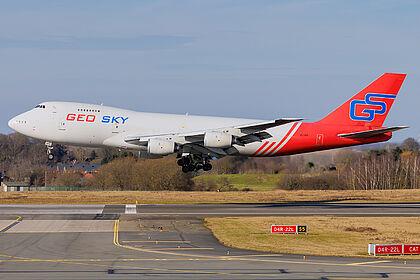
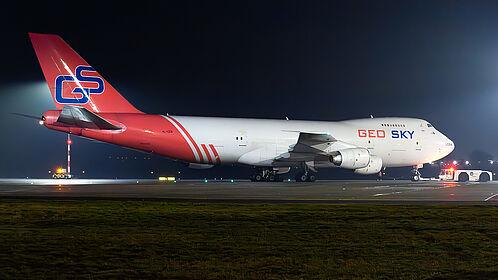
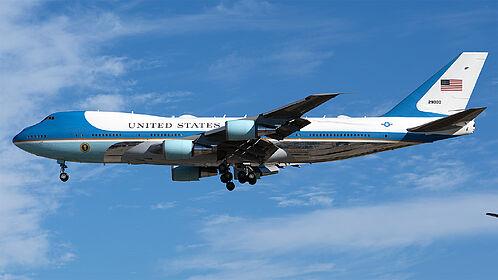
Passenger 747-200s left the big airlines in the early 2000s, flew on with second-tier operators and charter airlines, and had mostly gone by 2010. The freighters lasted longer: 747-200Fs worked for cargo airlines in Africa, the Middle East and Eastern Europe into the 2020s, and a handful, such as Georgia's Geo Sky, still fly. The military airframes are the survivors with the longest future. The four E-4B "doomsday planes" and the two VC-25A Air Force One aircraft are 747-200Bs, maintained to fly for years yet, and they are the reason the code B742 still appears on trackers; this site has a page for each.
Specifications
- First flight
- 1970
- Entered service
- 1971
- Engines
- 4 × Pratt & Whitney JT9D-7, GE CF6-50, or Rolls-Royce RB211-524
- Typical seating
- 366 (2-class)
- Cruise speed
- Mach 0.84
- Range
- 6,560 nm
- MTOW
- 377,842 kg
- Length
- 70.66 m
- Wingspan
- 59.64 m
- Status
- Production ended
Design notes
The 747-200 is structurally a 747-100 built for more weight. Boeing thickened the wing skins, strengthened the landing gear and fuselage and raised the maximum takeoff weight from 333 tons to as much as 378 tons on the final versions, with fuel capacity of about 204,000 liters. The wing span is 59.6 meters and the fuselage 70.7 meters long, with the short upper deck above the forward cabin that gives the 747 its hump; early -200s have three upper-deck windows per side, later ones ten.
The engines are the 747's original choice, four high-bypass turbofans in the 45,000- to 55,000-pound-thrust class: the Pratt & Whitney JT9D-7 series, the General Electric CF6-50 from 1972 and the Rolls-Royce RB211-524 from 1975. The landing gear has four main legs with four wheels each, 16 wheels plus the nose gear, which spread the airplane's weight across ordinary runways.
The flight deck is a three-crew layout with a flight engineer's panel, the main difference from the 747-400 that followed. The 747-200F has the hinged nose of the first 747 freighter and a strengthened main deck floor with a cargo-handling system; the Combi adds a large side door at the rear. The E-4B and VC-25A are -200Bs fitted with air-refueling receptacles, hardened electronics, satellite communications and, in the VC-25A's case, a cabin with a presidential suite and conference room.
Notable facts
- The heavier, longer-range development of the original 747-100: more fuel, stronger structure and a choice of three engine makers. First flight October 11, 1970; into service with KLM in 1971. Production ended in 1991.
- It is recognizable by the short upper deck with three windows per side (later 747-200s had ten), the same hump as the 747-100.
- Airline 747-200s are gone, but a few 747-200F freighters still fly, and the US Air Force's E-4B "doomsday planes" and the two VC-25A Air Force One aircraft are 747-200B airframes, which is why this code still appears on trackers.
- Freighter and Combi versions kept the 747-200 in service long after the passenger versions were retired.
Who flies it
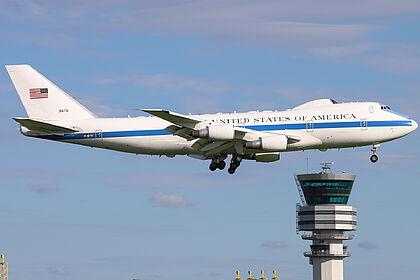
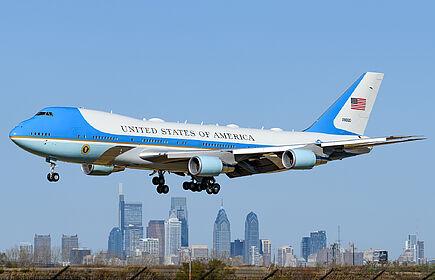
Commercial 747-200s have nearly vanished. The last passenger operators, mostly charter and Middle Eastern carriers, retired theirs in the 2010s; a few 747-200F freighters remain with operators such as Geo Sky of Georgia, flying ad-hoc cargo charters through Europe and the Middle East. The type's most important operators today are military. The US Air Force's four E-4B Nightwatch aircraft, the airborne command posts known as the doomsday planes, are 747-200Bs flown by the 1st Airborne Command Control Squadron at Offutt Air Force Base, Nebraska, and one accompanies the president on overseas trips. The two VC-25As that serve as Air Force One are also 747-200Bs, flown by the 89th Airlift Wing at Andrews. Both types will fly until their 747-8-based replacements arrive, which for the VC-25B has been delayed repeatedly.
Flying on one
Passenger 747-200s are gone, so this is history. In its day the -200 was the airplane that made long-haul flying ordinary: economy was ten-abreast in 3-4-3, often at 34 inches of pitch, with a small upper-deck lounge or first-class cabin up the spiral staircase that passengers remember more fondly than any seat. The cabin was quiet by 1970s standards and the airplane rode turbulence well because of its size. Side-block window seats and the nose section, with its wide, curved cabin and no engine noise, were the places to sit; the rows over the wing were loudest. The few people who fly on a 747-200 today do so on Air Force One or the E-4B, which is a different kind of seat map.
Variants
- 747-200B — Passenger version with increased weights and range
- 747-200F — Freighter with the opening nose
- 747-200C / -200M Combi — Convertible and mixed passenger-cargo versions
- E-4B and VC-25A — US Air Force airborne command post and Air Force One
How to spot it
The hump identifies a 747; the version takes a second look. The 747-200 has the short upper deck of the original 747, ending above the forward doors, where the 747-300 and -400 have a stretched one that reaches well back over the wing. It has no winglets, which separates it from the 747-400, and its engines are 1970s turbofans with long nacelles and visible fan cases rather than the 747-400's bigger, blunter engines. Against a 747-100 the -200 is identical in shape; upper-deck windows help, since most -200s have ten per side and most -100s three. The E-4B is in white and blue with a large radome bump on top of the upper deck and a refueling receptacle on the nose; the VC-25A is in the white, light-blue and dark-blue presidential scheme with no radome. A 747-200F has no cabin windows and a hinged nose with a visible seam.
Frequently asked
Why does Air Force One show up as a Boeing 747-200?
The two VC-25A aircraft that fly as Air Force One are Boeing 747-200B airframes, delivered in 1990, so they carry the 747-200's ICAO code B742. The E-4B doomsday planes are 747-200Bs too. Their replacements, the VC-25B, are based on the 747-8.
What is the difference between the 747-100 and the 747-200?
The -200 has a strengthened structure, more fuel and more powerful engines, raising takeoff weight from about 333 to 378 tons and range from about 4,600 to 6,500 nautical miles. The shape is the same; most -200s have ten upper-deck windows per side against the -100's three.
Are any 747-200s still flying?
A handful of 747-200F freighters, such as Geo Sky's in Georgia, plus the US Air Force's four E-4B command posts and two VC-25A Air Force One aircraft. Passenger 747-200s left airline service in the 2000s.
How many 747-200s were built?
Boeing built 393 between 1971 and 1991: passenger -200Bs, -200F freighters, -200C convertibles and -200M Combis, plus the military E-4 and VC-25A versions.
What aircraft is B742?
B742 is the ICAO type designator for the Boeing 747-200, a Boeing quad that first flew in 1970. It is the code flight trackers and air traffic control use.
What is the wingspan of the Boeing 747-200?
The Boeing 747-200 has a wingspan of 59.64 m (196 ft) and is 70.66 m (232 ft) long.
What engines does the Boeing 747-200 have?
Four Pratt & Whitney JT9D-7, GE CF6-50, or Rolls-Royce RB211-524.
What is the MTOW and range of the Boeing 747-200?
Maximum takeoff weight is 377,842 kg (832,990 lb) and maximum range is about 6,560 nautical miles (12,149 km) at a cruise of Mach 0.84.
How many passengers does the Boeing 747-200 carry?
Typically 366 passengers in a two-class layout; dense single-class layouts seat more and premium-heavy layouts fewer.
Compare with
Specs are approximate, compiled from public sources. See our editorial policy.