Boeing 777-9
B779Boeing · Widebody · In production
In the wild
History
The Boeing 777-9 is the larger of two models in the 777X programme, Boeing's re-engined and re-winged development of the 777. The company launched the 777X in 2013 with a large order book from Gulf and Asian carriers, positioning it as a successor to both the 777-300ER and the four-engine 747-8 in the very-large-aircraft segment. The programme pairs an all-new carbon-fibre composite wing with the General Electric GE9X engine and a stretched fuselage, aiming to carry more passengers than the -300ER over similar ranges while lowering fuel burn per seat. In typical layouts the 777-9 is planned to seat more than 400 passengers.
The defining engineering challenge was the wing. To gain the aerodynamic benefit of a very long, high-aspect-ratio span while still fitting existing airport gates, Boeing gave the 777-9 folding wingtips: the outer sections of each wing hinge upward on the ground, reducing the parked span to roughly that of earlier 777s before extending for flight. Building the composite wing required a large new manufacturing facility in Washington state, with spars and skins made from carbon fibre rather than aluminium. The GE9X, the sole engine, has the largest fan diameter of any commercial jet engine, at around 3.4 metres. The 777-9 first flew in January 2020 and, at about 76.7 metres long, is the longest airliner yet built.
Development proved protracted. Entry into service, originally targeted for around 2020, slipped repeatedly through the decade because of engine issues, the wider effects of the 737 MAX crisis on Boeing's certification relationships, the pandemic, and problems found during flight testing, including with a structural component. As a result, certification and first delivery ran years behind the original plan, and as of this dataset the aircraft had not yet entered widespread commercial service. Launch operator Lufthansa and Gulf carriers such as Emirates and Qatar Airways hold large orders.
Commercially the 777-9 sits at the top of the twin-engine market, above the Airbus A350-1000 and, since the end of A380 and 747 production, effectively without a direct competitor at its size. Order totals have been substantial but concentrated among a relatively small number of large network carriers, and the repeated delays led some customers to adjust or defer commitments, though most kept the type on order in anticipation of retiring older widebodies. Boeing also offers a shorter, longer-range 777-8 and a 777-8 freighter derived from the same platform. Whether the 777-9 matches the commercial reach of the -300ER will depend heavily on how quickly it enters service and how the very-large-twin market develops.
Specifications
- First flight
- 2020
- Entered service
- Not yet in service
- Engines
- 2 × General Electric GE9X
- Typical seating
- 426 (2-class)
- Cruise speed
- Mach 0.84
- Range
- 7,285 nm
- MTOW
- 351,500 kg
- Length
- 76.7 m
- Wingspan
- 71.8 m
- Status
- In production
Design notes
The 777-9's headline features are its wing and engines. The wing is an all-new carbon-fibre composite structure with a span of about 71.8 metres, giving a high aspect ratio for cruise efficiency. Because that span is too wide for many gates, the outer sections of each wing fold upward on the ground, an arrangement studied on the original 777 in the 1990s but not adopted until the 777X. Folded, the aircraft occupies roughly the same gate footprint as earlier 777s.
Power comes solely from the General Electric GE9X. Although its rated thrust is lower than the GE90-115B on the -300ER, it is physically the largest commercial jet engine by fan diameter, at around 3.4 metres, and uses a high bypass ratio and composite fan blades for lower fuel burn.
The fuselage is stretched to just under 77 metres and reprofiled internally to widen the cabin slightly, supporting a comfortable ten-abreast economy section. Boeing has adopted larger windows, a lower cabin altitude, and higher humidity, drawing on 787 experience. The flight deck keeps the general layout of the 777 to ease pilot transition while adding touchscreen displays. Much of the airframe outside the wing remains aluminium, making the 777X a hybrid of composite wing and largely metal fuselage rather than an all-composite design like the 787.
Notable facts
- The larger of the two Boeing 777X models, with composite wings, folding wingtips, and General Electric GE9X engines.
- The GE9X is the largest commercial jet engine by fan diameter (around 3.4 m).
- First flew in January 2020; at about 76.7 m it is the longest airliner ever built.
- Entry into service was repeatedly delayed through the 2020s.
- Positioned as a successor to the 747-8 and 777-300ER in the very-large-aircraft segment.
Who flies it
Because the 777-9's development ran long, its operator base is defined by orders rather than active fleets. The launch customer is Lufthansa, and the largest order books belong to Gulf carriers, principally Emirates, Qatar Airways, and Etihad, along with Singapore Airlines, Cathay Pacific, All Nippon Airways, British Airways, and Korean Air. These are overwhelmingly large network airlines that intend to use the aircraft on high-capacity long-haul trunk routes, replacing 777-300ERs and, in some cases, retired A380s and 747s. In that role it is expected to carry more than 400 passengers in typical multi-class layouts on dense intercontinental sectors. Actual in-service patterns will only become clear once deliveries begin in volume.
Flying on one
The 777-9 had not yet entered passenger service at the time of writing, so its cabin experience is still partly a promise. Boeing designed it around a slightly wider cabin than today's 777, with larger windows, a lower cabin altitude and higher humidity than the outgoing -300ER — improvements aimed squarely at long-haul comfort. Most airlines are expected to configure economy ten-abreast, as they do on the current 777, so individual seat width will again depend far more on the operator than on the airframe. The aircraft's enormous size should make for a very quiet, stable ride, and the folding wingtips that let it use normal airport gates have no bearing on the cabin. Overhead bins are expected to be generous. Until carriers publish their layouts and the type is flying passengers, specifics such as seat width and premium products remain to be confirmed; for now the promise is a roomier-feeling, quieter big twin, and the best economy seats will follow the usual rule — a window, away from the rear galleys.
Variants
- 777-8 (B778) — Shorter, longer-range 777X model
- 777-8F — Freighter version of the 777X
How to spot it
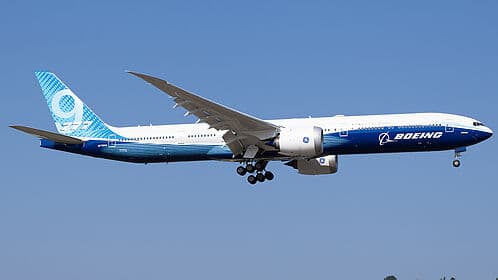
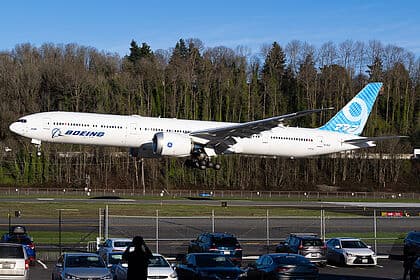
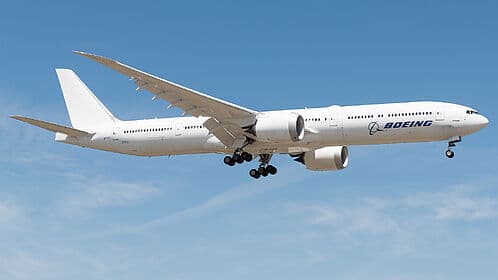
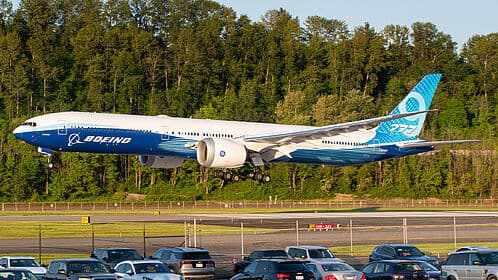
The 777-9 is unmistakable for two reasons: it is the longest airliner ever built, at nearly 77 metres, and it is the only airliner with folding wingtips, which stand vertically when the aircraft is parked. On the ground, raised tips are conclusive. In flight the very long, slender composite wing shows pronounced flex. Its GE9X engines are the largest-diameter jet engines flying, with prominent nacelles. Against the 777-300ER, the 777-9 is longer, its cabin windows are larger, and its cockpit windows are reshaped; the -300ER never has folding tips. Against the A350-1000, the 777-9 is bigger, lacks the Airbus's black cockpit-window mask and downward-curving wingtip, and rides on six-wheel main bogies rather than four-wheel units.
Frequently asked
Why does the 777-9 have folding wingtips?
The wing is long enough to improve cruise efficiency but too wide to fit standard airport gates, so the outer sections fold upward on the ground. Folded, the aircraft takes up about the same width as earlier 777s. The tips extend and lock before takeoff and fold again after landing.
Is the 777-9 in service yet?
Its entry into service was delayed repeatedly through the 2020s and ran well behind the original target. As of this dataset it had not yet entered widespread commercial service, with certification and first deliveries pushed back by engine, testing, and certification issues. Launch customer Lufthansa and several Gulf carriers are due to receive early aircraft.
How do you tell a 777-9 from a 777-300ER?
The easiest tell is the wingtips: the 777-9 folds its outer wing upward on the ground, something no 777-300ER does. The -9 is also noticeably longer, has larger cabin windows and reshaped cockpit windows, and carries the enormous GE9X engines. In flight, the -9's composite wing flexes more visibly.
How does the 777-9 compare with the Airbus A350-1000?
They are the two largest twin-engine airliners, and both target routes once flown by 747s and A380s. The 777-9 is larger, carrying more passengers, and is distinguished by folding wingtips and six-wheel main gear. The A350-1000 is lighter, has a curved wingtip and a black cockpit-window surround, and entered service years earlier.
What does the 777-9 replace?
Boeing positions it as a successor to both the 777-300ER and the four-engine 747-8, and for some operators as a replacement for the A380. It offers roughly 747-scale capacity with two engines, in line with the wider industry move to large twins. A shorter 777-8 and a freighter round out the family.
Compare with
Specs are approximate, compiled from public sources. See our editorial policy.