Airbus A220-300
BCS3Airbus · Narrowbody · In production
In the wild
History
The Airbus A220-300 began life as the Bombardier CSeries CS300, the larger of two clean-sheet narrowbody jets that the Canadian manufacturer Bombardier Aerospace developed for the market between roughly 100 and 150 seats. Bombardier formally launched the CSeries program in July 2008, positioning the smaller CS100 and the stretched CS300 to compete at the lower end of a segment long dominated by the Airbus A320 and Boeing 737 families. It was Bombardier's first venture into mainline jets, a step up from its established regional aircraft and business jets.
The CS300 first flew on 27 February 2015, following the smaller CS100's maiden flight in September 2013. The two aircraft shared engines, systems and a common cockpit, differing mainly in fuselage length. The CS100 entered service with Swiss International Air Lines in July 2016, and the CS300 followed with the Latvian carrier airBaltic in December 2016. Development ran well over budget and behind schedule, straining Bombardier's finances; in 2015 the government of Quebec agreed to invest one billion US dollars for a stake in the program.
The program then became the subject of a high-profile trade dispute. After Delta Air Lines ordered the CS100 in 2016, Boeing petitioned US authorities in 2017, alleging that Bombardier had sold the aircraft below cost and had benefited from improper government subsidies. In late 2017 the US Department of Commerce proposed combined duties of nearly 300 percent on CSeries imports. The tariffs never took effect: in January 2018 the US International Trade Commission ruled that the American industry had not been harmed, in part because Boeing did not offer a directly competing aircraft in the same size class.
While the dispute was unfolding, Airbus agreed in October 2017 to take a majority stake in the CSeries, acquiring just over 50 percent of the program's partnership for no cash payment while assuming control of sales, marketing and support. The deal closed in mid-2018, and in July 2018 Airbus rebranded the aircraft as the A220 family, with the CS100 becoming the A220-100 and the CS300 the A220-300. Airbus added a second assembly line in Mobile, Alabama, alongside the original plant at Mirabel, Quebec, partly to serve US customers.
Bombardier exited the venture in February 2020, selling its remaining interest so that ownership passed to Airbus and Quebec, with Airbus holding the controlling share. Under Airbus, the A220 has drawn substantial orders, particularly for the larger -300, from operators including Delta Air Lines, JetBlue, Air France and airBaltic. The type remains in production and is generally regarded as commercially healthier under Airbus than it had been as an independent Bombardier program, though its lengthy and costly development is often cited as a cautionary example in the industry.
Specifications
- First flight
- 2015
- Entered service
- 2016
- Engines
- 2 × Pratt & Whitney PW1500G geared turbofan
- Typical seating
- 145 (2-class)
- Cruise speed
- Mach 0.82
- Range
- 3,400 nm
- MTOW
- 70,900 kg
- Length
- 38.7 m
- Wingspan
- 35.1 m
- Status
- In production
Design notes
The A220 is a clean-sheet design rather than a derivative, which sets it apart from the re-engined narrowbodies it competes against. It is powered by two Pratt and Whitney PW1500G geared turbofans, an engine family in which a reduction gearbox lets the fan turn more slowly than the turbine that drives it, improving efficiency and lowering noise. Bombardier, and later Airbus, cited large reductions in fuel burn and noise compared with earlier-generation aircraft of similar size.
The airframe makes extensive use of modern materials, with carbon-fibre composite wings and rear fuselage and aluminium-lithium alloy in the forward fuselage, saving weight relative to conventional aluminium structures. The aircraft uses fly-by-wire flight controls and a flight deck built around five large displays.
Inside, the cabin adopts a five-abreast layout in a two-plus-three arrangement, which allows wider-than-typical economy seats and a single wider aisle for a jet of this class. The windows are notably large. The design was optimised for the shorter and medium-haul routes typical of its segment, while retaining enough range for some transcontinental and shorter transatlantic services.
The -100 and -300 share a high degree of commonality, differing chiefly in fuselage length and seating. That shared design was intended to let operators move crews, training and maintenance between the two variants with minimal difference.
Notable facts
- Began life as the Bombardier CSeries CS300 before Airbus took over the program in 2018 and renamed it.
- Clean-sheet design with a composite wing and Pratt & Whitney geared-turbofan engines.
- Its five-abreast cabin gives wider seats than typical six-abreast narrowbodies.
- The A220-100 (ICAO BCS1) is the shorter member of the family.
Who flies it
The A220 is flown by a mix of full-service and low-cost carriers, most of them operating the larger -300. Delta Air Lines is among the largest operators and uses the type on US domestic and shorter international routes; JetBlue and Breeze Airways fly it in the United States, while Air France, Swiss, airBaltic and Korean Air are among the international users. airBaltic in particular has built much of its fleet around the -300.
Airlines typically deploy the A220 on thinner routes that do not justify a larger single-aisle jet, and on longer domestic and regional sectors where its range and economics suit lower-density demand. The aircraft is assembled at Mirabel in Quebec and at Mobile in Alabama, and it remains in production and in active service worldwide.
Flying on one
The A220 is a small aircraft with a big secret: it may be the most comfortable narrowbody economy cabin flying. Its clever trick is an asymmetric five-abreast layout — two seats on one side of the aisle, three on the other — rather than the usual six. That makes the seats unusually wide for a single-aisle jet, commonly around eighteen and a half inches, and on the two-seat side there is no middle seat to negotiate at all. Add large windows, quiet geared-turbofan engines, tall ceilings, generous overhead bins and modern LED lighting, and the cabin feels a class above the 737 and A320. For the best seat, book the two-seat side — the A/C pair — for a window and an aisle with only one neighbour and no middle-seat lottery. Even the middle seat on the three-seat side is more bearable here than on rival types, and the whole cabin is quieter than travellers expect from something this size.
Variants
- A220-100 (BCS1) — Shorter fuselage, roughly 110–135 seats
How to spot it
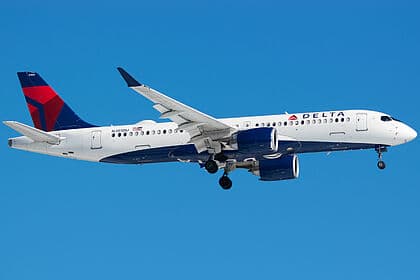
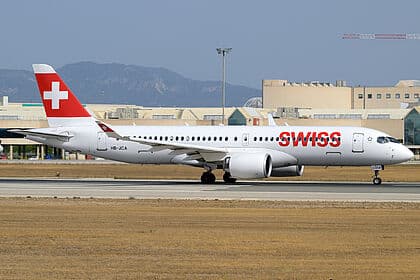
The A220 is a slim single-aisle jet with a distinctive drooping, pointed nose and relatively tall, spindly main landing gear. Its two Pratt and Whitney geared turbofans are large in diameter for the airframe's size. Inside, the tell-tale is the five-abreast two-plus-three cabin, wider than the Embraer E-Jet family's four-abreast layout.
Against the Embraer E190-E2 and E195-E2, which occupy a similar market, the A220 is larger, has that pronounced nose droop, and seats five across rather than four. Against the Airbus A319 and Boeing 737, the A220 is visibly slimmer and shorter, with a different nose profile and larger cabin windows. Distinguishing the longer -300 from the shorter -100 comes down to fuselage length.
Frequently asked
Why was the Bombardier CSeries renamed the A220?
Airbus took a majority stake in the CSeries program in 2018 and rebranded the family as the A220 in July of that year. The CS100 became the A220-100 and the CS300 became the A220-300. Airbus assumed sales, marketing and product support while manufacturing continued in Canada.
What is the difference between the A220-100 and A220-300?
The two share engines, systems and a common cockpit and differ mainly in fuselage length. The -300 is the longer, higher-capacity variant, typically seating around 130 to 150 passengers in two classes, while the -100 is shorter and seats fewer. The -300 has proved the more popular of the two.
Who builds the A220 today?
The A220 is built by Airbus Canada, a partnership controlled by Airbus with the government of Quebec as minority owner after Bombardier exited in 2020. Final assembly takes place at Mirabel in Quebec and at a second line in Mobile, Alabama, in the United States.
What engines does the A220 use?
It is powered by two Pratt and Whitney PW1500G geared turbofans. The geared design allows the fan to spin more slowly than the driving turbine, which improves fuel efficiency and reduces noise compared with conventional turbofans.
Did Boeing's proposed tariffs on the CSeries ever take effect?
No. Although the US Department of Commerce proposed duties of nearly 300 percent in 2017, the US International Trade Commission ruled in January 2018 that the American industry had not been harmed, so no duties were imposed. A contributing factor was that Boeing did not build a directly competing aircraft in the same size class.
Compare with
Specs are approximate, compiled from public sources. See our editorial policy.