Boeing 777-200/200ER (B772)
Boeing · Widebody · Production ended
B772 is the ICAO aircraft type code for the Boeing 777-200/200ER, a Boeing widebody airliner that first flew in 1994 and entered service in 1995. It typically carries 314 passengers in a two-class layout, cruises at Mach 0.84, and has a range of about 7,065 nautical miles (13,084 km).

Loading live positions…
In the wild
History
The 777-200 is where the 777 began, and the way it was designed changed how Boeing builds airliners. In the late 1980s the company needed something between the 767 and the 747, and after a false start with a stretched 767 it opened a clean-sheet program in 1990 with United Airlines as launch customer. Unusually, Boeing brought eight airlines into the design process from the start, a program it called "Working Together," so cabin widths, galley positions and maintenance access were argued over with the people who would operate the airplane. It was also Boeing's first airliner designed entirely on computer, without a physical mock-up, and its first with fly-by-wire flight controls.
The first 777-200 flew on June 12, 1994 and entered service with United on June 7, 1995, London to Washington. From day one it was approved for 180-minute ETOPS, which no airliner had achieved at entry into service; that approval, and the engines' reliability, let the 777 take over ocean routes that had belonged to the 747, the DC-10 and the MD-11.
The basic 777-200 was built for US domestic and regional international flying. The version most airlines wanted was the 777-200ER, originally called the 777-200IGW for "increased gross weight," which added fuel and structural strength for about 7,000 nautical miles of range. British Airways put the first one into service in February 1997, and over the next decade it became the standard long-haul twin for carriers like United, American, Air France, Singapore Airlines and Emirates. Airlines chose between three engines, the GE90, the Pratt & Whitney PW4000 and the Rolls-Royce Trent 800, a choice Boeing never offered again on later 777s.
Boeing built 88 basic 777-200s and 422 777-200ERs, the last of them in 2013. The stretched 777-300 and the much longer-range 777-200LR and 777-300ER followed, and it was those later versions, especially the -300ER, that made the 777 the best-selling widebody of its generation. Many 777-200ERs are now in their third decade. A number have been retired or parked since 2020, some have been converted to freighters, but others remain on front-line service with the airlines that bought them new, carrying the dense long-haul cabins that still make the type economic.
Specifications
- First flight
- 1994
- Entered service
- 1995
- Engines
- 2 × GE90-76B/-94B, Pratt & Whitney PW4077/PW4090, or Rolls-Royce Trent 877/895
- Typical seating
- 314 (2-class)
- Cruise speed
- Mach 0.84
- Range
- 7,065 nm
- MTOW
- 297,550 kg
- Length
- 63.73 m
- Wingspan
- 60.93 m
- Status
- Production ended
Design notes
The 777 introduced a fuselage cross-section about 6.2 meters wide, between the 767 and the 747, which lets airlines fit nine or ten seats across in economy. The cabin is the reason the type won so many orders: it is wide enough for ten-abreast economy and large enough for the premium cabins long-haul airlines sell.
Everything about the airframe was sized for the biggest turbofans then imaginable. The GE90 that launched with the 777 had a fan over three meters across, and the engines hang well forward on a wing with a 60.9-meter span and large, double-slotted flaps. Each main landing gear leg carries six wheels on three axles, the first six-wheel bogie on an airliner, which spreads the weight so the 777 can use runways built for lighter jets; the rear axle steers to reduce tire scrubbing in turns.
The flight deck has fly-by-wire controls that keep a conventional control column rather than Airbus-style sidesticks, with the computers providing envelope protection that pilots can override with force. Composites account for about nine percent of the structure, used in the floor beams, the tail and the control surfaces. Where the -200 and -200ER differ is weight and fuel: the ER's higher maximum takeoff weight and larger fuel capacity come with strengthened landing gear and structure, and the GE90-94B, PW4090 and Trent 895 engines rated for it.
Notable facts
- The original 777: first flight June 12, 1994, and into service with United Airlines in June 1995. The 777-200ER, with more fuel and higher weights, followed with British Airways in February 1997 and became the long-haul workhorse of the 2000s.
- Boeing designed it with eight airlines in the room (the "Working Together" program), and it was the first Boeing airliner with fly-by-wire controls.
- It entered service already approved for 180-minute ETOPS, the first airliner to do so, which let a twin fly the ocean routes that had needed three or four engines.
- The figures here are for the 777-200ER; the basic 777-200 has a 247-ton takeoff weight and about 5,240 nautical miles of range. The 777-200LR and the 777F carry their own code, B77L.
Who flies it
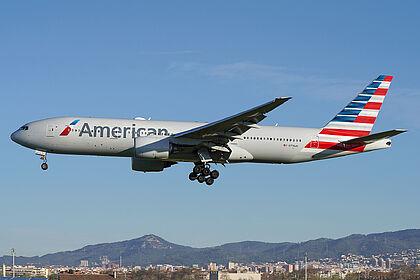
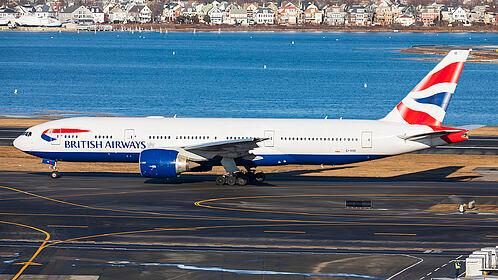
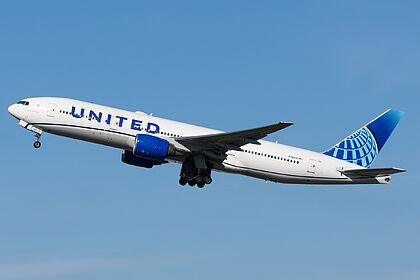
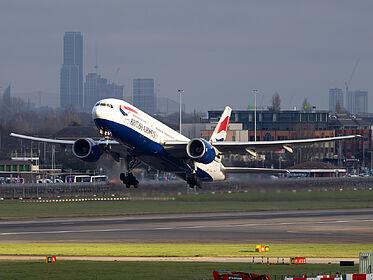
The 777-200ER is still a working long-haul airliner, though no longer a growing one. United Airlines and American Airlines fly the largest fleets in the United States, using them on transatlantic, transpacific and Hawaii routes and, in United's case, on dense domestic trunk routes as well. British Airways keeps a large fleet at Heathrow and Gatwick, and the type remains in service with carriers such as Air France, Austrian, Asiana and several Middle Eastern and Asian airlines. Omni Air International and other charter operators fly ex-airline examples on government and military contracts. Freighter conversions by Israel Aerospace Industries and Mammoth Freighters are giving some airframes a second career. Early GE90-powered 777-200s are mostly gone; the basic -200 survives mainly with United.
Flying on one
Economy on a 777-200ER depends on which decade the airline configured it in. Original layouts were nine-abreast in 3-3-3 with seats around 18.5 inches wide, the most comfortable long-haul economy of the 2000s. Most airlines have since moved to ten-abreast 3-4-3, which shaves the seat to about 17 inches and makes the aisle seats on the center block the ones to want. Check the seat map before booking: nine-across 777-200ERs still exist, notably at some Asian carriers, and the difference is real on a twelve-hour flight. The cabin is quiet for its age, with the Trent and PW4000 versions slightly quieter in the back than GE90 aircraft. Overhead bins are generous. Over the wing the ride is smoothest; the rear rows sit behind the wing and feel more turbulence. Premium cabins vary wildly, from 1990s angled-flat seats on older fleets to fully refitted suites, so the airline and the specific aircraft matter more than the type.
Who flies it, and how
3 airline cabin layouts of the Boeing 777-200/200ER in our dataset — expand any to see the cabin breakdown and seat map.
Austrian777-200ER330 seats32J · 40W · 258Y
- Business (Business): 32 seats, 2-2-2 across
- Premium Economy (Premium Economy): 40 seats, 2-4-2 across
- Economy (Economy): 258 seats, 3-4-3 across
Cabin counts from public fleet records (checked 2026-10-28); abreast layout is the type's standard configuration.
United777-200 Domestic (High-density)364 seats28F · 336Y
- First (United First): 28 seats, 2-4-2 across
- Economy (Economy Plus): 102 seats, 3-4-3 across
- Economy (United Economy): 234 seats, 3-4-3 across
Two-cabin US-domestic 777-200 (no Polaris); the 28 front seats are marketed as United First. All 19 non-ER 777-200s carry this 364-seat config. A small 4-aircraft ex-777-200ER domestic sub-batch differs: 32F / 124 Economy Plus / 206 Economy = 362. Type retirement expected mid-decade.
United777-200 International (Polaris)276 seats50J · 24W · 202Y
- Business (Polaris): 50 seats, 1-2-1 across
- Premium Economy (United Premium Plus): 24 seats, 2-4-2 across
- Economy (Economy Plus): 46 seats, 3-4-3 across
- Economy (United Economy): 156 seats, 3-4-3 across
International 777-200ER with Polaris + Premium Plus (aeroLOPA code 77E; ~51 aircraft). Distinct subfleet from the 2-cabin domestic 777-200. Economy is 10-abreast 3-4-3. Fleet is slated for retirement/replacement later this decade.
Variants
- 777-200 — The 1995 original, built for US domestic and regional routes
- 777-200ER — Extended range, the version most airlines bought; same ICAO code
- 777-200LR / 777F — Longer-range and freighter versions, listed under B77L
How to spot it
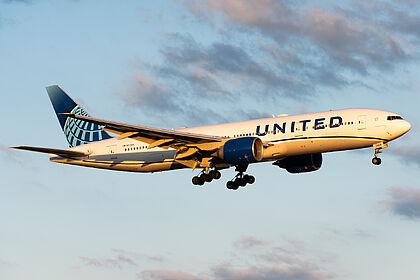
Start with the main landing gear: six wheels per leg, three axles, something only the 777 and the A350-1000 have. The 777 then has a conventional swept wing with no winglets and a blade-like tail cone that ends in a flattened wedge rather than a point. Telling the -200 and -200ER apart from the ground is not possible; they share the same 63.7-meter fuselage, and only the registration gives it away. Against the stretched -300 the -200 is noticeably shorter in proportion to its wingspan, with eight main doors instead of ten. Against the 777-300ER, the ER lacks the raked wingtips. The engines help narrow the operator: GE90s are the largest, Trent 800s have a visible spinner cone, PW4000s sit between them.
Frequently asked
What is the difference between the 777-200 and the 777-200ER?
Weight and fuel. The 777-200ER carries about 45 tons more at takeoff and holds more fuel, which stretches its range from roughly 5,200 to about 7,000 nautical miles. The fuselage, wing and cabin are the same, so you cannot tell them apart by eye. Both share the ICAO code B772.
Is the 777-200ER the same as the 777-200LR?
No. The 777-200LR, which came in 2006, has the raked wingtips, GE90-110B engines and extra fuel tanks of the 777-300ER, and can fly about 8,500 nautical miles. It carries its own ICAO code, B77L, which it shares with the 777 freighter.
Which engines does the 777-200 have?
Airlines chose one of three: the General Electric GE90, the Pratt & Whitney PW4000-112 or the Rolls-Royce Trent 800. All three were offered on both the -200 and the -200ER. Later 777s, from the -200LR and -300ER on, are GE90-only.
Are 777-200s still flying?
Yes. United, American and British Airways fly large 777-200ER fleets, and the type remains in service with several other airlines and charter operators. Numbers are falling as 787s and A350s arrive, and some retired aircraft are being converted to freighters.
How many 777-200s were built?
Boeing delivered 88 basic 777-200s and 422 777-200ERs between 1995 and 2013, out of more than 1,700 777s of all versions.
What aircraft is B772?
B772 is the ICAO type designator for the Boeing 777-200/200ER, a Boeing widebody that first flew in 1994. It is the code flight trackers and air traffic control use.
What is the wingspan of the Boeing 777-200/200ER?
The Boeing 777-200/200ER has a wingspan of 60.93 m (200 ft) and is 63.73 m (209 ft) long.
What engines does the Boeing 777-200/200ER have?
Two GE90-76B/-94B, Pratt & Whitney PW4077/PW4090, or Rolls-Royce Trent 877/895.
What is the MTOW and range of the Boeing 777-200/200ER?
Maximum takeoff weight is 297,550 kg (655,979 lb) and maximum range is about 7,065 nautical miles (13,084 km) at a cruise of Mach 0.84.
How many passengers does the Boeing 777-200/200ER carry?
Typically 314 passengers in a two-class layout; dense single-class layouts seat more and premium-heavy layouts fewer.
Compare with
Specs are approximate, compiled from public sources. See our editorial policy.