Airbus A321 (A321)
Airbus · Narrowbody · Production ended
A321 is the ICAO aircraft type code for the Airbus A321, an Airbus narrowbody airliner that first flew in 1993 and entered service in 1994. It typically carries 185 passengers in a two-class layout, cruises at Mach 0.78, and has a range of about 3,200 nautical miles (5,926 km).
Loading live positions…
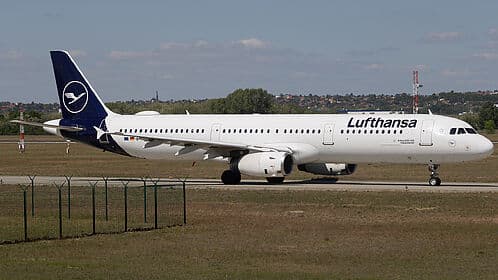
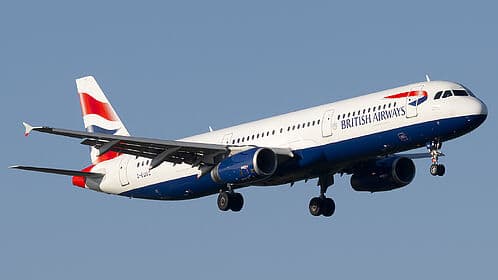
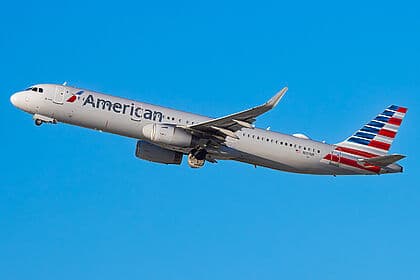
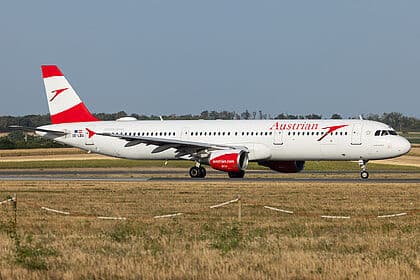
In the wild
History
The Airbus A321 was the first stretch of the A320, launched in November 1989 once the original aircraft had proved itself and airlines asked for more seats on the same cockpit. Airbus added two fuselage plugs, 4.27 m ahead of the wing and 2.67 m behind it, for a total of 6.94 m, which took the cabin from about 150 seats to roughly 185 in two classes and up to 220 in one. To carry the extra weight the wing gained double-slotted flaps, the landing gear was strengthened and the engines moved up to higher-thrust versions of the CFM56-5B and IAE V2500.
The first A321 flew from Hamburg on 11 March 1993, and Lufthansa began services in early 1994. It was also the first Airbus assembled in Germany rather than Toulouse, the start of the Hamburg final assembly line that would later build most of the family. The initial A321-100 had limited fuel capacity and range, and sales were modest until the A321-200 of 1996 added an extra centre fuel tank and higher weights, lifting range to around 3,000 nautical miles and making it a credible 757 replacement.
That replacement role defined the aircraft's second decade. As Boeing ended 757 production in 2004 without a direct successor, the A321 became the largest single-aisle on the market, and US carriers that had flown 757s on dense domestic and Caribbean routes turned to it: American, Delta, JetBlue and United all built large fleets. American and JetBlue went further, fitting lie-flat business or Mint seats for transcontinental premium service, something no other narrowbody was offering.
The re-engined A321neo of 2017, with its LR and XLR long-range versions, completed the transformation into a transatlantic aircraft, and the A321ceo ended production around 2021. Freighter conversions have since given many early A321s a second career with express operators.
Specifications
- First flight
- 1993
- Entered service
- 1994
- Engines
- 2 × CFM International CFM56-5B or IAE V2500
- Typical seating
- 185 (2-class)
- Cruise speed
- Mach 0.78
- Range
- 3,200 nm
- MTOW
- 93,500 kg
- Length
- 44.51 m
- Wingspan
- 35.8 m
- Status
- Production ended
Design notes
The A321's structure is the A320's with reinforcements: the fuselage plugs are standard frames, but the wing centre section, keel beam and landing gear were strengthened for a maximum take-off weight that grew from 83 to 93.5 tonnes across the -100 and -200. The most visible aerodynamic change is the double-slotted trailing-edge flap, needed to keep approach speeds reasonable at the higher weights, where the A320 and A319 use single-slotted flaps.
Unlike its siblings, the A321 has no overwing emergency exits; instead it carries four full-size doors per side, with the second and third pairs ahead of and behind the wing. On later aircraft Airbus offered the Cabin Flex layout, which deletes one door pair in favour of overwing exits and allows up to 240 seats on the neo. The cockpit, fly-by-wire system and sidesticks are identical to the A320, so the whole ceo family shares one type rating.
Notable facts
- The longest member of the original A320 family, stretched 6.9 m over the A320 with plugs ahead of and behind the wing.
- Uses double-slotted flaps and strengthened landing gear to handle the extra weight; it is the only ceo family member built mainly in Hamburg.
- Seats up to 220 in a single class, making it a frequent 757 replacement on dense domestic and leisure routes.
- American Airlines flies it on its transcontinental premium service with lie-flat seats, a rare use for a single-aisle.
- Succeeded by the A321neo (A21N), whose LR and XLR variants turned the type into a transatlantic aircraft.
Who flies it
American Airlines and Delta operate the world's largest A321ceo fleets, using them on dense domestic trunk routes and to Hawaii and the Caribbean; American's transcontinental A321T carries lie-flat first and business seats. JetBlue, United, Spirit and Frontier fly it in the United States, while in Europe Lufthansa, British Airways, Aer Lingus, Turkish Airlines, Wizz Air and TUI use it for leisure and trunk routes of up to four or five hours. Asian operators include China Eastern, Philippine Airlines and Vietnam Airlines. With the A321neo replacing it on front-line routes, many ceo airframes are being converted to freighters for carriers such as Qantas Freight and SmartLynx.
Flying on one
An A321 is a long walk from the front to the back, but the cabin is the familiar A320 cross-section, so the seats are the same 18-inch width in a 3-3 layout and the aisle is wider than a 737's. Airlines use the length very differently: American's transcontinental aircraft have lie-flat first and business cabins, JetBlue fits Mint suites on premium routes, while leisure carriers pack in 220 seats at 28–29 inches of pitch. Because the engines are far forward relative to the long rear cabin, the last rows are quieter than on a 737-900 but feel the tail's movement more in turbulence. The absence of overwing exits means no exit-row legroom in the middle of the cabin; the extra-legroom seats are usually at the bulkheads and the doors. For the best seat, choose a window a few rows behind the wing on a two-class aircraft, and avoid the final two rows, which back onto the lavatories and may not recline.
Who flies it, and how
3 airline cabin layouts of the Airbus A321 in our dataset — expand any to see the cabin breakdown and seat map.
AmericanA321 (Domestic)190 seats20F · 170Y
- First (First): 20 seats, 2-2 across, 37″ pitch
- Economy (Main Cabin Extra): 35 seats, 3-3 across, 34″ pitch
- Economy (Main Cabin): 135 seats, 3-3 across, 31″ pitch
Standardised domestic A321ceo 'Oasis' retrofit (20F / 170 economy). MCE/MC split of 35/135 per AeroLOPA and Wikipedia; a few sources cite 38/132.
AmericanA321T (Transcontinental)102 seats10F · 20J · 72Y
- First (Flagship First): 10 seats, 1-1 across, 63″ pitch
- Business (Flagship Business): 20 seats, 2-2 across, 43″ pitch
- Economy (Main Cabin Extra): 36 seats, 3-3 across, 35″ pitch
- Economy (Main Cabin): 36 seats, 3-3 across, 31″ pitch
Dedicated 3-cabin premium transcontinental subfleet (JFK-LAX/SFO). First is 1-1 lie-flat, Flagship Business 2-2 lie-flat. Registrations not reliably documented, so omitted per policy.
JetBlueA321ceo Mint159 seats16J · 143Y
- Business (Mint): 16 seats, 2-2/1-1 across
- Economy (Even More Space): 41 seats, 3-3 across
- Economy (Core): 102 seats, 3-3 across
Original transcon Mint: 16 open (non-suite) Mint seats laid out 2-2 with four single 'throne' seats (1-1).
Variants
- A321-100 — Launch version with lower weights and shorter range; about 90 built
- A321-200 — Higher-weight, longer-range standard with additional fuel tanks
- A321neo (A21N) — Re-engined successor; A321LR and A321XLR extend range to transatlantic distances
- A321P2F — Freighter conversion, popular with express carriers
How to spot it
The A321 is the long one. Against the A320 it is almost seven metres longer, with four full-size doors per side and no overwing exits, which is the quickest check: if you see two full doors between the wing and the tail, it is an A321. The double-slotted flaps, visible as a second hinged section when extended, are another distinguishing detail. Telling a ceo from an A321neo is harder: the neo has much larger engine nacelles (the LEAP-1A and PW1100G fans are a full metre across) and Sharklets as standard, and many neos use the Cabin Flex door layout with overwing exits that no ceo has.
Flights we've seen the Airbus A321 operate
From our own observations of notable flights — each links to the flight's status, on-time history and fares.
Frequently asked
How many seats does an A321 have?
Roughly 185 in a two-class layout and up to 220 in a single-class cabin for the ceo; the A321neo with the Cabin Flex layout is certified for 244. American's premium transcontinental A321T has only 102.
What is the difference between the A321 and the A321neo?
The A321neo is the re-engined version with LEAP-1A or PW1100G engines, Sharklets and higher weights, burning around 15–20% less fuel. Its LR and XLR variants carry extra fuel for transatlantic ranges the ceo cannot reach. On trackers the ceo is A321 and the neo is A21N.
Does the A321 replace the Boeing 757?
In practice yes for most routes. It carries a similar passenger load with lower operating costs, though the ceo lacks the 757's range and hot-and-high performance; the A321neo LR and XLR close most of that gap.
Why does the A321 have no overwing exits?
Its length requires four pairs of full-size doors to meet evacuation rules, which also allows the dense single-class layouts leisure airlines favour. The A321neo's optional Cabin Flex layout reintroduces overwing exits in place of one door pair.
What aircraft is A321?
A321 is the ICAO type designator for the Airbus A321, a Airbus narrowbody that first flew in 1993. It is the code flight trackers and air traffic control use; airlines and booking sites show it as 321.
What is the wingspan of the Airbus A321?
The Airbus A321 has a wingspan of 35.8 m (117 ft) and is 44.51 m (146 ft) long.
What engines does the Airbus A321 have?
Two CFM International CFM56-5B or IAE V2500.
What is the MTOW and range of the Airbus A321?
Maximum take-off weight is 93,500 kg (206,130 lb) and maximum range is about 3,200 nautical miles (5,926 km) at a cruise of Mach 0.78.
How many passengers does the Airbus A321 carry?
Typically 185 passengers in a two-class layout; dense single-class layouts seat more and premium-heavy layouts fewer.
Compare with
Specs are approximate, compiled from public sources. See our editorial policy.