Boeing 767-400ER (B764)
Boeing · Widebody · Production ended
B764 is the ICAO aircraft type code for the Boeing 767-400ER, a Boeing widebody airliner that first flew in 1999 and entered service in 2000. It typically carries 245 passengers in a two-class layout, cruises at Mach 0.8, and has a range of about 5,625 nautical miles (10,418 km).
Loading live positions…
In the wild

History
The Boeing 767-400ER was born of two airlines' requests and a merger that never happened. In the mid-1990s Delta and Continental wanted a larger, more modern 767 to replace their Lockheed L-1011s and McDonnell Douglas DC-10s on domestic trunk routes and across the Atlantic, something between the 767-300ER and the 777-200. Boeing answered in 1997 with a stretch of the 767-300ER: 6.4 m of extra fuselage, a strengthened wing with new raked tips, taller landing gear and the flat-panel cockpit displays of the 777.
The first 767-400ER flew on 9 October 1999 and Continental put it into service in September 2000, with Delta following a month later. It was, by the standards of the time, a modern aircraft, with a new interior, larger overhead bins and the cockpit that let 767 pilots step into the 777 family with minimal training. But the market had moved. Airlines wanted either the range of the 777 or the economics of the forthcoming 787, and the -400ER, with only marginally more range than the -300ER, found no customers beyond its two launch airlines and a single VIP order for Bahrain.
Boeing hoped a military version would rescue the line. The E-10A MC2A, a battle-management aircraft for the US Air Force with a large radar array, was based on the -400ER and a test aircraft was built, but the programme was cancelled in 2007 after the airframe had flown. Production ended with 37 aircraft, making it one of the rarest Boeing airliners of the jet age.
Rarity has not meant retirement. United inherited Continental's sixteen in the 2010 merger and refurbished them with Polaris business class, and Delta still flies its twenty-one, mostly on transatlantic and busy domestic routes. Both fleets have been scheduled for replacement by 787s and A330-900s more than once; as of 2026 they remain in daily service, the longest 767s ever built.
Specifications
- First flight
- 1999
- Entered service
- 2000
- Engines
- 2 × General Electric CF6-80C2B8F
- Typical seating
- 245 (2-class)
- Cruise speed
- Mach 0.8
- Range
- 5,625 nm
- MTOW
- 204,116 kg
- Length
- 61.37 m
- Wingspan
- 51.92 m
- Status
- Production ended
Design notes
The 767-400ER's stretch added two fuselage plugs, 3.4 m ahead of the wing and 3.0 m behind it, and the longer body required a taller main landing gear with larger wheels to keep the tail clear on rotation. The wing is the 767-300ER's strengthened structure with 2.3 m raked tips that extend the span to 51.9 m, the first use of raked wingtips on a Boeing airliner and a device that improved cruise efficiency without the ground-clearance penalty of winglets.
Inside, the -400ER introduced the 777-style interior to the 767 family, with sculpted sidewalls and larger pivot bins, and in the cockpit six liquid-crystal displays replaced the earlier 767's CRT screens, giving crews commonality with the 777. Engines are GE CF6-80C2B8F turbofans at 63,500 lb of thrust; the Pratt & Whitney and Rolls-Royce options of other 767s were never certified. Fuel capacity and range are only slightly better than the -300ER's, which is the main reason the type sold so poorly.
Notable facts
- The longest 767, stretched 6.4 m over the 767-300ER with a strengthened wing, taller landing gear and raked wingtips.
- The first Boeing airliner with raked wingtips, later used on the 777-200LR/300ER and 787.
- Only 37 were built, for Continental and Delta (plus one VIP aircraft); United inherited Continental's fleet in the 2010 merger.
- Its 777-style flat-panel cockpit displays were a first for the 767 family.
- A planned military E-10A command aircraft based on the -400ER was cancelled in 2007, ending prospects for more sales.
Who flies it
Delta Air Lines operates twenty-one 767-400ERs, configured with Delta One lie-flat seats, Premium Select and economy, on transatlantic routes from Atlanta and New York and on busy domestic trunks. United flies sixteen ex-Continental aircraft, refitted with Polaris business class, mainly between its East Coast hubs and Europe. The two fleets are the only scheduled operators; one further airframe serves as a VIP transport for the government of Bahrain. Both airlines have repeatedly pencilled in retirement dates, so the type is one to see while you can.
Flying on one
A 767-400ER is a pleasant widebody to fly on, and its cabin is the reason: the 767 fuselage was designed for 2-3-2 economy seating, so most seats are a window or an aisle and only one in seven is a middle, a layout that no newer twin-aisle offers. Seats are about 17.5 inches wide at 31–32 inches of pitch on Delta and United. The 777-style interior gives it large bins and a more open feel than older 767s, and both operators have fitted lie-flat business seats and premium economy. The CF6 engines are a touch louder than a 787's and the cabin altitude is the conventional 8,000 ft, so a long overnight is a little more tiring than on a Dreamliner. For the best seat, take a window or aisle in the side pairs ahead of the wing; the rear rows near the aft galleys see the most traffic.
Variants
- 767-400ER — The only version built; 37 airframes
- 767-300ER (B763) — The shorter, far more numerous sibling
- E-10A MC2A — Cancelled US Air Force command-and-control derivative
How to spot it
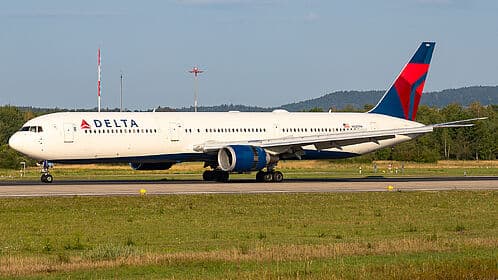
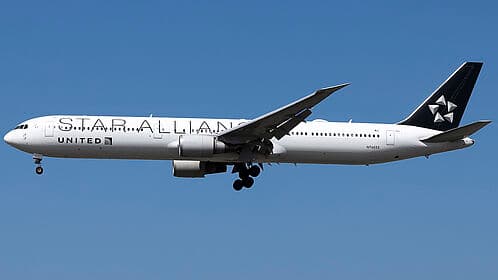
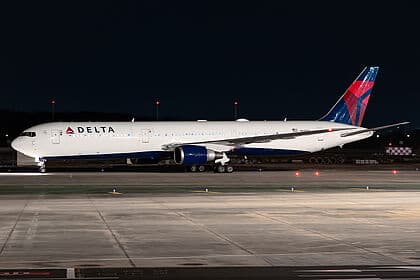
Length and wingtips are the giveaways. The 767-400ER is noticeably longer than a 767-300ER, with four full-size doors per side, and its wingtips are raked back in a sharp sweep rather than ending square or in a winglet; no other 767 has them. The main landing gear is taller, so the aircraft sits higher on the ramp with a longer nose gear too. Against a 787-9 of similar length, the 767's cockpit windows are smaller and more conventional, the engines are larger in proportion and lack chevrons, and the fuselage is slimmer. Only Delta and United liveries will be on it.
Frequently asked
Why were so few 767-400ERs built?
Timing. It arrived in 2000 with only slightly more range than the 767-300ER, just as airlines were choosing between the 777's range and the coming 787's efficiency, and only Delta and Continental ordered it. A planned military version, the E-10A, was cancelled in 2007, so production ended at 37.
Who still flies the 767-400ER?
Delta (21 aircraft) and United (16, inherited from Continental) are the only airline operators, using it on transatlantic and busy domestic routes. One aircraft is a VIP transport for Bahrain.
What is the difference between the 767-300ER and 767-400ER?
The -400ER is 6.4 m longer, seats about 30–40 more, has raked wingtips, taller landing gear and a 777-style cockpit and cabin. Range is similar; the -300ER is far more common, with more than 580 built against 37.
Is the 767-400ER being retired?
Both Delta and United have planned to replace it with 787s and A330-900s, but the dates have slipped repeatedly and the aircraft remain in daily service as of 2026.
What aircraft is B764?
B764 is the ICAO type designator for the Boeing 767-400ER, a Boeing widebody that first flew in 1999. It is the code flight trackers and air traffic control use.
What is the wingspan of the Boeing 767-400ER?
The Boeing 767-400ER has a wingspan of 51.92 m (170 ft) and is 61.37 m (201 ft) long.
What engines does the Boeing 767-400ER have?
Two General Electric CF6-80C2B8F.
What is the MTOW and range of the Boeing 767-400ER?
Maximum take-off weight is 204,116 kg (449,994 lb) and maximum range is about 5,625 nautical miles (10,418 km) at a cruise of Mach 0.8.
How many passengers does the Boeing 767-400ER carry?
Typically 245 passengers in a two-class layout; dense single-class layouts seat more and premium-heavy layouts fewer.
Compare with
Specs are approximate, compiled from public sources. See our editorial policy.