Airbus A320 (A320)
Airbus · Narrowbody · Production ended
A320 is the ICAO aircraft type code for the Airbus A320, an Airbus narrowbody airliner that first flew in 1987 and entered service in 1988. It typically carries 150 passengers in a two-class layout, cruises at Mach 0.78, and has a range of about 3,300 nautical miles (6,112 km).
Loading live positions…
In the wild
History
The Airbus A320 was the aircraft that turned Airbus from a European project into a global manufacturer. Through the 1970s the consortium had built only widebodies, the A300 and A310, and depended on a handful of launch customers. To compete with the Boeing 737 and McDonnell Douglas DC-9/MD-80 in the far larger single-aisle market, Airbus studied a family of 150-seat jets under the name JET and then SA, and in March 1984 launched the A320 with an order from Air France.
The design was deliberately ambitious. Rather than copy the 737, Airbus specified a slightly wider fuselage, a new high-technology wing, and above all a digital fly-by-wire flight control system with sidestick controllers in place of the conventional yoke, the first on a civil airliner. The flight-envelope protections built into that system, which prevent the aircraft from being stalled or over-banked in normal operation, were controversial at the time and remain the family's defining engineering choice. The prototype flew from Toulouse on 22 February 1987, and Air France put the A320 into service in April 1988.
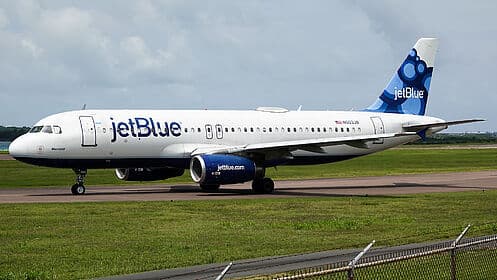
Commercially it was a slow burn and then an avalanche. Early sales came from European flag carriers and from Northwest in the United States; the launch of the stretched A321 in 1994, the shortened A319 in 1996 and the smaller A318 in 2003 turned a single aircraft into a family sharing one cockpit and type rating. That commonality let airlines size each route exactly while keeping one pool of pilots, and low-cost carriers such as easyJet and JetBlue built entire fleets around it. By the mid-2000s the A320 family was outselling the 737 in most years.
The original-engine A320, retrospectively called the A320ceo for current engine option once the A320neo was launched in 2010, received a steady stream of improvements: higher weights, the enhanced cabin, and from 2012 the blended Sharklet wingtips that cut fuel burn by around 3.5%. Production of the ceo wound down after 2021 as the neo took over the line, but with more than 4,700 A320ceos built and most still flying, it will be a common sight well into the 2030s, increasingly as a freighter conversion.
Specifications
- First flight
- 1987
- Entered service
- 1988
- Engines
- 2 × CFM International CFM56-5B or IAE V2500
- Typical seating
- 150 (2-class)
- Cruise speed
- Mach 0.78
- Range
- 3,300 nm
- MTOW
- 78,000 kg
- Length
- 37.57 m
- Wingspan
- 35.8 m
- Status
- Production ended
Design notes
The A320's cabin cross-section is the detail that matters most to passengers: at 3.95 m the fuselage is about 18 cm wider than a 737's, which gives an 18-inch seat in a six-abreast row and a noticeably wider aisle. The wing, with its moderate 25-degree sweep and a wide-chord root, was designed from the outset for the family's heavier members and carries single-slotted flaps and spoilers used for roll control as well as braking.
The fly-by-wire system has no mechanical link between the sidesticks and the control surfaces except for the rudder and horizontal stabiliser trim; five flight-control computers interpret pilot inputs within the aircraft's normal law protections. The flight deck introduced the glass-cockpit layout, with six displays and a tray table where a yoke would be, that every later Airbus has inherited, so a crew rated on the A320 converts to the A330 or A350 with only differences training.
Engines are a choice of CFM56-5B or IAE V2500, the two mounted on pylons under the wing with the characteristic flat-bottomed CFM nacelle. Later aircraft carry Sharklets, 2.4 m blended wingtips that replaced the small wingtip fences of early production.
Notable facts
- The first airliner with digital fly-by-wire flight controls and sidestick controllers, entering service with Air France in 1988.
- Its 3.95 m fuselage is about 18 cm wider than a 737's, giving an 18-inch economy seat and wider aisle that airlines still trade on.
- The A320 family passed 10,000 deliveries in 2021 and is the best-selling airliner line in history, ahead of the 737.
- Replaced on the production line by the re-engined A320neo (A20N) from 2016; thousands of ceo aircraft remain in service.
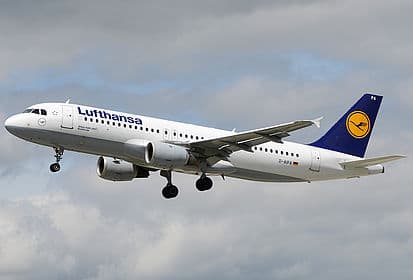
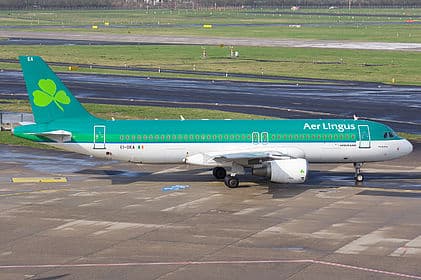
- Flown by almost every kind of carrier, from easyJet and JetBlue to Lufthansa and Air China; a frequent freighter conversion candidate.
Who flies it
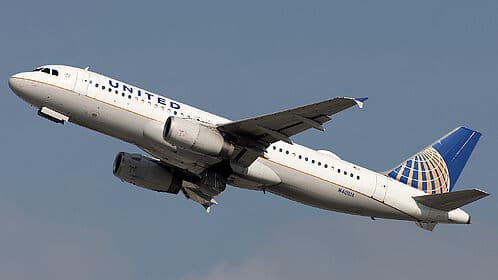
The A320ceo flies for a wider range of airlines than almost any other jet. In Europe easyJet, Lufthansa, British Airways, Air France, Iberia, Vueling and Wizz Air (which moved to the neo) all built large fleets; in the Americas it is the backbone of JetBlue, United, Delta, American, LATAM and Avianca; across Asia and the Middle East it serves Air China, China Eastern, IndiGo, AirAsia, Qatar Airways and dozens more. Typical missions are short- and medium-haul routes of one to five hours, from shuttle services between capitals to leisure flights of several hours. As the neo replaces it on mainline routes, ceo aircraft are moving to secondary operators and to passenger-to-freighter conversion programmes.
Flying on one
Flying on an A320 is the generic modern short-haul experience, with one advantage the industry has spent thirty years pointing out: the cabin is wider than a 737's. In a standard six-abreast layout that means an 18-inch seat and a wider aisle, so a full flight feels less crowded, and the overhead bins swallow a roll-aboard with room to spare on most aircraft. Legroom is entirely the airline's choice, from 28 inches on the densest low-cost layouts to 32 or more up front. The CFM56 and V2500 engines are relatively quiet and the ride is smooth for a single-aisle, though rows at the very back sit between the engines and the rear lavatories. Window seats ahead of the wing have the best views; the overwing exit rows give extra legroom but the seats do not always recline. If you are choosing between an A320 and a 737 on the same route, the Airbus seat is the wider one.
Variants
- A320-100 — Original short-range version without wingtip fences or centre tank; only 21 built
- A320-200 — The standard A320 with wingtip fences or Sharklets and higher weights
- A320neo (A20N) — Re-engined successor with LEAP-1A or PW1100G engines and Sharklets
- A320P2F — Passenger-to-freighter conversion by EFW/ST Engineering
How to spot it
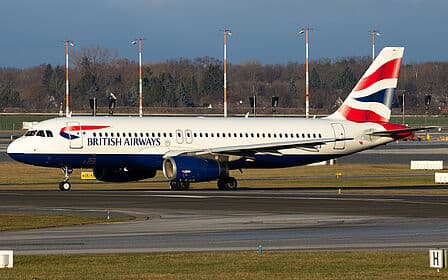
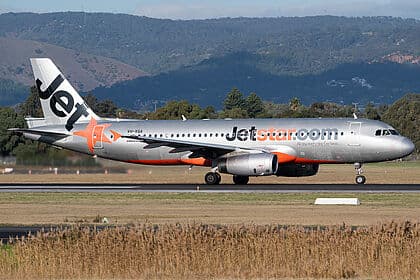
The A320 family is told apart from the 737 by its nose and tail: the Airbus nose is rounder and more blunt, the cockpit windows are smaller with a flat lower edge, and the tail cone ends in a pointed, slightly upswept shape with the APU exhaust at the tip. Under the wing, CFM56-engined A320s have a flat-bottomed nacelle, while V2500 aircraft have a rounder one. Within the family, the A320 is the middle length: it has two overwing exits per side (the A321 has none, using full-size doors instead, and the A319 has one). Sharklets, the tall blended wingtips, mark aircraft built or retrofitted since 2012; earlier aircraft have small vertical fences at the tips.
Flights we've seen the Airbus A320 operate
From our own observations of notable flights — each links to the flight's status, on-time history and fares.
Frequently asked
What is the difference between the A320 and the A320neo?
The A320neo (new engine option) is the same airframe fitted with larger, much more efficient engines, the CFM LEAP-1A or Pratt & Whitney PW1100G, plus Sharklets as standard and cabin updates. It burns roughly 15–20% less fuel per seat. The original aircraft became known as the A320ceo (current engine option). On trackers the two show as A320 and A20N.
How many passengers does an A320 carry?
Typically about 150 in a two-class layout and up to 180 in a dense single-class cabin, the certified maximum. Most European low-cost carriers use 180 or 186 (with slimline seats and the space-flex rear galley), while US carriers with a first-class cabin seat around 150.
Is the A320 safe?
Yes. It is one of the most widely flown airliners in history, with more than 10,000 family members delivered and a fatal accident rate comparable to the 737. Its fly-by-wire envelope protections, once debated, are now standard across modern airliners.
Why does the A320 have a wider cabin than the 737?
Because it was designed from scratch in the 1980s, Airbus chose a 3.95 m fuselage to beat the 737's 3.76 m cross-section, which dates from the 1960s 707 and 727. The extra width goes into a slightly wider seat and aisle rather than more seats.
What aircraft is A320?
A320 is the ICAO type designator for the Airbus A320, a Airbus narrowbody that first flew in 1987. It is the code flight trackers and air traffic control use; airlines and booking sites show it as 320.
What is the wingspan of the Airbus A320?
The Airbus A320 has a wingspan of 35.8 m (117 ft) and is 37.57 m (123 ft) long.
What engines does the Airbus A320 have?
Two CFM International CFM56-5B or IAE V2500.
What is the MTOW and range of the Airbus A320?
Maximum take-off weight is 78,000 kg (171,959 lb) and maximum range is about 3,300 nautical miles (6,112 km) at a cruise of Mach 0.78.
How many passengers does the Airbus A320 carry?
Typically 150 passengers in a two-class layout; dense single-class layouts seat more and premium-heavy layouts fewer.
In-depth comparisons
Compare with
Specs are approximate, compiled from public sources. See our editorial policy.