Airbus A319 (A319)
Airbus · Narrowbody · Production ended
A319 is the ICAO aircraft type code for the Airbus A319, an Airbus narrowbody airliner that first flew in 1995 and entered service in 1996. It typically carries 124 passengers in a two-class layout, cruises at Mach 0.78, and has a range of about 3,750 nautical miles (6,945 km).
Loading live positions…
In the wild
History
The Airbus A319 is the A320 shortened by seven frames, 3.73 m in all, to seat around 124 passengers in two classes. Airbus launched it in June 1993 after lessor ILFC committed to the type, and the first aircraft flew from Hamburg on 25 August 1995. Swissair introduced it in April 1996, and it quickly became the family's second-best seller behind the A320 itself.
The design logic was commonality. The A319 kept the A320's wing, engines, landing gear and cockpit, so an airline could add a smaller aircraft to its fleet without new pilots, spares or training, and could swap aircraft between routes as demand shifted. Because it carried the full A320 wing and fuel capacity on a lighter airframe, it also had the longest range in the family, which made it attractive for thin long routes and, in the form of the ACJ319, as a corporate jet able to cross the Atlantic.
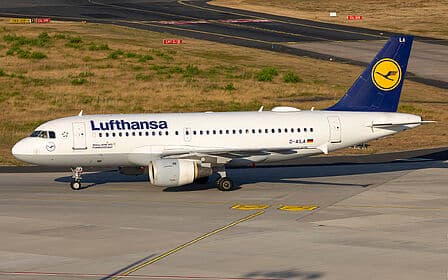
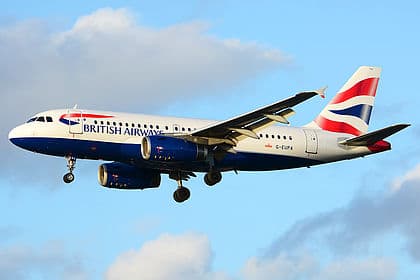
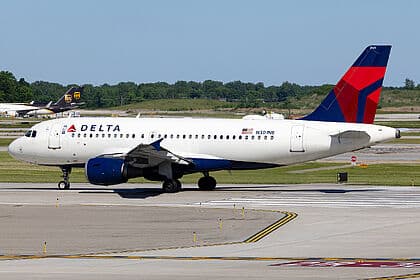
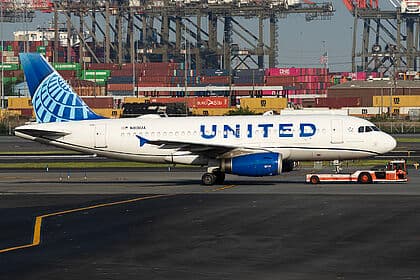
Low-cost carriers made it a mass-market aircraft. easyJet ordered 120 in 2002 and eventually flew more than 150, configured with 156 seats and an extra pair of overwing exits, and Frontier, Spirit and US Airways built large American fleets. Mainline carriers used it on their thinnest routes, and Air Canada, Lufthansa, British Airways and Delta all operated dozens.
Its decline came from both ends. From the late 2000s airlines found the A320's extra 30 seats cost almost nothing more to fly, and later the A220 arrived as a purpose-built small aircraft with a lower per-seat cost. The A319neo, launched with the rest of the neo family, attracted only a handful of orders. Production of the A319ceo ended around 2020 after roughly 1,480 deliveries; many are now with second-tier operators or converted for cargo and corporate use.
Specifications
- First flight
- 1995
- Entered service
- 1996
- Engines
- 2 × CFM International CFM56-5B or IAE V2500
- Typical seating
- 124 (2-class)
- Cruise speed
- Mach 0.78
- Range
- 3,750 nm
- MTOW
- 75,500 kg
- Length
- 33.84 m
- Wingspan
- 35.8 m
- Status
- Production ended
Design notes
Shortening the A320 was straightforward structurally: Airbus removed four frames ahead of the wing and three behind, keeping the wing box and centre section unchanged. That left the A319 with the same 35.8 m wing (with Sharklets) and the same engines, de-rated for the lighter weight, so take-off and climb performance is lively and the aircraft is comfortable at short, high-altitude airfields.
The cabin has one overwing exit per side in the standard layout, with a second pair added on high-density aircraft for easyJet and others. The ACJ319 corporate version adds up to six auxiliary fuel tanks in the hold, giving a range beyond 6,000 nautical miles with a small payload. The flight deck and fly-by-wire system are identical to the A320 and A321.
Notable facts
- A shortened A320 (3.73 m less fuselage) that keeps the same wing, engines and cockpit, so pilots fly all three on one rating.
- With the full A320 wing on a lighter airframe it has the longest range of the ceo family, which is why it underpins the ACJ319 corporate jet.
- Swissair was the launch customer in 1996; easyJet later operated one of the world's largest A319 fleets with a 156-seat layout.
- The A319neo (A19N) found few buyers, as airlines moved up to the A320neo and the A220 took the smaller segment.
- Several have been converted to the ACJ319 and to freighters; many ex-mainline A319s now fly with leisure and regional operators.
Who flies it
American Airlines operates the largest remaining A319 fleet in the United States, inherited from US Airways, alongside Delta and United; Frontier and Spirit have moved on to larger neos. In Europe British Airways, Lufthansa, easyJet (reducing), Air France and Iberia still fly it on domestic and short international routes, and many have migrated to carriers such as Volotea, Tibet Airlines and Eurowings. Corporate and government ACJ319s fly worldwide. Typical duties are short- and medium-haul routes where 120–150 seats is the right size, often to airports with shorter runways or at altitude.
Flying on one
Inside, an A319 is simply a shorter A320: the same wide cabin, 18-inch seats in a 3-3 layout, the same generous bins. With fewer rows, boarding and deplaning are quick and the cabin feels calm. Because it is light for its wing and engines it climbs briskly and handles turbulence well for a small jet. Airlines that use it as a mainline aircraft usually give it a comfortable layout, while easyJet and similar carriers run 156 seats at tight pitch; check the seat map. The single overwing exit row (two on dense layouts) offers the most legroom. For the best seat, take a window ahead of the wing, where the view is unobstructed and engine noise is lowest; the last row sits hard against the rear galley and lavatories.
Variants
- A319-100 — The standard airliner version
- A319LR / ACJ319 — Extra fuel tanks for corporate and long-range use
- A319neo (A19N) — Re-engined successor built in small numbers
How to spot it
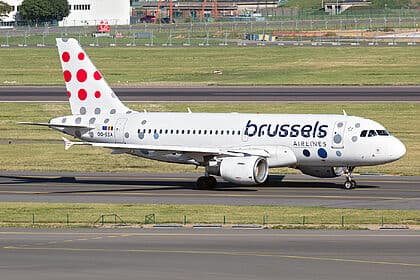
The A319 is the stubby one: the short fuselage makes the wing and tail look oversized, and the rear fuselage tapers to the tail cone almost immediately behind the last door. The quick check is the overwing exits: a standard A319 has one small exit per side over the wing, where the A320 has two and the A321 has none. High-density easyJet-style aircraft have two overwing exits, which can cause confusion, so count windows instead: the A319 has noticeably fewer between the doors. Nose, cockpit windows and engine nacelles are identical to the rest of the family.
Frequently asked
What is the difference between the A319 and the A320?
Length and seats: the A319 is 3.73 m shorter and carries about 124 passengers in two classes against the A320's 150. Wing, engines, cockpit and fuel capacity are the same, which is why the A319 has slightly longer range and why pilots fly both on one type rating.
Is the A319 still in production?
No. The A319ceo line ended around 2020, and the A319neo sells only in small numbers because airlines prefer the larger A320neo or the purpose-built A220 at this size.
What is an ACJ319?
The Airbus Corporate Jet version of the A319, fitted with extra fuel tanks in the hold and a VIP cabin for 8–19 passengers. Its long range on the A320 wing made it a favourite with governments and large corporations.
How far can an A319 fly?
Up to about 3,750 nautical miles (6,950 km) with Sharklets at the highest weight option, the longest range in the original A320 family, though airlines rarely use it on routes beyond four or five hours.
What aircraft is A319?
A319 is the ICAO type designator for the Airbus A319, a Airbus narrowbody that first flew in 1995. It is the code flight trackers and air traffic control use.
What is the wingspan of the Airbus A319?
The Airbus A319 has a wingspan of 35.8 m (117 ft) and is 33.84 m (111 ft) long.
What engines does the Airbus A319 have?
Two CFM International CFM56-5B or IAE V2500.
What is the MTOW and range of the Airbus A319?
Maximum take-off weight is 75,500 kg (166,447 lb) and maximum range is about 3,750 nautical miles (6,945 km) at a cruise of Mach 0.78.
How many passengers does the Airbus A319 carry?
Typically 124 passengers in a two-class layout; dense single-class layouts seat more and premium-heavy layouts fewer.
Compare with
Specs are approximate, compiled from public sources. See our editorial policy.