Boeing 737-800
B738Boeing · Narrowbody · Production ended
In the wild
History
The Boeing 737-800 is the best-selling member of the 737 Next Generation family, the third major generation of a design whose origins reach back to the 1960s. By the early 1990s the 737 Classic series was competing against the all-new Airbus A320, which offered fly-by-wire controls and a wider cabin. Boeing chose to modernise the 737 rather than replace it, launching the Next Generation programme in 1993. The new family kept the 737's fuselage cross-section and much of its character but introduced a new wing, updated systems and a modern flight deck.
The 737-800 was the stretched, higher-capacity member of the initial Next Generation line-up, sitting above the 737-600 and 737-700 and, later, below the 737-900. It was aimed squarely at the Airbus A320 and at replacing earlier 737-400s and the ageing 727. Powered by the CFM56-7B, it seated around 160 to 189 passengers depending on layout. The aircraft first flew in 1997 and entered service in 1998 with the German leisure carrier Hapag-Lloyd.
What followed was one of the most successful sales runs in commercial aviation. The 737-800 hit a capacity and cost point that suited an enormous range of operators, from full-service carriers to the fast-growing low-cost sector. Ryanair and Southwest built large, standardised fleets around it, using its low trip cost and quick turnarounds to underpin high-frequency, point-to-point networks. Blended winglets, offered as an option and later widely fitted, improved fuel burn and became a common visual signature of the type. Over roughly two decades of production the 737-800 was built in very large numbers and became a fixture at airports worldwide.
The 737-800 also served beyond passenger flying. Boeing developed a Converted Freighter programme to turn retired airframes into cargo aircraft, giving the type a long second life in express and e-commerce logistics as newer jets took over passenger duties. A military maritime patrol derivative, the P-8 Poseidon, is based on the 737-800 airframe with features drawn from the 737-900, extending the design into a wholly different role.
Production of the passenger 737-800 wound down as Boeing transitioned to the re-engined 737 MAX, and the MAX 8 succeeded it as the company's standard single-aisle offering. The changeover was not seamless: the MAX's troubled introduction and prolonged grounding meant that many operators kept 737-800s flying longer than planned, and strong demand for used examples kept values high well into the 2020s. Even as the newest aircraft leave the assembly line as MAX variants, the 737-800 remains one of the most numerous airliners in service.
Its commercial legacy is substantial. The 737-800 gave Boeing a durable answer to the A320 through the 2000s and 2010s, anchored the growth of several of the world's largest low-cost carriers, and established the seating and economics that the MAX 8 was designed to inherit. For many travellers and spotters it is simply the default short-haul Boeing, a type encountered on a large share of narrowbody flights across North America, Europe and Asia.
Specifications
- First flight
- 1997
- Entered service
- 1998
- Engines
- 2 × CFM56-7B
- Typical seating
- 162 (2-class)
- Cruise speed
- Mach 0.785
- Range
- 2,935 nm
- MTOW
- 79,010 kg
- Length
- 39.47 m
- Wingspan
- 35.8 m
- Status
- Production ended
Design notes
The Next Generation 737, and the 737-800 with it, introduced a redesigned wing that was larger, aerodynamically refined and able to carry more fuel than the Classic series it replaced, raising cruise speed and range. The tail surfaces were enlarged and the aircraft received the CFM56-7B engine, an updated version of the CFM56 tuned for the new airframe. As on earlier 737s, the engines sit close to the ground, and their nacelles are flattened along the bottom to preserve clearance, giving the distinctive non-circular intake that identifies the 737 family.
The flight deck moved to a modern layout with electronic displays, replacing the older analogue instruments of the Classic, while retaining the conventional control yoke and the underlying systems philosophy of the 737. Boeing deliberately preserved commonality so that crews and maintenance organisations could transition from earlier 737s with limited retraining, a selling point against the clean-sheet Airbus A320.
Blended winglets, developed with Aviation Partners, were offered to reduce drag on longer sectors and were retrofitted to many aircraft; they are among the most recognisable features of the type, though not every 737-800 carries them. The cabin uses the long-standing 737 cross-section, narrower than the A320's, in a six-abreast economy layout. Later production aircraft could be fitted with the Boeing Sky Interior, featuring sculpted sidewalls and LED lighting, bringing the cabin closer in feel to newer designs without altering the underlying structure.
Notable facts
- The best-selling variant of the Boeing 737 Next Generation family.
- Powered by the CFM56-7B; blended winglets are common.
- Entered service in 1998.
- A workhorse of low-cost carriers such as Ryanair and Southwest.
- Succeeded in production by the 737 MAX 8.
Who flies it
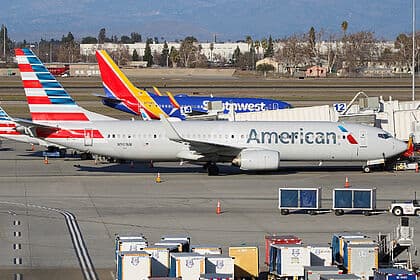
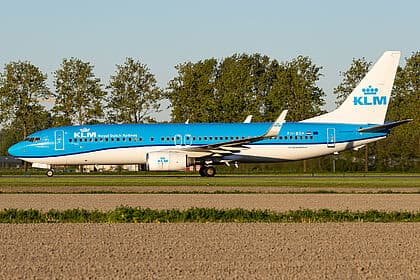
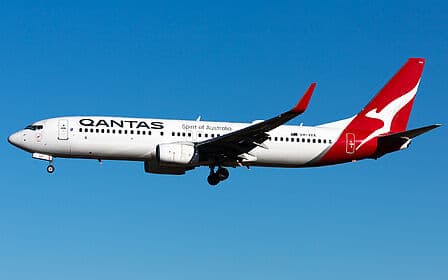
The 737-800 is flown by an exceptionally broad set of operators and remains one of the most common narrowbodies in the world. Low-cost giants such as Ryanair and Southwest have operated large, single-type fleets of it, and full-service carriers including American, United, Delta and many others use it on domestic and regional international routes. It is widespread across Europe, the Americas, Asia and Africa, both with major airlines and with smaller operators buying used aircraft.
Its roles are mostly short- and medium-haul passenger flying, from high-frequency shuttles to leisure charters. As passenger fleets renew, growing numbers of 737-800s are being converted to freighters for parcel and e-commerce carriers, giving the type a substantial cargo presence. Even with the MAX 8 now in production, the sheer size of the 737-800 fleet means it will remain a familiar sight for many years.
Flying on one
The 737-800 is the single-aisle workhorse a huge number of travellers know best, and as a passenger it is perfectly serviceable if a touch tighter than its Airbus rival. The 737 fuselage is a little narrower than the A320's, so in the standard six-abreast 3-3 layout seats are commonly around seventeen inches — a small but noticeable difference, felt most in the middle seat. Older -800s can have modest overhead bins, though many now wear Boeing's Sky Interior with sculpted sidewalls and larger pivoting bins that hold more roll-aboards. Engine noise is moderate and the ride is familiar and stable. Cabins vary widely by airline, from low-cost dense layouts to comfortable legacy configurations. For the best seat, the over-wing exit rows give the most legroom, and a forward window keeps you clear of the aft galley and lavatory queues. Steer clear of the very back rows, which sit by the rear galley and often have limited or no recline.
Who flies it, and how
1 airline cabin layout of the Boeing 737-800 in our dataset — expand any to see the cabin breakdown and seat map.
United737-800166 seats16F · 150Y
- First (United First): 16 seats, 2-2 across
- Economy (Economy Plus): 54 seats, 3-3 across
- Economy (United Economy): 96 seats, 3-3 across
First class is 16 seats fleet-wide; the Economy Plus/Economy split varies by sub-batch (54/96 dominant, also 48/102 and 42/108 — all totaling 166).
Variants
- 737-700 (B737) — Shorter Next Generation variant
- 737-900ER (B739) — Stretched Next Generation variant
How to spot it
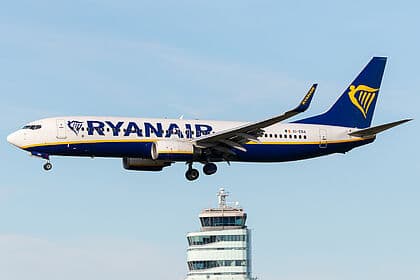
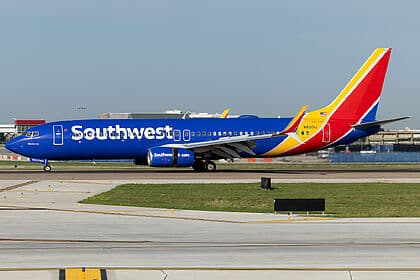
The 737-800 shows the classic 737 signatures: a pointed nose, a low-slung stance close to the ground, and engine nacelles that are noticeably flattened at the bottom, giving a non-circular intake. Compared with the Airbus A320 family, the 737 sits lower, has a sharper nose profile and a longer, more tapered tail cone.
Within the 737 range, length and winglets help. The 737-800 is longer than the -700 but shorter than the -900, which is hard to judge in isolation. Most 737-800s wear blended winglets that sweep smoothly upward in a single blade. Distinguishing it from the newer 737 MAX 8 is easiest at the wingtips and engines: the MAX carries split-tip winglets pointing both up and down, and larger nacelles, whereas the -800's engines are smaller and its winglets, when fitted, point only upward.
Frequently asked
What is the difference between the 737-800 and the 737 Next Generation?
The 737-800 is one variant within the 737 Next Generation family, which also includes the shorter -600 and -700 and the stretched -900. Next Generation refers to the whole third-generation 737 line launched in the 1990s, with a new wing and modern flight deck. The -800 is the best-selling member of that family.
How do you tell a Boeing 737 from an Airbus A320?
The clearest cues are the nose and the engines. The 737 has a pointed nose and sits low to the ground, while the A320 has a rounder nose and a taller stance. The 737's engine intakes are flattened along the bottom, giving a distinctly non-circular shape, whereas the A320's nacelles are close to circular.
How do you tell a 737-800 from a 737 MAX 8?
Look at the wingtips and engines. The MAX 8 has split-tip winglets that extend both upward and downward, and larger engine nacelles set higher and further forward. The 737-800 typically has single blended winglets that point only upward, and smaller CFM56 nacelles. Be aware that some 737-800s were retrofitted with split-scimitar winglets that partly resemble the MAX arrangement.
Why is the 737-800 so popular with low-cost carriers?
It offered a favourable combination of seat count, low trip cost and fast turnaround times, all of which suit high-frequency point-to-point operations. Standardising on a single type also reduces training, maintenance and spares costs. Carriers such as Ryanair and Southwest built much of their business models around large 737-800 fleets.
Is the 737-800 still in production?
No. Boeing ended production of the passenger 737-800 as it transitioned to the re-engined 737 MAX 8, which succeeded it. However, the 737-800 remains one of the most numerous airliners in service, and many are now being converted into freighters, so it will be visible for years to come.
In-depth comparisons
Compare with
Specs are approximate, compiled from public sources. See our editorial policy.