Boeing 747-400
B744Boeing · Four-Engine · Production ended
History
The Boeing 747-400 is the best-selling version of the 747, the four-engine widebody that reshaped long-haul travel after its 1969 debut. By the mid-1980s the original 747 had been through several improvements, but Boeing saw room for a major update. Launched in 1985, the 747-400 combined the proven 747 fuselage and its distinctive humped forward upper deck with a range of modern changes: a new wing with six-foot winglets, more efficient engines, greater fuel capacity, and, most significantly, a two-crew glass cockpit that removed the flight engineer of earlier models. It first flew in 1988 and entered service in 1989 with Northwest Airlines.
Those changes gave the -400 markedly better range and economics than earlier 747s while retaining the huge capacity that made the type famous. In a typical three-class layout it seated around 416 passengers, with far more in denser configurations, and it could fly non-stop between most major intercontinental city pairs. Through the 1990s it became the flagship of many of the world's largest airlines, the standard aircraft for premium long-haul routes across the Atlantic and Pacific, and a symbol of international air travel. British Airways, Japan Airlines, Singapore Airlines, Cathay Pacific, KLM, Lufthansa, Qantas, and United were among its many major operators.
Boeing built the -400 in a wide range of forms: standard passenger aircraft, the Combi carrying passengers and freight on the main deck, dedicated 747-400F freighters with a hinged nose door, extended-range and higher-weight versions, and a winglet-less high-density domestic model for the Japanese market. In all, 694 were delivered between 1989 and 2009, making it comfortably the most-produced 747 variant.
The 747-400's decline was driven by economics rather than any failing of its own. As twin-engine widebodies such as the 777 and later the A350 and 787 matured, airlines found they could carry similar loads with two engines instead of four, cutting fuel and maintenance costs sharply. Passenger 747-400s were progressively retired through the 2010s, a process accelerated by the 2020 travel downturn, and by the mid-2020s only a handful remained in scheduled passenger service. As of 2026 the type is effectively retired from mainstream passenger flying, though a fair number continue as freighters with cargo operators, and some serve charter, government, and specialist roles. Its successor, the larger 747-8, was itself built only in modest numbers, marking the slow end of the four-engine jumbo era. Even so, the 747-400 remains one of the most recognisable and fondly regarded airliners ever built, and preserved and freighter examples ensure the jumbo will be seen for years yet.
Specifications
- First flight
- 1988
- Entered service
- 1989
- Engines
- 4 × Pratt & Whitney PW4000, GE CF6-80C2, or Rolls-Royce RB211-524
- Typical seating
- 416 (2-class)
- Cruise speed
- Mach 0.85
- Range
- 7,260 nm
- MTOW
- 396,890 kg
- Length
- 70.66 m
- Wingspan
- 64.44 m
- Status
- Production ended
Design notes
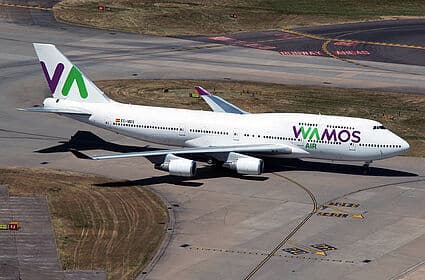
The 747-400 is instantly recognisable as a 747: a very large four-engine widebody with a partial second deck forming the famous forward hump. What sets the -400 apart from earlier 747s is a package of upgrades rather than a new shape. The wing was extended and fitted with six-foot canted winglets, the first on a 747, improving range and cruise efficiency and serving as the clearest external identifier of the variant. The upper deck is the stretched version introduced on the earlier 747-300, longer than that of the original 747s.
Power comes from four high-bypass turbofans, with airlines choosing between the Pratt & Whitney PW4000, the General Electric CF6-80C2, and the Rolls-Royce RB211-524. Each main landing gear uses a complex arrangement of four four-wheel bogies, sixteen wheels in total, plus the nose gear, to spread the aircraft's great weight.
The biggest change was inside the cockpit. The -400 introduced a two-crew glass flight deck with electronic displays, eliminating the flight engineer's station that earlier 747s required and modernising the systems. The cabin retained the 747's wide, twin-aisle main deck, typically ten abreast in economy, with the upper deck used for premium seating or lounges. Structurally it remained an aluminium airframe, a careful refinement of a 1960s design rather than a new one.
Notable facts
- The best-selling 747 variant, with 694 built between 1989 and 2009.
- Introduced a two-crew glass cockpit, removing the flight engineer of earlier 747 generations.
- Recognisable by its stretched upper deck and, on most examples, six-foot winglets.
- Built in passenger, Combi, freighter (747-400F), and high-density domestic forms.
- Largely displaced from passenger fleets by efficient twins and the later 747-8; now flies mostly as a freighter.
Who flies it
As of 2026 the 747-400 has largely disappeared from scheduled passenger service, the role in which it once defined long-haul flying. The great fleets of British Airways, Qantas, United, Singapore Airlines, Cathay Pacific, and others were retired through the late 2010s and early 2020s, many pushed out early by the 2020 downturn. A very small number may linger on niche or charter passenger work, but the passenger era is effectively over. The aircraft's enduring role is as a freighter: 747-400F and converted 747-400BCF and BDSF freighters remain important to cargo operators such as Atlas Air, Kalitta Air, and UPS, hauling outsize and heavy main-deck freight that the hinged nose door uniquely suits. A handful also serve governments, charter fleets, and specialist operators. Where you still see a 747-400, it is increasingly at a cargo ramp.
Flying on one
For millions of travellers the 747-400 was the queen of the skies, and although it has now largely left passenger service — only a handful of carriers still fly it — a trip on one remains a special experience. As with every 747, the upper deck is the seat to have: a quieter, intimate cabin up the spiral staircase, with handy side stowage bins, prized by frequent flyers. The long main deck is usually ten-abreast, a 3-4-3 economy layout at around seventeen inches a seat, so economy width is ordinary, but the four engines and the aircraft's sheer mass give a famously smooth and quiet ride. The nose section and the sense of occasion are part of the magic. Cabin altitude and humidity are of the type's era. For the best seat, head to the upper deck if the aircraft has a cabin up there; on the main deck, a window forward of the wing keeps you away from the galleys. Enjoy it while you still can.
Variants
- 747-400F — Freighter with nose and side cargo doors; still flown by cargo carriers
- 747-400ER — Higher-weight, extended-range passenger and freighter version
- 747-400D — High-density domestic model for Japanese routes, without winglets
How to spot it
The 747-400 is unmistakable as a 747: a huge four-engine widebody with the famous forward upper-deck hump. The challenge is separating it from the later 747-8, the only other long-hump 747. Two cues settle it. First, the wingtips: the 747-400 has upward-canted six-foot winglets, whereas the 747-8 has no winglets but instead long, raked wingtips like a modern twin. Second, length and the upper deck: the 747-8 is noticeably longer, with a further-stretched upper deck, while the -400's hump is shorter. Against the older 747-100, -200, and -300, the -400's winglets are again the giveaway, as those earlier jumbos have plain wingtips. From a distance, any four-engine aircraft with a forward hump is a 747; winglets versus raked tips then tell the -400 from the -8.
Frequently asked
Does anyone still fly the 747-400 in 2026?
In scheduled passenger service, almost no one; the great passenger fleets were retired through the late 2010s and early 2020s, a process hastened by the 2020 travel downturn. The type lives on mainly as a freighter, with cargo operators such as Atlas Air, Kalitta Air, and UPS flying 747-400F and converted freighters. A few also serve charter, government, and specialist roles.
Why was the 747-400 retired from passenger service?
The reason was economics rather than any fault: modern twin-engine widebodies such as the 777, A350, and 787 can carry similar loads with two engines instead of four, cutting fuel and maintenance costs substantially. That made the four-engine 747 expensive to run, and airlines retired it in favour of twins. The 2020 downturn accelerated an already-underway process.
How do you tell a 747-400 from a 747-8?
Look first at the wingtips: the 747-400 has upward-canted winglets, while the newer 747-8 has no winglets but long, raked wingtips instead. The 747-8 is also noticeably longer and has a further-stretched upper-deck hump. Both are four-engine jumbos, so these two cues are the reliable way to separate them.
What made the 747-400 different from earlier 747s?
The -400 added a new wing with six-foot winglets, more efficient engines, and greater fuel capacity, but the biggest change was a two-crew glass cockpit that removed the flight engineer earlier 747s needed. It also used the stretched upper deck first seen on the 747-300. These improvements gave it better range and economics while keeping the classic 747 shape.
Why does the 747 have that hump on top?
The raised forward section houses a partial second deck, a feature dating to the original 747's design, when the cockpit was placed above the main deck partly to allow a full-width nose cargo door on freighter versions. On the 747-400 the hump is the stretched upper deck introduced with the 747-300, used for premium seats or lounges. It remains the aircraft's most famous visual signature.
Compare with
Specs are approximate, compiled from public sources. See our editorial policy.