Boeing 787-10 (B78X)
Boeing · Widebody · In production
B78X is the ICAO aircraft type code for the Boeing 787-10, a Boeing widebody airliner that first flew in 2017 and entered service in 2018. It typically carries 336 passengers in a two-class layout, cruises at Mach 0.85, and has a range of about 6,330 nautical miles (11,723 km).
Loading live positions…
In the wild
History
The Boeing 787-10 is the stretched, high-capacity member of the Dreamliner family, launched in June 2013 at the Paris Air Show with orders from Singapore Airlines, United, British Airways, Etihad and the lessor GECAS. Boeing's aim was a 787 that could carry around 330 passengers at the lowest cost per seat of any widebody on medium- and long-haul routes of up to twelve hours, competing with the Airbus A350-900 and replacing older 777-200s and A330-300s.
The stretch was simple in concept and demanding in practice. Boeing added 5.5 m to the 787-9's fuselage, keeping the same wing, engines and landing gear, which meant the aircraft shared the -9's type rating and 95% of its parts but gave up some range. The longer fuselage sections could not fit inside the Dreamlifter transport aircraft that carries 787 components to Everett, so the -10 became the first Boeing airliner built exclusively at the North Charleston plant in South Carolina, which later took over all 787 assembly.
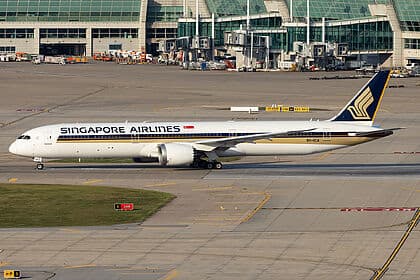
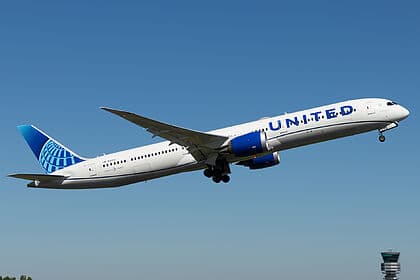
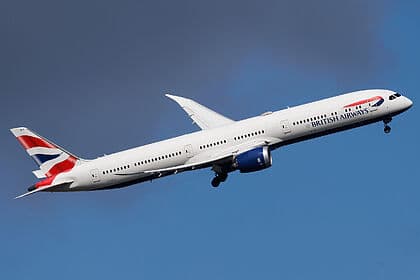
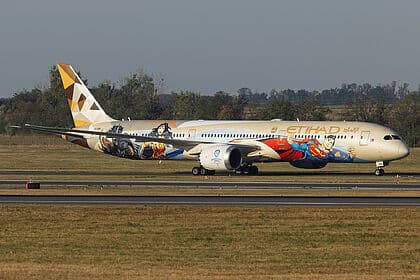
The first 787-10 flew on 31 March 2017, with certification following in January 2018. Singapore Airlines took the first delivery in March 2018 and put it to work on regional routes to Osaka, Perth and Bangkok, where its capacity mattered more than its range. United, the largest customer, used it to replace 777-200s on transatlantic and transcontinental routes; British Airways, KLM, Etihad, EVA Air, Vietnam Airlines and Air Premia followed.
Orders have been steadier than spectacular, with around 250 sold, because the -9's extra range suits more airlines. But on dense medium-haul routes the -10's economics are hard to beat, and as 777-200ERs and A330s retire it has become the default large twin for carriers that do not need ultra-long range.
Specifications
- First flight
- 2017
- Entered service
- 2018
- Engines
- 2 × General Electric GEnx-1B or Rolls-Royce Trent 1000
- Typical seating
- 336 (2-class)
- Cruise speed
- Mach 0.85
- Range
- 6,330 nm
- MTOW
- 254,011 kg
- Length
- 68.28 m
- Wingspan
- 60.12 m
- Status
- In production
Design notes
The 787-10 is the 787-9 with two fuselage plugs, one ahead of the wing and one behind, and almost nothing else changed: the composite wing of 60.1 m span, the GEnx-1B or Trent 1000 engines at their highest thrust ratings, the main landing gear and the systems are all common with the -9, which is why Boeing could certify it as an amendment to the existing type certificate rather than a new aircraft.
The extra length brings a tail-strike consideration on take-off and landing, handled by a semi-levered main landing gear that lets the aircraft rotate about the rear axle, and the maximum take-off weight is the same 254 tonnes as the -9, so the additional structure and passengers come out of fuel, reducing range to about 6,330 nautical miles. The cabin cross-section, window size, electric systems and 6,000 ft cabin altitude are standard Dreamliner.
Notable facts
- The longest Dreamliner, a 5.5 m stretch of the 787-9 that trades range for about 40 more seats.
- Built only at Boeing's North Charleston, South Carolina plant, because the fuselage sections are too long to fly in the Dreamlifter from Everett.
- Singapore Airlines took the first delivery in March 2018 and uses it on regional Asian trunk routes rather than ultra-long-haul.
- Shares the 787-9's wing, engines and landing gear, so it needs no new type rating and little extra training.
- Flown by United, British Airways, KLM, Etihad, EVA Air and others as a 777-200 or A330-300 replacement on dense medium- and long-haul routes.
Who flies it
United Airlines is the largest 787-10 operator, flying it on transatlantic trunk routes and premium transcontinental services; British Airways, KLM and Air France use it to Africa, the Middle East and North America. In Asia Singapore Airlines, EVA Air, Vietnam Airlines, Korean Air (ex-Asiana) and Air Premia operate it on regional and medium-haul trunks, while Etihad deploys it across its network. Typical missions are six- to twelve-hour routes with strong demand, where its roughly 330 seats and low trip cost replace 777-200ERs and A330-300s.
Flying on one
A 787-10 cabin is a long 787-9 cabin: the same lower cabin altitude, humidity, large dimmable windows and quiet engines, with more rows. Nine-abreast economy is universal on the type, so seats are about 17 inches wide; the trade-off for the Dreamliner's comfort features is a slightly narrower seat than an A350's. Because the -10 flies mainly medium-haul trunk routes, some operators fit it with lighter premium cabins than their -9s, though United's Polaris and BA's Club Suite aircraft are exceptions. The long cabin takes a while to board and deplane; choose a seat near a door if you have a connection. For the best economy seat, go for a window in the cabin ahead of the engines, and avoid the last block of rows between the rear doors and galleys where the aisle traffic gathers.
Variants
- 787-8 (B788) — The original, smallest Dreamliner
- 787-9 (B789) — Mid-size, longest-range member of the family
How to spot it
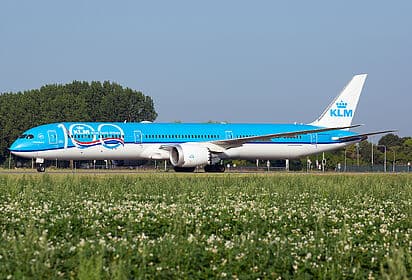
Spotting a 787-10 is a question of length. All three Dreamliners share the chevron engine exhausts, raked wingtips, high-flexing wing and the swept four-pane cockpit windows; the -10, at 68 m, is the long one, almost as long as a 777-300ER, with a long straight run of fuselage between the wing and the tail and the third door pair set well behind the wing. A quick comparison with the wingspan helps: on a -10 the fuselage is noticeably longer than the wing is wide, where on a -8 they look about equal. The semi-levered main gear is hard to see, but the aircraft rotates with an unusually nose-high, slow lift-off.
Flights we've seen the Boeing 787-10 operate
From our own observations of notable flights — each links to the flight's status, on-time history and fares.
Frequently asked
What is the difference between the 787-9 and 787-10?
The 787-10 is 5.5 m longer and seats about 40 more passengers, but has the same wing, engines and maximum weight, so its range is roughly 1,000 nautical miles shorter: about 6,330 nm against 7,500 nm for the -9. It is built only in South Carolina.
How many passengers does a 787-10 carry?
Around 330 in a typical two-class layout and up to 440 in a single class. Singapore Airlines fits 337, United 318 with a large premium cabin.
Why is the 787-10 built only in South Carolina?
Its longer fuselage sections cannot fit inside the Dreamlifter, the modified 747 that flies 787 parts between suppliers and the Everett factory, so assembly was placed at the North Charleston plant where the rear fuselage is made. Boeing later moved all 787 production there.
Does the 787-10 replace the 777?
It replaces the older 777-200 and 777-200ER on many routes, offering similar capacity at much lower cost, but it cannot match the 777-300ER's capacity or the 777-200LR's range; those roles go to the 787-9, the 777-9 and the A350.
What aircraft is B78X?
B78X is the ICAO type designator for the Boeing 787-10, a Boeing widebody that first flew in 2017. It is the code flight trackers and air traffic control use; airlines and booking sites show it as 78X.
What is the wingspan of the Boeing 787-10?
The Boeing 787-10 has a wingspan of 60.12 m (197 ft) and is 68.28 m (224 ft) long.
What engines does the Boeing 787-10 have?
Two General Electric GEnx-1B or Rolls-Royce Trent 1000.
What is the MTOW and range of the Boeing 787-10?
Maximum take-off weight is 254,011 kg (559,993 lb) and maximum range is about 6,330 nautical miles (11,723 km) at a cruise of Mach 0.85.
How many passengers does the Boeing 787-10 carry?
Typically 336 passengers in a two-class layout; dense single-class layouts seat more and premium-heavy layouts fewer.
In-depth comparisons
Compare with
Specs are approximate, compiled from public sources. See our editorial policy.