ATR 72-600
AT76ATR · Regional · In production
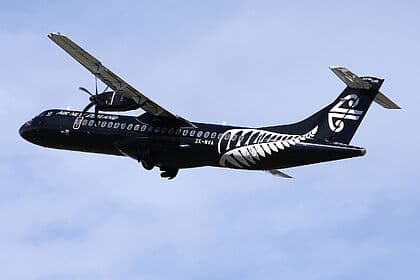
In the wild
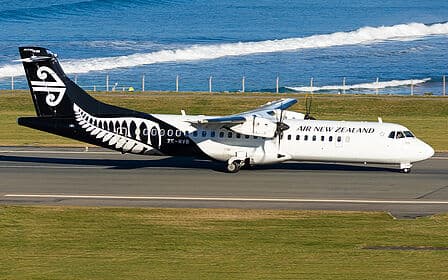
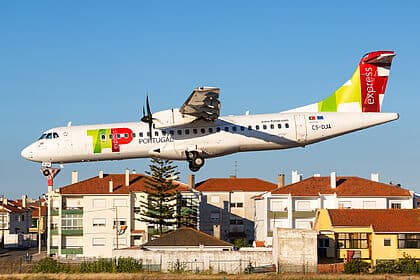
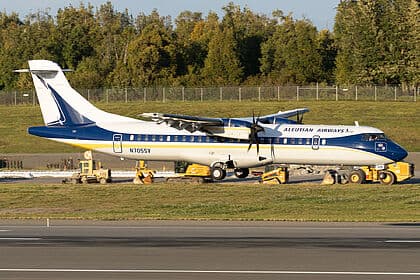
History
The ATR 72 is a twin-turboprop regional airliner built by ATR, a manufacturer formed in 1981 as a partnership between the French company Aerospatiale and the Italian company Aeritalia. Those firms are today part of Airbus and Leonardo respectively, which jointly own the venture. ATR's first product was the ATR 42, seating around 42 to 50, which flew in 1984. The larger ATR 72, a stretch seating roughly 70, followed and first flew in October 1988, entering service in 1989. The two family names reflect the approximate seat counts of the aircraft.
From the start ATR built its aircraft for short regional sectors, where a turboprop's low fuel burn and short-field capability count for more than the higher cruising speed of a jet. The ATR 72 uses a high-mounted wing, a T-tail and two wing-mounted turboprops, a layout well suited to operations from short or lightly equipped runways. The cabin is pressurised and seats passengers four abreast. Passengers board at ground level through built-in stairs, so the type does not depend on jet bridges or tall ground equipment, which further suits it to smaller airfields.
The subject of this page, the ATR 72-600, is the current production version and carries the ICAO designator AT76. ATR launched it in the late 2000s as a modernisation of the earlier ATR 72-500. It first flew in 2009 and entered service in 2011. The headline change was a fully glass flight deck built around Thales avionics with five liquid-crystal displays, replacing the older analogue and hybrid cockpits. The -600 also introduced updated PW127 engines, a revised cabin and lighter, more capable systems, while keeping the airframe and general performance broadly similar to the -500 it replaced.
Across all its variants the ATR 72 has become one of the most widely sold regional turboprops in its size class, with many hundreds delivered to operators worldwide. Its principal competitor in the larger-turboprop segment has been the De Havilland Canada Dash 8-400, a faster but thirstier aircraft; with the Dash 8 line's production suspended, the ATR 72-600 has been left as the main new-build option in its category. ATR has also developed a dedicated freighter, the ATR 72-600F, launched with the express carrier FedEx as customer. Demand for the passenger version has tracked the regional and island markets it serves. High fuel prices tend to favour its economics, while its comparatively low cruising speed of around 275 knots limits it to shorter sectors. The type remains in production, assembled at Toulouse in France. Many examples have replaced older turboprops and small jets on regional networks, and the -600 is expected to remain the core product of ATR for the foreseeable future.
Specifications
- First flight
- 1988
- Entered service
- 1989
- Engines
- 2 × Pratt & Whitney Canada PW127 (turboprop)
- Typical seating
- 70 (2-class)
- Cruise speed
- Mach 0.44
- Range
- 825 nm
- MTOW
- 23,000 kg
- Length
- 27.17 m
- Wingspan
- 27.05 m
- Status
- In production
Design notes
The ATR 72-600 is defined by an emphasis on economy over speed. Power comes from two Pratt and Whitney Canada PW127-series turboprops, each driving a six-blade propeller. Because a propeller is more efficient than a jet at the low speeds and altitudes typical of short regional hops, the aircraft burns markedly less fuel per sector than a comparable regional jet, at the cost of a cruising speed of around 275 knots, well below jet cruise.
The high wing keeps the propellers and engines clear of the ground and leaves the cabin floor close to the tarmac, which aids boarding through the aircraft's own rear airstair. The main landing gear retracts into fairings on the lower fuselage rather than into the engine nacelles, a detail that helps distinguish the type from several rivals.
A notable operational feature is the propeller brake, sometimes called Hotel Mode. It lets the right-hand engine keep running with its propeller locked stationary, driving a generator to supply electrical power and air on the ground without a separate auxiliary power unit and without a spinning propeller near the door; an APU is available as an option. The -600 generation adds the glass Thales cockpit, and a typical cabin seats about 70 in a four-abreast, two-plus-two layout. ATR promotes low operating cost as the type's central selling point.
Notable facts
- One of the best-selling regional turboprops in its size class.
- The ATR 72 first flew in 1988; the -600 (ICAO AT76), with a glass cockpit, is the current production version.
- Built by ATR, a joint venture between Airbus and Leonardo.
- Its low fuel burn makes it economical on short regional sectors where jets are less efficient.
- Powered by two Pratt & Whitney Canada PW127 turboprops driving six-blade propellers.
Who flies it
The ATR 72-600 is operated worldwide, with particular strength in Europe, South and Southeast Asia, Latin America and island networks where short sectors and modest runways suit its economics. Large fleets are flown by carriers such as Wings Air in Indonesia, IndiGo in India and Azul in Brazil, alongside many smaller regional and national airlines. In some markets it flies in mainline colours; in others it is operated by regional subsidiaries or franchise partners feeding a larger carrier's hubs. The type's role is the classic regional one: linking smaller communities to hubs, serving inter-island routes, and operating thin sectors that could not profitably support a jet. A growing number also fly as ATR 72-600F freighters in parcel and express networks, most visibly with FedEx feeder operators. Its combination of low trip cost and short-field capability keeps it common on routes where frequency and economy matter more than speed.
Flying on one
An ATR 72 is a turboprop, and flying on one is a different, more characterful experience than a jet. The cabin seats four-abreast in a 2-2 layout, so there are no middle seats, but the propellers make their presence felt: expect more noise and a gentle vibration, most pronounced in the rows level with the props around the middle of the cabin. Because the ATR is small, its overhead bins are modest, and larger roll-aboards are routinely gate-checked — handed over at the foot of the airstairs and returned to you there on arrival. It cruises lower and slower than a jet, so short hops can feel a little bumpier in weather but reward you with better low-altitude views. Boarding is often through a rear airstair. For the best seat, choose a row ahead of the propeller line, roughly the first two or three rows, where the noise is lowest; the seats immediately beside the props are the ones to avoid if quiet matters. It is in its element on short regional and island routes.
Variants
- ATR 72-500 (AT75) — Previous-generation variant
- ATR 72-600F — Freighter version (e.g. for FedEx)
How to spot it
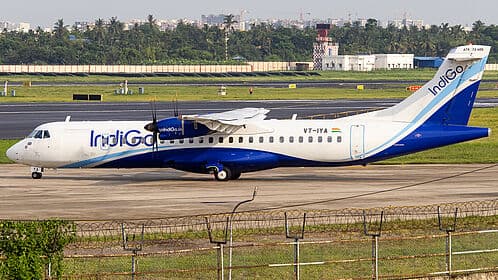
The ATR 72 is a high-wing twin turboprop with a T-tail and a long, slender fuselage that rides low to the ground on short landing gear. The clearest way to separate it from its main look-alike, the De Havilland Canada Dash 8-400, is the landing gear and nacelles: the ATR's main wheels fold into blister fairings on the lower fuselage, leaving short engine nacelles, whereas the Dash 8 retracts its gear into long nacelles that extend well behind the wing. The ATR also has a shorter, blunter nose and a shorter fuselage than the Dash 8, and its six-blade propellers sit relatively close to the fuselage. Compared with the smaller ATR 42, the 72 is simply longer, with more cabin windows. The general impression is of a compact, low-slung turboprop rather than the longer, taller Dash 8.
Frequently asked
How do you tell an ATR 72 from a Dash 8 Q400?
Both are high-wing, T-tailed twin turboprops, so look at the engine nacelles and gear. The Dash 8-400 has long nacelles because its main landing gear retracts into them, and it has a longer fuselage and a more pointed nose. The ATR 72 is shorter, has stubby nacelles, and folds its main gear into fairings on the lower fuselage. The Dash 8 is also noticeably faster in the cruise.
Why would an airline choose an ATR 72 over a regional jet?
On short sectors a turboprop burns considerably less fuel than a jet of similar size, and the ATR needs less runway. The trade-off is speed: the ATR 72 cruises at around 275 knots, so on longer routes a jet's time advantage outweighs the fuel saving. Airlines therefore favour the ATR where routes are short and where fuel economy or airfield limits dominate.
What does the -600 designation mean?
It identifies the current production generation of the ATR 72, which entered service in 2011. Its main upgrades over the earlier -500 are a glass cockpit with Thales displays, updated PW127 engines and a revised cabin. The airframe and general performance are largely carried over.
Does the ATR 72 have an auxiliary power unit?
Standard aircraft do not carry a conventional APU. Instead they use a propeller brake, known as Hotel Mode, that lets the right engine run with its propeller locked to provide electrical power and air on the ground. An APU is offered as an option for operators that want one.
Who builds the ATR 72?
It is built by ATR, a joint venture established in 1981 and today owned equally by Airbus and the Italian company Leonardo. Final assembly takes place at Toulouse in France. The same company also produces the smaller ATR 42.
Compare with
Specs are approximate, compiled from public sources. See our editorial policy.