Airbus A220-100 (BCS1)
Airbus · Narrowbody · In production
BCS1 is the ICAO aircraft type code for the Airbus A220-100, an Airbus narrowbody airliner that first flew in 2013 and entered service in 2016. It typically carries 110 passengers in a two-class layout, cruises at Mach 0.78, and has a range of about 3,450 nautical miles (6,389 km).

Loading live positions…
In the wild
History
The A220-100 began life as the Bombardier CS100, the airplane that nearly broke its maker and ended up with its rival's name on the side. Bombardier launched the CSeries in 2008 as a clean-sheet 100- to 150-seat jet to compete with the smallest Airbus and Boeing narrowbodies, betting on Pratt & Whitney's new geared turbofan, a carbon-fiber wing and an aluminum-lithium fuselage. The CS100 first flew on September 16, 2013 from Mirabel, Québec, more than a year late, and the larger CS300 followed in February 2015.
Swiss International Air Lines put the CS100 into service on July 15, 2016, Zurich to Paris, and the reviews were good: the quietest narrowbody at any airport, the widest economy seats and a cabin that felt like a small widebody. Sales were not. Development had cost Bombardier over six billion dollars, Delta's 2016 order for 75 aircraft triggered a US trade complaint from Boeing that briefly threatened 300 percent import duties, and Bombardier could not fund production. In October 2017 it gave Airbus a majority stake in the program for nothing. Airbus renamed the jets A220-100 and A220-300 in July 2018, added an assembly line at its Mobile, Alabama plant to serve US customers, and in 2020 bought out Bombardier entirely.
Under Airbus the program found its market. Delta became the largest customer and the first US operator in February 2019; Air Canada, JetBlue, Breeze, airBaltic, Air France, Korean Air and others followed. Most orders went to the larger A220-300, which carries about 30 more passengers for roughly the same operating cost, and the A220-100 has settled into a niche: airports with short runways or noise limits, such as London City and Toronto Billy Bishop, and routes too thin for a 150-seater. Delta, Swiss and airBaltic are among the few to fly the -100 in numbers, and Airbus has studied a stretched A220-500 rather than a smaller version.
By late 2026 Airbus had delivered more than 550 A220s of both sizes. The A220-300 has its own page under the code BCS3.
Specifications
- First flight
- 2013
- Entered service
- 2016
- Engines
- 2 × Pratt & Whitney PW1500G geared turbofan
- Typical seating
- 110 (2-class)
- Cruise speed
- Mach 0.78
- Range
- 3,450 nm
- MTOW
- 63,100 kg
- Length
- 35 m
- Wingspan
- 35.1 m
- Status
- In production
Design notes
The A220 was the first clean-sheet narrowbody in a generation, and its structure shows it. The wing is carbon-fiber composite, built by Bombardier's Belfast plant, now owned by Spirit AeroSystems and then Airbus, with a 35.1-meter span and a high aspect ratio for low drag. The fuselage is aluminum-lithium, lighter than conventional alloys, with a cross-section 3.5 meters wide, between a 737 and an E-Jet, sized for a 2-3 cabin.
Two Pratt & Whitney PW1500G geared turbofans in the 19,000- to 23,000-pound-thrust class provide the power. The gearbox lets the fan turn slowly while the turbine spins fast, which is what makes the airplane quiet and efficient; early engines needed frequent inspections, a problem Pratt & Whitney has worked through across the family. The flight controls are full fly-by-wire with sidesticks, the first on a Bombardier airliner, and the Rockwell Collins Pro Line Fusion cockpit has five large displays.
The A220-100 is 35 meters long with a maximum takeoff weight of about 63 tons and a range of around 3,450 nautical miles, enough for US transcontinental flights, which is unusual for a 110-seat jet. The A220-300 is the same airplane stretched 3.7 meters to carry up to 160 passengers. Both share the type rating, engines and most parts.
Notable facts
- Born as the Bombardier CSeries CS100: first flight September 16, 2013, and into service with Swiss in July 2016. Airbus took over the program in 2018 and renamed it A220.
- The shorter of the two A220s; most airlines order the A220-300. Delta is the largest A220 operator and flies both.
- Its 2-3 cabin gives the widest economy seats of any narrowbody, and the geared turbofans make it one of the quietest jets at an airport.
- Assembled at Mirabel, near Montréal, and at Mobile, Alabama. Range is about 3,450 nautical miles, enough for US transcontinental routes.
Who flies it
Delta Air Lines flies the largest A220-100 fleet, using the type from hubs such as New York LaGuardia, Boston, Salt Lake City and Detroit on routes where a 737 would be too big, including transcontinental services to the West Coast. Swiss, the launch customer, operates A220-100s on short European routes from Zurich and Geneva, and airBaltic, Air Canada and a handful of other carriers fly small numbers alongside larger A220-300 fleets. Bulgaria's Air Lazur and several lessors have placed ex-airline examples. The corporate ACJ TwoTwenty version flies for charter operators such as Comlux. Because most airlines standardized on the -300, the -100 is a minority of A220s in the air; on a tracker, BCS1 traffic is dominated by Delta.
Flying on one
The A220 is the narrowbody frequent flyers go out of their way to book, and the reasons hold on the -100. Economy is 2-3, so only one seat in five is a middle, and the seats are the widest in the class at 18.5 to 19 inches, with 20-inch middles on some airlines. Windows are larger than a 737's and the overhead bins take roll-aboards wheels-first. The geared turbofans make it the quietest jet in its size, especially forward of the wing. Delta's A220-100s have 109 seats with a 12-seat first class in 2-2, Comfort+ and standard economy at 30 to 31 inches; Swiss flies 125 seats all in 2-3 with a flexible business section up front. Best seats are the A and C side pairs forward of the wing; the rear rows are closest to the engines and the single rear lavatory. The lavatories themselves have windows on many aircraft, a small A220 novelty.
Variants
- A220-100 — 100-120 seats, described here
- A220-300 — 3.7 m longer, 120-150 seats, code BCS3
- ACJ TwoTwenty — Corporate-jet version
How to spot it
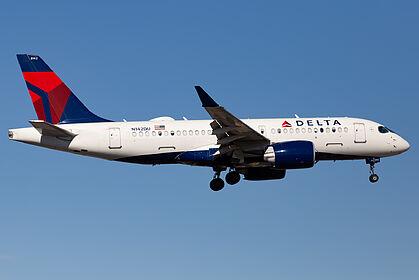
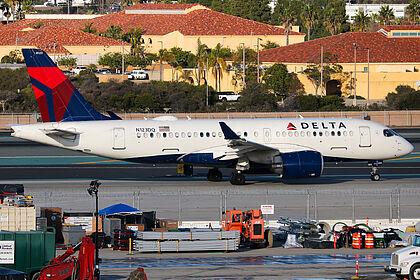
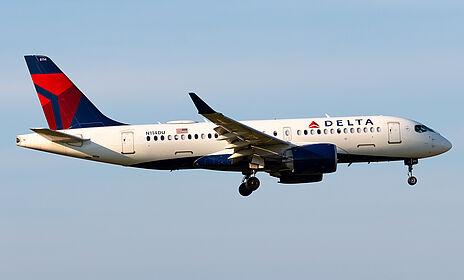
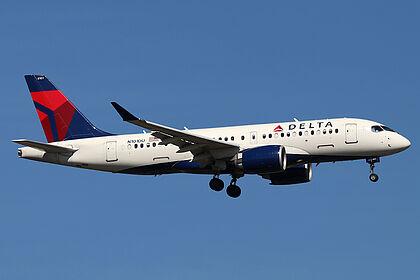
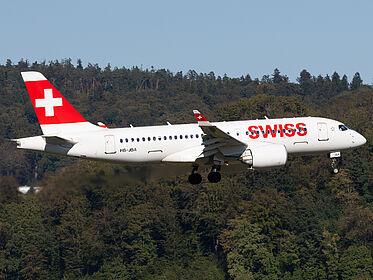
The A220 has a look of its own: a wide, rounded fuselage on a long, thin wing with upswept raked tips, large-fan engines that sit close under the wing, and a nose that is short and blunt compared with an E-Jet's. The cockpit windows are large with a distinctive flat lower edge. The A220-100 is the short version, 35 meters long, and looks almost square in proportion; the -300 is 3.7 meters longer with an extra pair of overwing exits and two more windows per side. From the front the 2-3 cabin reads as five windows across. Against the E195-E2 the A220 is rounder and wider with a shorter nose; against the A319neo and 737-7 it is smaller, with a visibly thinner wing and no winglets, just raked tips.
Frequently asked
What is the difference between the A220-100 and the A220-300?
The -300 is 3.7 meters longer, seats up to 160 instead of 135, and has slightly higher weights. The wing, engines, cockpit and type rating are the same. Most airlines buy the -300; the -100 suits short runways, noise-restricted airports and thinner routes.
Why is the A220 sometimes called the Bombardier CSeries?
Bombardier designed and launched it as the CS100 and CS300. Airbus took a majority stake in 2018 and renamed the jets A220-100 and A220-300; Bombardier left the program entirely in 2020. The airframe, factory at Mirabel and engines are unchanged.
Is the A220 quiet?
Yes. Its Pratt & Whitney geared turbofans make it one of the quietest airliners of any size, both in the cabin and on the ground, which is why it is used at noise-sensitive airports such as London City.
Who flies the A220-100?
Delta operates the largest fleet, followed by Swiss, the launch customer, and airBaltic. Air Canada and a few other carriers fly small numbers alongside larger A220-300 fleets.
Where is the A220 built?
At Mirabel, near Montréal, and since 2020 also at Airbus's plant in Mobile, Alabama, which builds most of the aircraft for US airlines.
What aircraft is BCS1?
BCS1 is the ICAO type designator for the Airbus A220-100, a Airbus narrowbody that first flew in 2013. It is the code flight trackers and air traffic control use.
What is the wingspan of the Airbus A220-100?
The Airbus A220-100 has a wingspan of 35.1 m (115 ft) and is 35 m (115 ft) long.
What engines does the Airbus A220-100 have?
Two Pratt & Whitney PW1500G geared turbofan.
What is the MTOW and range of the Airbus A220-100?
Maximum takeoff weight is 63,100 kg (139,110 lb) and maximum range is about 3,450 nautical miles (6,389 km) at a cruise of Mach 0.78.
How many passengers does the Airbus A220-100 carry?
Typically 110 passengers in a two-class layout; dense single-class layouts seat more and premium-heavy layouts fewer.
Compare with
Specs are approximate, compiled from public sources. See our editorial policy.