Cessna 172 Skyhawk
C172Cessna · Piston single · In production
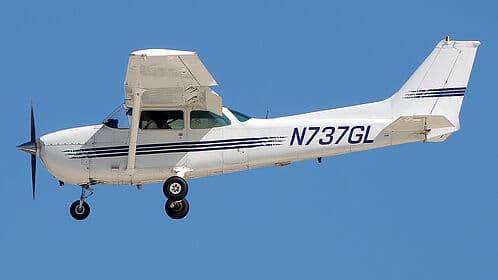
In the wild
History
The Cessna 172 grew directly out of an earlier Cessna design, the tailwheel-equipped Model 170. In the mid-1950s Cessna recognised that many pilots found conventional tailwheel aircraft tricky to handle on the ground, and that a nosewheel, or tricycle, undercarriage would make an aeroplane far more forgiving to land and taxi. The company took the proven 170 airframe, fitted it with tricycle landing gear and a squared-off tail, and the 172 was the result. It first flew in 1955, and deliveries began in 1956.
The timing could hardly have been better. Post-war America had a large pool of trained pilots, rising prosperity and growing enthusiasm for private flying, and the 172 offered a simple, docile and relatively affordable four-seat aircraft that both flight schools and private owners could use. It sold in large numbers almost immediately, and its reputation for benign handling made it a natural primary trainer.
Over the following decades the design was refined many times rather than replaced. Engines grew more powerful, the rear fuselage was cut down and a wraparound rear window added for better visibility, fuel injection replaced carburettors on later models, and the avionics were repeatedly modernised. Through all these changes the essential recipe, a strut-braced high wing, fixed tricycle gear and a stable, honest character, remained intact.
Production was suspended in the mid-1980s, when a wave of product-liability litigation made building light aircraft in the United States commercially painful. After legislation in 1994 limited that liability, Cessna resumed 172 production later in the decade with updated, fuel-injected models, and the type has been built more or less continuously since.
As of 2026 the Cessna 172 is generally described as the most-produced aircraft in history, with well over 44,000 built. Current 172S Skyhawk models pair a 180-horsepower Lycoming engine with modern Garmin glass cockpits, and they remain a staple of flight schools around the world. Its longevity rests less on any single outstanding quality than on a blend of forgiving handling, adequate performance, rugged simplicity and a vast global network of parts and mechanics.
For enthusiasts the 172 is significant precisely because it is so ordinary and so ubiquitous: it is the aeroplane in which a very large share of the world's pilots first learned to fly, and it has quietly outlasted almost every rival. A modified 172 even holds a celebrated flight-endurance record, staying continuously airborne for close to 65 days in 1958-59 with the help of in-flight refuelling.
Specifications
- First flight
- 1955
- Entered service
- 1956
- Engines
- 1 × Lycoming IO-360-L2A (180 hp)
- Typical seating
- 4 seats
- Cruise speed
- Mach 0.18
- Range
- 640 nm
- MTOW
- 1,157 kg
- Length
- 8.28 m
- Wingspan
- 11 m
- Status
- In production
Design notes
The Cessna 172's defining features are its high, strut-braced wing and its fixed tricycle undercarriage. Mounting the wing above the cabin gives good downward visibility, keeps the aircraft stable, and places the fuel tanks high in the wings so that gravity can feed the engine. The single bracing strut on each side carries much of the wing's load and is one of the type's most recognisable details.
Structurally the 172 is a conventional all-metal aeroplane, mostly aluminium, built to be simple, rugged and cheap to maintain. The cabin seats four and has two doors, and later models added a cut-down rear fuselage and wraparound rear window to improve the view.
Current production 172S models are powered by a 180-horsepower Lycoming engine driving a fixed-pitch propeller, a deliberately straightforward combination with no constant-speed propeller or retractable gear to complicate training. Modern examples carry Garmin glass-cockpit avionics, a considerable leap from the analogue instruments of older aircraft.
The overall design philosophy is forgiveness rather than performance. The 172 stalls gently, recovers readily, and is hard to mishandle badly, which is exactly why it has endured as a trainer. It is not fast, and it does not carry a heavy load with full fuel, but as of 2026 those trade-offs remain acceptable for its training and touring roles.
Notable facts
- Widely described as the most-produced aircraft in history, with more than 44,000 built since 1956.
- A high-wing, fixed-tricycle-gear single that has been the world's default primary trainer for decades.
- Developed from the tailwheel Cessna 170 by adding nosewheel (tricycle) landing gear.
- Current 172S Skyhawk SP models use a 180 hp Lycoming engine and Garmin glass cockpits.
- A modified 172 set an aircraft flight-endurance record in 1958-59, staying aloft nearly 65 days with in-flight refuelling.
Who flies it
As of 2026 the Cessna 172 is, above all, a training aircraft. Flight schools, university aviation programmes and some military primary-training units around the world use it to take students from their first lesson through to a private or commercial licence. Its forgiving handling and huge support network make it an obvious choice.
Beyond training, large numbers are owned privately for personal and family flying, and many belong to flying clubs that share the cost among members. Others earn their keep on light utility work such as pipeline patrol, aerial photography, glider and banner towing, and short private trips. Because so many were built and they are comparatively cheap to run, 172s are found at almost every general-aviation airfield, from major training hubs to small grass strips.
Flying on one
Most people who fly on a Cessna 172 do so from the right-hand front seat on a discovery flight, a sightseeing hop or a lesson rather than as an airline passenger, and that front seat is the one to want. The 172 is a four-seater in theory, but the two rear seats are tight and best kept for children or bags; with four adults and full fuel it simply cannot carry much. Being a high-wing design, its great gift is the view: with the wing above you, the ground is laid out clearly below, which makes it a superb little sightseeing platform. There are no overhead bins — luggage goes on a small shelf behind the rear seats, limited to around fifty-five kilograms — and you will wear a headset, because the piston engine is loud and the intercom is how everyone talks. Expect to feel thermals and gusts far more than in an airliner. Slow, low and simple, it is flying at its most direct.
Variants
- 172N / 172P — Common 1970s-80s production models, 160 hp
- 172R — Relaunched 1996 model, fuel-injected 160 hp
- 172S Skyhawk SP — Current production, 180 hp, glass cockpit
- 172RG Cutlass — Retractable-gear variant
- T-41 Mescalero — Military trainer version
How to spot it
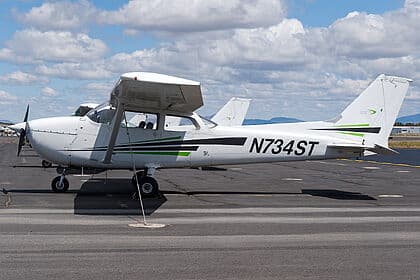
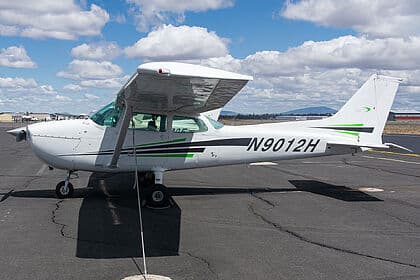
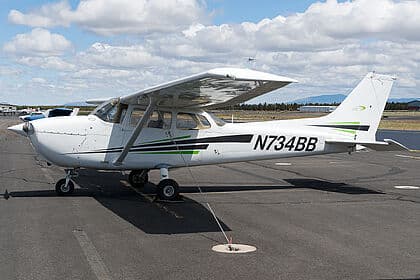
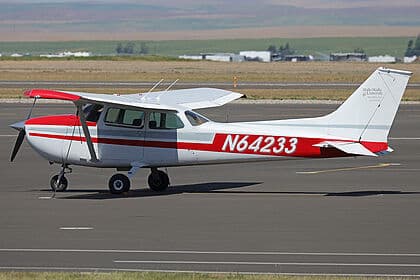
At a general-aviation airport the Cessna 172 shows the classic Cessna look: a high wing mounted on top of the fuselage, braced by a single strut on each side, above a fixed tricycle undercarriage. It sits fairly nose-high on the ground and has a simple, fixed-pitch propeller.
Telling it from its low-wing rivals is easy, as the Piper Cherokee, Cirrus SR22 and most Diamonds carry their wings below the fuselage. The harder task is separating it from the Cessna 182. The 182 looks almost identical but is a little longer, has a more powerful engine with a constant-speed propeller, and often a more purposeful cowling; a 172 generally sits slightly lower on its nose gear. Registration marks or a look at the propeller are the surest way to be certain.
Frequently asked
Why are there so many Cessna 172s?
The 172 arrived in 1956 just as private flying was booming, and its forgiving handling made it an ideal trainer, so it sold in large numbers from the start. Cessna then kept refining and building it for decades rather than replacing it, and a vast worldwide network of parts and mechanics grew up around it. As of 2026 it is generally described as the most-produced aircraft in history, with more than 44,000 built. That ubiquity feeds itself, because operators value an aircraft that is easy to support anywhere.
Is the Cessna 172 hard to fly?
No; it is widely regarded as one of the easiest aircraft to learn on. It has docile, predictable handling, stalls gently and recovers readily, and its fixed-pitch propeller and fixed landing gear keep the workload low for a student. That said, flying any aircraft safely still demands proper training, and the 172's very forgiveness means pilots must take care not to become complacent.
Cessna 172 versus Piper Cherokee - which is better to learn on?
Both are classic four-seat trainers with similar performance, and neither is clearly superior; the choice often comes down to what a local school operates. The high-wing 172 gives better downward visibility and shade, and its two doors ease access, while the low-wing Cherokee offers a better view upward in turns. Many instructors argue the differences matter less than the quality of instruction. In practice, pilots learn readily on either and often fly both during their careers.
How fast and how far can a Cessna 172 go?
A modern 172S cruises at roughly 120 to 125 knots, or about 140 miles per hour, which is modest by design. Its range depends heavily on fuel load and power setting, but figures of around 500 to 700 nautical miles are typical. It is intended for training and shorter trips rather than fast long-distance travel, so most flights are local or regional hops.
What does it cost to own and fly a Cessna 172?
Costs vary widely by region, age and condition, so firm numbers are hard to give. Buyers can find older used 172s for a modest sum, while a new factory 172S costs several hundred thousand dollars. Beyond the purchase price, owners must budget for fuel, insurance, hangar or tie-down fees, annual inspections and maintenance, which is why many pilots share ownership through a flying club or partnership. Renting from a flight school is usually the cheapest way to fly one occasionally.
Compare with
Specs are approximate, compiled from public sources. See our editorial policy.